

Ebook Info
- Published: 2014
- Number of pages: 602 pages
- Format: PDF
- File Size: 15.15 MB
- Authors: Eric L. Michelsen
Description
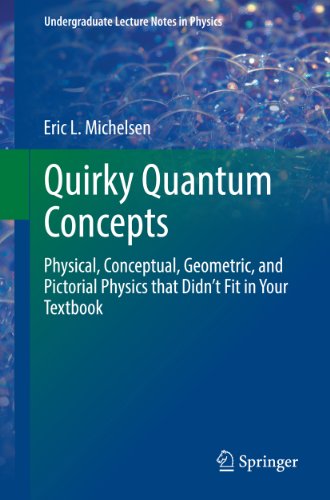
Quirky Quantum Concepts explains the more important and more difficult concepts in theoretical quantum mechanics, especially those which are consistently neglected or confusing in many common expositions. The emphasis is on physical understanding, which is necessary for the development of new, cutting edge science.In particular, this book explains the basis for many standard quantum methods, which are too often presented without sufficient motivation or interpretation. The book is not a simplification or popularization: it is real science for real scientists. Physics includes math, and this book does not shy away from it, but neither does it hide behind it. Without conceptual understanding, math is gibberish. The discussions here provide the experimental and theoretical reasoning behind some of the great discoveries, so the reader may see how discoveries arise from a rational process of thinking, a process which Quirky Quantum Concepts makes accessible to its readers.Quirky Quantum Concepts is therefore a supplement to almost any existing quantum mechanics text. Students and scientists will appreciate the combination of conversational style, which promotes understanding, with thorough scientific accuracy.
User’s Reviews
Reviews from Amazon users which were colected at the time this book was published on the website:
⭐You’ve taken a first course in quantum mechanics. You know your way round Schrödinger’s equation, eigenstates and eigenvalues, and you’ve thoroughly explored the hydrogen atom. But deep down you’re confused.You read about Schrödinger’s Cat and that you don’t see superpositions ‘in real life’ because of ‘decoherence’, but what’s that? Populist accounts talk airily about the ‘leakage of phase information into the environment’, but that sort of hand-waving hardly adds clarity. The technical literature discusses the exponential decay of off-diagonal terms in the density matrix … but what’s physically going on?You read about the various interpretations. Is the wave function part of reality? Is it just a subjective statement of the experimenter’s state of knowledge? So much ink discussing the significance of Schrödinger’s equation: and of course, that eponymous equation isn’t even correct. The road to the truth about quantum mechanics must run through its relativistic cousin, quantum field theory. But what a chasm separates you, the student, from that towering intellectual achievement. No-one can explain in accessible terms what QFT is, the map of the territory. Saying baldly that ‘at each point in space and time there are an infinite number of simple harmonic oscillator modes (with creation and annihilation operators) for each type of fundamental particle’ … doesn’t really do it for most people.What you need is a book in which these concepts are discussed via simple models, mathematically clear but at a level accessible to people who’ve completed a first course in quantum mechanics at undergraduate level (and understood it). Eric L. Michelsen has admirably succeeded in this book, which is a natural successor to Gary Bowman’s
⭐. In both cases the texts are meant to be read alongside a traditional textbook, but focus on conceptual clarity – what is the math really saying? – and a careful linkage with what’s observed in reality.Quirky Quantum Concepts covers many other topics. There are fine reviews of wave mechanics itself; scattering (barely touched on in most elementary classes); matrix mechanics and density matrices; angular momentum; and the QM treatment of multi-electron atoms. But for me the clear treatment of the loss of coherence and the very introductory but rigorous and comprehensible guide to QED/QFT were the high points of this excellent book.(Note: as a bonus, the PDF is available on the Internet. I bought the book not just through guilt – it’s easier to flip to and fro in hard copy).
⭐You’ve taken a first course in quantum mechanics. You know your way round Schrödinger’s equation, eigenstates and eigenvalues, and you’ve thoroughly explored the hydrogen atom. But deep down you’re confused.You read about Schrödinger’s Cat and that you don’t see superpositions `in real life’ because of `decoherence’, but what’s that? Populist accounts talk airily about the’ leakage of phase information into the environment’, but that sort of hand-waving hardly adds clarity. The technical literature discusses the exponential decay of off-diagonal terms in the density matrix … but what’s physically going on?You read about the various interpretations. Is the wave function part of reality? Is it just a subjective statement of the experimenter’s state of knowledge? So much ink discussing the significance of Schrödinger’s equation: and of course, that eponymous equation isn’t even correct. The road to the truth about quantum mechanics must run through its relativistic cousin, quantum field theory. But what a chasm separates you, the student, from that towering intellectual achievement. No-one can explain in accessible terms what QFT is, the map of the territory. Saying baldly that ‘at each point in space and time there are an infinite number of simple harmonic oscillator modes (with creation and annihilation operators) for each type of fundamental particle’ … doesn’t really do it for most people.What you need is a book in which these concepts are discussed via simple models, mathematically clear but at a level accessible to people who’ve completed a first course in quantum mechanics at undergraduate level (and understood it). Eric L. Michelsen has admirably succeeded in this book, which is a natural successor to Gary Bowman’s
⭐Essential Quantum Mechanics
⭐. In both cases the texts are meant to be read alongside a traditional textbook, but focus on conceptual clarity – what is the maths really saying? – and a careful linkage with what’s observed in reality.Quirky Quantum Concepts covers many other topics. There are fine reviews of wave mechanics itself; scattering (barely touched on in most elementary classes); matrix mechanics and density matrices; angular momentum; and the QM treatment of multi-electron atoms. But for me the clear treatment of loss of coherence and the very introductory but rigorous and comprehensible guide to QED/QFT were the high points of this excellent book.(Note: as a bonus, the PDF is available on the Internet. I bought the book not just through guilt – it’s easier to flip to and fro in hard copy).
⭐If you’ve already taken some quantum mechanics in a physics course, this book is very helpful in looking at the more tricky points, mathematical and physical, routinely quietly tiptoed round by your professor. If in taking such a course, you’ve ever asked yourself ‘Huh? Why this way?’ – you’ll probably find an answer here. Not a ‘popular science’ book, or a straight textbook on quantum mechanics, but a series of explanations of thorny points you never quite understood – because they weren’t dealt with!
⭐This is truly a great book! All these little doubts you had about Quantum Mechanics are explained with a lot of patience. I would also highly recommend this book to beginners in QM. As the author explains: “After the first two chapters, this book is meant to read in any order that suits you”. After you work yourself through the first 120 pages – which is not that much – you can choose the topic you’re interested in. All in all, excellent!
Keywords
Free Download Quirky Quantum Concepts: Physical, Conceptual, Geometric, and Pictorial Physics that Didn’t Fit in Your Textbook (Undergraduate Lecture Notes in Physics) 2014th Edition in PDF format
Quirky Quantum Concepts: Physical, Conceptual, Geometric, and Pictorial Physics that Didn’t Fit in Your Textbook (Undergraduate Lecture Notes in Physics) 2014th Edition PDF Free Download
Download Quirky Quantum Concepts: Physical, Conceptual, Geometric, and Pictorial Physics that Didn’t Fit in Your Textbook (Undergraduate Lecture Notes in Physics) 2014th Edition 2014 PDF Free
Quirky Quantum Concepts: Physical, Conceptual, Geometric, and Pictorial Physics that Didn’t Fit in Your Textbook (Undergraduate Lecture Notes in Physics) 2014th Edition 2014 PDF Free Download
Download Quirky Quantum Concepts: Physical, Conceptual, Geometric, and Pictorial Physics that Didn’t Fit in Your Textbook (Undergraduate Lecture Notes in Physics) 2014th Edition PDF
Free Download Ebook Quirky Quantum Concepts: Physical, Conceptual, Geometric, and Pictorial Physics that Didn’t Fit in Your Textbook (Undergraduate Lecture Notes in Physics) 2014th Edition