

Ebook Info
- Published:
- Number of pages:
- Format: PDF
- File Size: 3.03 MB
- Authors: David J. Epstein
Description
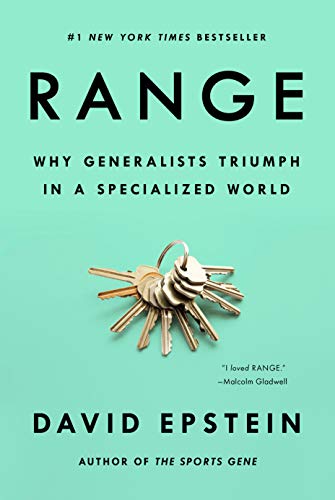
The #1 New York Times bestseller that has all America talking: as seen/heard on Morning Joe, CBS This Morning, The Bill Simmons Podcast, Rich Roll, and more. Shortlisted for the Financial Times/McKinsey Business Book of the Year Award “The most important business—and parenting—book of the year.” —Forbes “Urgent and important. . . an essential read for bosses, parents, coaches, and anyone who cares about improving performance.” —Daniel H. Pink “So much crucial and revelatory information about performance, success, and education.” —Susan Cain, bestselling author of Quiet “As David Epstein shows us, cultivating range prepares us for the wickedly unanticipated… a well-supported and smoothly written case on behalf of breadth and late starts.” —Wall Street Journal Plenty of experts argue that anyone who wants to develop a skill, play an instrument, or lead their field should start early, focus intensely, and rack up as many hours of deliberate practice as possible. If you dabble or delay, you’ll never catch up to the people who got a head start. But a closer look at research on the world’s top performers, from professional athletes to Nobel laureates, shows that early specialization is the exception, not the rule. David Epstein examined the world’s most successful athletes, artists, musicians, inventors, forecasters and scientists. He discovered that in most fields—especially those that are complex and unpredictable—generalists, not specialists, are primed to excel. Generalists often find their path late, and they juggle many interests rather than focusing on one. They’re also more creative, more agile, and able to make connections their more specialized peers can’t see. Provocative, rigorous, and engrossing, Range makes a compelling case for actively cultivating inefficiency. Failing a test is the best way to learn. Frequent quitters end up with the most fulfilling careers. The most impactful inventors cross domains rather than deepening their knowledge in a single area. As experts silo themselves further while computers master more of the skills once reserved for highly focused humans, people who think broadly and embrace diverse experiences and perspectives will increasingly thrive.
User’s Reviews
Reviews from Amazon users which were colected at the time this book was published on the website:
⭐“The response, in every field, to a ballooning library of human knowledge and an interconnected world has been to exalt increasingly narrow focus… Both training and professional incentives are aligning to accelerate specialization, creating intellectual archipelagos.”In Range, David Epstein examines the advantages of having a range of experiences, a broader perspective, an interdisciplinary approach, and the value of flexible thinking and reasoning in a world full complexity and uncertainty where precise, deterministic solutions are unknowable.SAMPLING PERIOD. The book starts by contrasting Tiger Woods, who began golfing at age two, and Roger Federer, who dabbled in a lot of activities before taking up competitive tennis. “As complexity increases—as technology spins the world into vaster webs of interconnected systems in which each individual only sees a small part—we also need more Rogers: people who start broad and embrace diverse experiences and perspectives while they progress.”“The sampling period is not incidental to the development of great performers—something to be excised in the interest of a head start—it is integral.” Yo-Yo Ma “started on violin, moved to piano, and then to the cello because he didn’t really like the first two instruments.”“Teaching kids to read a little early is not a lasting advantage. Teaching them how to hunt for and connect contextual clues to understand what they read can be… The trouble is that a head start comes fast, but deep learning is slow. ‘The slowest growth,’ the researchers wrote, occurs ‘for the most complex skills.’”MATCH QUALITY. Northwestern University economist Ofer Malmud studied match quality, “a term economists use to describe the degree of fit between the work someone does and who they are—their abilities and proclivities… For the period he studied, English and Welsh students had to specialize before college so that they could apply to specific, narrow programs… In Scotland… students were actually required to study different fields for their first two years of college… It should come as no surprise that more students in Scotland ultimately majored in subjects that did not exist in their high schools, like engineering.” Graduates in England and Wales were more likely to switch careers.“Instead of asking whether someone is gritty, we should ask when they are. ‘If you get someone into a context that suits them,” Orgas said, ‘they’ll more likely work hard and it will look like grit from the outside.” This reminds me of psychologist Mihaly Csikszentmihalyi’s concept of flow.“All of the strengths-finder stuff, it gives people license to pigeonhole themselves or others in ways that just don’t take into account how much we grow and evolve and blossom and discover the new things.”KIND OR WICKED? Epstein explains the difference between “kind” learning environments, where patterns repeat predictably, and “wicked” learning environments.“In kind environments, where the goal is to re-create prior performance with as little deviation as possible, teams of specialists work superbly… Facing kind problems, narrow specialization can be remarkably efficient.”“In wicked domains, the rules of the game are often unclear or incomplete, there may or may not be repetitive patterns and they may not be obvious, and feedback is often delayed, inaccurate, or both. In the most devilishly wicked learning environments, experience will reinforce the exact wrong lesson.”“Our ability to think relationally… analogical thinking… allows humans to reason through problems they have never seen in unfamiliar contexts. It also allows us to understand that which we cannot see at all… It is a powerful tool for solving wicked problems.”“Facing uncertain environments and wicked problems, breadth of experience is invaluable… In a wicked world, relying on experience from a single domain is not only limiting, it can be disastrous.”HEDGEHOGS AND FOXES. “The narrow-view hedgehogs, who ‘know one big thing,’ and the integrator foxes, who ‘know many little things’” are good metaphors. “Beneath complexity, hedgehogs tend to see simple, deterministic rules of cause and effect framed by their area of expertise, like repeating patterns on a chessboard. Foxes see complexity in what others mistake for simple cause and effect. They understand that most cause-and-effect relationships are probabilistic, not deterministic. There are unknowns, and luck, and even when history apparently repeats, it does not do so precisely. They recognize that they are operating in the very definition of a wicked learning environment, where it can be very hard to learn from either wins or losses.”DEFINING A PROBLEM TOO NARROWLY. “Seeing small pieces of a larger jigsaw puzzle in isolation, no matter how hi-def the picture, in insufficient to grapple with humanity’s greatest challenges.”ORGANIZATIONAL CULTURE. Epstein explains how “incongruence” shifts the culture from mindlessly following standard procedures to encouraging critical thinking and good judgment. The book includes a life-or-death example of this sort of nimble thinking involving a team of U.S. Air Force pararescue jumpers.The book also includes a very interesting post-mortem analysis of the NASA Challenger shuttle catastrophe. “Physicist and Nobel laureate Richard Feynman was one of the members of the commission that investigated the Challenger and in one hearing he admonished a NASA manager for repeating that Boisjoly’s data did not prove his point. ‘When you don’t have any data,’ Feynman said, ‘you have to use reason.’”Psychologist and organizational behavior expert Karl Weick coined the term “dropping one’s tools” as a metaphor for “unlearning, for adaptation, for flexibility.”“These are, by definition, wicked situations. Wildland firefighters and space shuttle engineers do not have the liberty to train for their most challenging moments by trial and error. A team or organization that is both reliable and flexible, according to Weick, is like a jazz group. There are fundamentals—scales and chords—that every member must overlearn, but those are just tools for sensemaking in a dynamic environment. There are no tools that cannot be dropped, reimagined, or repurposed in order to navigate an unfamiliar challenge. Even the most scared tools. Even the tools so taken for granted they become invisible. It is, of course, easier said than done. Especially when the tool is the very core of an organization’s culture.”RESEARCH AND INNOVATION. Epstein quotes Arturo Casadevall, chair of molecular microbiology and immunology at Johns Hopkins School of Public Health. “If you write an interdisciplinary grant proposal, it goes to people who are really, really specialized in A or B, and maybe if you’re lucky they have the capacity to see the connections at the interface of A and B… Everyone acknowledges that great progress is made at the interface, but who is there to defend the interface?”The book includes a great example of how knowledge from an unlikely field—concrete mixing—helped to solve a problem that petrochemical engineers working on the Exxon Valdez oil spill were unable to solve within their own domain.“The challenge we all face is how to maintain the benefits of breadth, diverse experience, interdisciplinary thinking, and delayed concentration into a world that increasingly incentivizes, even demands, hyperspecialization.”This book came highly recommended and it did not disappoint. It nicely complements books I’ve read about complexity and efficiency.
⭐Once I started reading the book, I had a hard time putting it down. Since the reading has sincerely resonated with me, I decided to share a review before you make any commitment. First, I hope to put together a brief summary from each chapter including key excerpts highlighted while taking notes. Then, I will share some personal thoughts and recommendations.SUMMARY[Introduction] Right in the beginning David says we are often taught that the more competitive and complicated the world gets, the more specialized we must become, and the earlier we must start to navigate it. However, while studying the topic, he noticed that accumulated experience in different domains and late specialization are worth it in the long run. The stories of Tiger Woods and Roger Federer are presented to illustrate that, although both reached the top of their domains, the approach they took growing up was completely different.[Chapter 1] Through the premise of early specialization, Laszlo Polgar pushed his daughters to their limits through rigorous chess practices from an early age. Even though they achieved outstanding results, we learn that a head start in hyperspecialized practices from day one, such as chess and golf, are exceptions. In most domains, however, “the rules of the game are often unclear or incomplete, there may or may not be repetitive patterns and they may not be obvious, and feedback is often delayed, inaccurate, or both.” In order to thrive in these domains, Christopher Connolly says that successful adapters are excellent at taking knowledge from one pursuit and applying it creatively to another, and at avoiding cognitive entrenchment.[Chapter 2] Now we take a close look at how modern societies have drawn to a more holistic context of abstract thinking. David explains that “exposure to the modern world has made us better adapted for complexity, and that has manifested as flexibility, with profound implications for the breadth of our intellectual world.” Like chess and golf masters, premodern villagers relied on things being the same tomorrow as they were yesterday. They were extremely well prepared for what they had experienced before but failed at learning without experience. David adds that “their very thinking was highly specialized in a manner that the modern world has been telling us is increasingly obsolete.”[Chapter 3] Based on examples dated back to the 1710s and recent research studies regarding the development of musicians, David shows that a “sampling period, often lightly structured with some lessons and a breadth of instruments and activities, followed only later by narrowing of focus, increased structure, and an explosion of practice volume” is the most common path to excellence. Breadth in training is key to create abstract models so that we can better apply the knowledge to situations we have never seen before.[Chapter 4] David shifts gears toward effective strategies to learn science. Although some of them seem to impair performance in the short term, they have shown to be essential for better performance later. Among the strategies, we learn the benefits of [1] spacing practices between sessions for the same material; [2] promoting students to make connections with broader concepts; [3] testing progress over time; and [4] learning under varied conditions.[Chapter 5] This chapter is about the importance of cultivating an outside perspective to look for structurally similar analogies. Using astronomer Johannes Kepler’s approach—who thought entirely outside of his domain—as an example, David explains that “deep analogical thinking is the practice of recognizing conceptual similarities in multiple domains or scenarios that may seem to have little in common on the surface.” After all, in a confused and inaccurate world, relying upon experiences from a single domain isn’t only limiting, it can be disastrous.[Chapter 6] Here we explore the virtues of late start. The unusual paths taken by Van Gogh throughout his early life paid off later, becoming one of the most well-known painters in history. As David puts, Van Gogh “tested options with maniacal intensity and got the maximum information signal about his fit as quickly as possible, and then moved to something else and repeated, until he had zigzagged his way to a place no one else had ever been, and where he alone excelled.” Allowing students to delay specialization while sampling and finding out who they are and where they fit improves match quality throughout later career decisions.[Chapter 7] Our work and life preferences don’t stay the same across time and context. David argues that “because personality changes more than we expect with time, experience, and different contexts, we are ill-equipped to make ironclad long-term goals when our past consists of little time, few experiences, and a narrow range of contexts.” Professor Ibarra’s studies are interesting. She says that, instead of a grand plan, we should focus on finding experiments that can be undertaken quickly—something she calls “test-and-learn.” She concludes by affirming “we discover the possibilities by doing, by trying new activities, building new networks, finding new roles models.”[Chapter 8] Using interesting examples, David shows how framing problems with distant analogies from random experiences outside the field can be remarkably effective to find solutions. In fact, some organizations have actually facilitated entities in any field to post their challenges and reward for outside solvers. “The larger and more easily accessible the library of human knowledge, the more chances for inquisitive patrons to make connections at the cutting edge.”[Chapter 9] To reiterate the importance of having accumulated a range of experiences, David shows that even in hyperspecialized fields breadth becomes increasingly important. Andy Ouderkirk and other researchers at 3M set out to study the commercial impact inventors made through patents. They concluded that both specialist and generalists made contributions. Whereas “specialists were adept at working for a long time on difficult technical problems, and for anticipating development obstacles, the generalists tended to get bored working in one area for too long.” Instead, generalists “added value by integrating domains, taking technology from one area and applying it in others.” More important, though, is to know that specialists and generalists thrive when working together.[Chapter 10] Here we learn how to distinguish successful from unsuccessful forecasters. In essence, the best forecasters “are high in active open-mindedness.” Moreover, David says, “they are also extremely curious, and don’t merely consider contrary ideas, they proactively cross disciplines looking for them.” They aren’t only the best forecasters as individuals, but they also have qualities that make them particularly effective collaborators. The unsuccessful ones, however, tend to know one big thing—their expertise is deep but narrow. Some have spent their careers studying a single problem, “reaching for formulaic solutions to ill-defined problems.”[Chapter 11] In a hyperspecialized world, psychologist Karl Weick says that dropping familiar tools is particularly difficult for experienced professionals who rely on overlearned behavior. Based on a handful of tragic examples, we learn that experienced groups became rigid under pressure—“it’s the very unwillingness of people to drop their tools is what turns some dramas into tragedies.” To counterbalance that, studies have shown that an effective problem-solving culture is one that balances standard practices with forces that push in the opposite direction. The trick, David says, “is expanding the organization’s range by identifying the dominant culture and then diversifying it by pushing in the opposite direction.”[Chapter 12] The final chapter focuses on scientific progress through the results of free intellects working on interdisciplinary subjects. The cult of the head start, professor Arturo Casadevall argues, “is that young scientists are rushed to specialize before they learn how to think; they end up unable to produce good work themselves and unequipped to spot bad work by their colleagues.” He is indeed a big proponent of exploring innovation ecosystems that intentionally preserve range and inefficiency.”PERSONAL THOUGHTSWell, I ended preordering the book because I felt deeply compelled by the topic. Although I have taken a specialized route throughout education and the initial years of my career, I have noticed that it wasn’t a natural fit. To be more precise, I am drawn toward the diverse possibilities the world offers us to explore. The value of hyperspecialized domains is hardly questionable, despite the fact that a transdisciplinary approach toward education and research seems to be advantageous to move the needle forward for the rest of humanity.The book brings a wealth of knowledge through examples, stories, and practical applications. Moreover, David covers a vast array of topics, ranging from sports all the way to hyperspecialized scientific research. Because of that, throughout the reading, we are likely to find pieces that speak directly to us—to further reflect on the issues, and hopefully put them into practice.Take care,Haical
⭐These sorts of populist pseudo science books invariably race along and carry you with them until you are pulled up by a ‘fact’ that you happen to know isn’t true. David Epstein’s somewhat counter intuitive notion that generalists triumph over specialists may or may have some merit. However, a key argument that the 2014 German World Cup winning squad was stacked with players who’d come late to football and were ‘typically late specialists’ simply isn’t correct. Many of them had played for their national side at Under 17, 19 and 21 level and were attached during that time to major clubs. This might not leap out at American readers but European sports fans would know Epstein’s claim doesn’t ring true. Which, of course, makes you wonder what else he glosses over or fudges. Despite having shelled out on an appealing looking book and thesis I gave up at that point- page 8!
⭐I will give u a very brief summary of the book. So here it is.It is important to do a sampling a range of related things in your field before you choose a specialisation. It helps to develop an overall competence so that the skills learnt in other fields act as an added advantage and boost your final skill in your chosen field. Also, you will know which field suits you the best and for which you have a passion which will help you in the long term to achieve excellence on par with the best in the world.The age of sampling should be typically between 6 to 16. In these formative years you can experiment freely and as your body is flexible and ur brain plastic, you can learn many skills naturally.Thirdly, not all specialisation needs sampling and range. For eg Golf, Chess and Coding need a lot of practice and pattern recognition rather than different set of skills. So, in such fields u can simply go for a specialisation without wasting time on sampling period.
⭐I was encouraged by the early chapters, first 80 pages or so, it kept to the point of the title and gave good examples.Unfortunately at around 100 pages or so – Chapter 5 or thereabouts – the quality of writing deteriorated significantly with normal conventions on grammar and punctuation seemingly ignored. I gave up soon after that as the writing became so disjointed and irritating.I tried dipping in to later chapters and the quality of writing had seemed to improve but there was so much rambling that by the time the point of each description had been reached I didn’t care.I was disappointed since I have long been a believer in what was said in the early pages but the book just didn’t do it justice.
⭐We have all heard about the 10,000 hour rule: that to become an expert, it takes this much repetition and practice. So it seems to make sense that the best way to achieve that expertise is to get a good head start: start young, and to focus. Epstein picks apart that advice here. He has two main arguments, illustrated with copious anecdotes, about why range, or breadth of practice, is just as necessary as depth.First: 10,000 hours is a long time, requiring a lot of dedicated work. So, you need to be engaged with the topic: if you have not instantly picked your specific area (chess, golf, piano, whatever), you should spend some time surveying the field to discover what you want to do. Epstein give examples of world class sports people who engaged in several different sports initially, and world class musicians who played several instruments at first, before they focussed on one. These people at least had a field, and were just deciding which particular subgenre was for them. He also gives examples of people who tried a much broader range of occupations before discovering their vocation: flitting from job to job, never succeeding, giving up and moving on, until finally they found their life’s work; van Gogh is the best known example given here.Second: the fields where 10,000 hours of focussed practice works are relatively simple: the practitioner gets immediate feedback on how successful they are, and the topic is constrained, so it is clear where to focus the effort and expertise. However, many disciplines today involve wicked problems: there are no immediate or clear markers of success, the boundary of the problem is ill-defined, and expertise can become constraining, limiting the solution approaches considered. In these circumstances, breadth of experience is an advantage.Some depth is also needed, of course: too much breadth, and you end up knowing nothing about everything, as opposed to too much depth, where you know everything about nothing. So what are needed are T-shaped people: depth in some area, but breadth across areas, too. I am interesting in interdisciplinary working, and also use this metaphor of T-shaped expertise: in successful interdisciplinary teams, the ‘arms’ of the T join up to bridge between the different areas of expertise.The book is engagingly written, with many fascinating examples, and covers a broad range of ideas, from the Flynn effect of increasing IQ, to where outsiders have provided insight, to why too much grit may not be a good idea. This latter example discusses a problem with many suggested techniques for success: survivor bias. ‘All CEOs do X’, trumpet these works, implying that if you simply also do X, you too can become a CEO. But to evaluate this claim, you also need to know how many unsuccessful people also do X. After all, presumably all CEOs brush their teeth, eat food, and wear clothes, yet these are not the (sole) reasons for their success. In the case of grit, the successful people studied have indeed grittily persevered, yet Epstein provides examples of others who instead gave up, yet also succeeded, just in something different that fits them better.And, of course, this book itself also suffers somewhat from survivor bias: showing successful people who nevertheless flitted from job to job before their final success again does not imply that flitting from job to job will result in success. However, there is much interesting material here, and certainly it paints an interestingly different picture from the more mainstream view of the need for specialisation.
⭐I bought this book off the back of a mention in Steve Kotler’s ‘The Art of Impossible’. Kotler framed ‘Range’ as a counter argument to Ericsson and Pool’s work on deliberate practise and specialisation presented in ‘Peak’, which I thoroughly enjoyed and got a lot of pratical learning tips from that have improved my skill learning significantly. Naturally I was curious to read responses to their findings, to get a wider appreciation for the topic of learning.Unfortunately 70% of ‘Range’ turned our to be annecdotal. If studies are used to inform statements, most aren’t referenced. It feels like the author recieved some advice to couch his lessons within stories and took it to an almost satirical extreme.Every chapter starts with a story more suited to a fiction or narrative-history novel than a scientific text. I bought the book to learn more about the contemporary scientific discoveries around generalisation vs specialisation as advertised in the book’s marketing. If I wanted 8 pages of highly subjective descriptive writing for every actual insight I’d read a sci fi novel.It’s frustrating because I do believe there might be valuable insight here, but because most of it is packed within contextually-bare stories highly edited to fit a narrative, it’s nigh impossible to weed fact from assumption.I recommend just reading each chapter heading and then skipping straight to the last two pages of each, to get a brief summary of the argument without wasting your time on the fluff. Then use those topics as jumping-on points for futher study.Still, it’s well edited, the writing flows and there are some interesting points to chew on floating in a soup of pointless filler so two stars overall.
Keywords
Free Download Range: Why Generalists Triumph in a Specialized World in PDF format
Range: Why Generalists Triumph in a Specialized World PDF Free Download
Download Range: Why Generalists Triumph in a Specialized World PDF Free
Range: Why Generalists Triumph in a Specialized World PDF Free Download
Download Range: Why Generalists Triumph in a Specialized World PDF
Free Download Ebook Range: Why Generalists Triumph in a Specialized World