Ebook Info
- Published: 2005
- Number of pages: 151 pages
- Format: PDF
- File Size: 1.47 MB
- Authors: Frank Morgan
Description
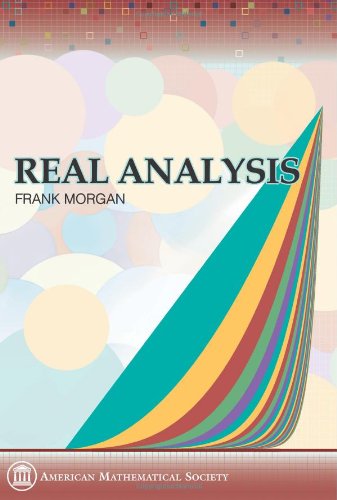
This book is written by award-winning author, Frank Morgan. It offers a simple and sophisticated point of view, reflecting Morgan’s insightful teaching, lecturing, and writing style. Intended for undergraduates studying real analysis, this book builds the theory behind calculus directly from the basic concepts of real numbers, limits, and open and closed sets in $mathbb{R}^n$. It gives the three characterizations of continuity: via epsilon-delta, sequences, and open sets. It gives the three characterizations of compactness: as “closed and bounded,” via sequences, and via open covers. Topics include Fourier series, the Gamma function, metric spaces, and Ascoli’s Theorem. This concise text not only provides efficient proofs, but also shows students how to derive them. The excellent exercises are accompanied by select solutions. Ideally suited as an undergraduate textbook, this complete book on real analysis will fit comfortably into one semester. Frank Morgan received the first Haimo Award for distinguished college teaching from the Mathematical Association of America. He has also garnered top teaching awards from Rice University (Houston, TX) and MIT (Cambridge, MA).
User’s Reviews
Editorial Reviews: Review “Reading your book is a refreshingly delightful change from the usual emphasis on series, rather than topology, as a foundation of analysis.” —- Robert Jones, University of Dusseldorf
Reviews from Amazon users which were colected at the time this book was published on the website:
⭐It has served its purpose. It seems pretty old but it is in fine condition. you get what you pay for.
⭐This the textbook for my first course in Real Analysis. I am managing well on account of the fact that I am using 3 other real analysis textbooks to make sense of what is going on this class. But this text is way too concise for a first time learner. Just a quick example, the infimum and supremum are left to the reader to “discover” as an exercise 9 chapters in, and these concepts are hardly used for the rest of the text. Most other books that I have found establish these concepts early on and their existence is essential to many subsequent topics.
⭐This book does little more than lightly touch on the subject of real analysis. It has almost no examples for anything and then expects you to be able to pull answers out of thin air for the “chapter” example questions. I put chapter in quotes, because some of these chapter are literally less than 2 pages long. I’m not sure how you could learn anything from this book. Absolutely awful.
⭐Excellent
⭐Amazingly concise yet rigorous development of the theory behind calculus.The material is broken up neatly into 30 short chapters, with highly relevant exercises after each one. Such organization focuses your attention on one topic at a time and encourages you to practice often and early.
⭐If you are actually want to learn how to perform epsilon-delta proofs, work through problems to better grasp the material and get a basic understanding of the subject don’t buy this book. It skims over virtually everything to the point where it seems almost pointless to refer to the text for solving problems.
⭐This is no conventional Analysis book. It is written to drive the reader’s focus to a single topic each time. The chapters are 1-2 pages long and it is useful for what is is thought for. Continuity? You read 1 page, straight to the point. Facts about number sets and infinity? 1 page. Obviously it leaves out many consequences, but the uniqueness of this book is that you will always find the basic facts you need right in the first page you happen to open. It is written so concisely that you will understand everything in the first read. In fact, I like to refer to it as “my first real analysis book”. OK, it is true that maybe it is too much to ask $40 for it, but is definitely nice to have it around.
⭐The book was used for my Real Analysis course. Despite having a single edition, the book has two version with the same ISBN, each having different page numberings, and one having more exercises than the other. This meant students buying the book from various sources had different versions of the textbook (despite carefully checking the ISBN). The trouble stems from some errata being corrected and simultaneously adding additional problem sets, while keeping the same ISBN for both “versions.”The first few chapters of the textbook are very well written. The first 2 chapters in particular are a good reference for proofs, inductions, and naive set-theory. However, the material of the textbook would have been much nicer to handle if everything was done in single variables. The content would be the same while the proofs would be much more digestible. Around Chapter 5 or 6, the chapters started becoming much too thin, to the extent that we had to supplement material for the textbook. The peak frustration was trying to find a precise statement of the Implicit Function Theorem and finding the result mentioned in the index, only to find the referenced page to say “While we did not quite get to state the Implicit Function Theorem..” If the result is not in the book, why is it in the index? Many other important results were likewise omitted, and supplemental material had to be dispersed.Next time we will use a more carefully written textbook, and hopefully one with better exercises.
Keywords
Free Download Real Analysis in PDF format
Real Analysis PDF Free Download
Download Real Analysis 2005 PDF Free
Real Analysis 2005 PDF Free Download
Download Real Analysis PDF
Free Download Ebook Real Analysis