

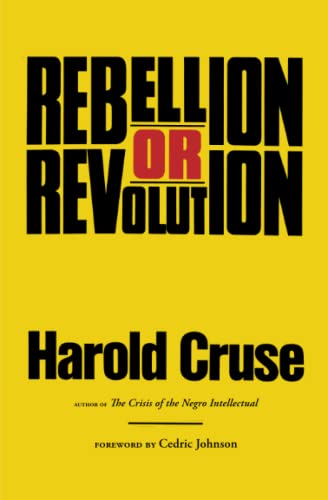
Ebook Info
- Published: 2009
- Number of pages: 280 pages
- Format: PDF
- File Size: 13.83 MB
- Authors: Harold Cruse
Description
Originally published: New York: Morrow, 1968.
User’s Reviews
Editorial Reviews: About the Author Harold Cruse (1916–2005) was a social critic, essayist, and teacher of African American studies at the University of Michigan.Cedric Johnson is associate professor of political science at Hobart and William Smith Colleges and author of Revolutionaries to Race Leaders: Black Power and the Making of African American Politics (Minnesota, 2007).
Reviews from Amazon users which were colected at the time this book was published on the website:
⭐This book was originally published in 1968, and even then was showing its age and distance from American political changes taking place (it was reprinted in 2009). My particular interest is in the chapters where he discusses Negro struggle and Marxism. While he is correct to note that Black political struggle can be absorbed by dominant white political organizations (aka ‘party building’), he is skeptical of efforts to find ways to bridge the racial, economic, political, labor, and cultural divides. For example, Cruz is dismisses Black labor activist Clifton DeBerry’s nomination by the U.S. Socialist Workers Party (SWP) for the party’s presidential ticket in 1964, as a pawn in the white socialist system, while debunking DeBerry’s apparent alignment with the embryonic Freedom Now Party (which existed only from 1963-early 1965, before voting rights legislation). Formerly a member of the U.S. Communist Party, DeBerry chose years prior to join the SWP, not the inverse. Cruse assails the effectiveness of the March on Washington, the Trotskyist SWP (who gave a significant platforms to Malcom X), and neglects contemporary inroads into Black-meets-socialist politics by the Black Panther Party and other organizations. Maybe he didn’t know about them? Cruse’s argument about the ineffectiveness and scope of 1960s Marxist-influenced political organizations are generalized, narrow, and conservative. His critique, however, of their fixation upon ‘proletarian revolution’ is spot-on. Today, the disenfranchisement of both the working class and the middle of all races are being expedited by our xenophobic Capitalist-in-Chief. In this way Cruse’s argument can be used as the basis for a new interpretation of Trotsky’s ideal of a ‘permanent revolution.’
Keywords
Free Download Rebellion or Revolution? in PDF format
Rebellion or Revolution? PDF Free Download
Download Rebellion or Revolution? 2009 PDF Free
Rebellion or Revolution? 2009 PDF Free Download
Download Rebellion or Revolution? PDF
Free Download Ebook Rebellion or Revolution?