

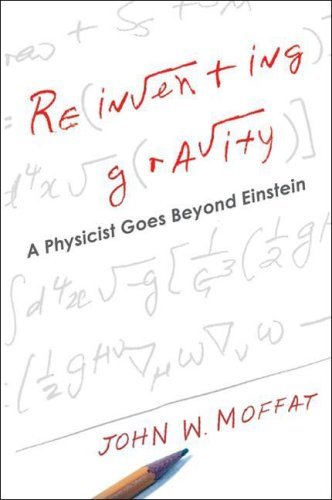
Ebook Info
- Published: 2008
- Number of pages: 291 pages
- Format: PDF
- File Size: 1.83 MB
- Authors: John W. Moffat
Description
Einstein’s gravity theory—his general theory of relativity—has served as the basis for a series of astonishing cosmological discoveries. But what if, nonetheless, Einstein got it wrong?Since the 1930s, physicists have noticed an alarming discrepancy between the universe as we see it and the universe that Einstein’s theory of relativity predicts. There just doesn’t seem to be enough stuff out there for everything to hang together. Galaxies spin so fast that, based on the amount of visible matter in them, they ought to be flung to pieces, the same way a spinning yo-yo can break its string. Cosmologists tried to solve the problem by positing dark matter—a mysterious, invisible substance that surrounds galaxies, holding the visible matter in place—and particle physicists, attempting to identify the nature of the stuff, have undertaken a slew of experiments to detect it. So far, none have.Now, John W. Moffat, a physicist at the Perimeter Institute for Theoretical Physics in Waterloo, Canada, offers a different solution to the problem. The capstone to a storybook career—one that began with a correspondence with Einstein and a conversation with Niels Bohr—Moffat’s modified gravity theory, or MOG, can model the movements of the universe without recourse to dark matter, and his work challenging the constancy of the speed of light raises a stark challenge to the usual models of the first half-million years of the universe’s existence. This bold new work, presenting the entirety of Moffat’s hypothesis to a general readership for the first time, promises to overturn everything we thought we knew about the origins and evolution of the universe.
User’s Reviews
Reviews from Amazon users which were colected at the time this book was published on the website:
⭐First off, I have to say I really enjoyed the flow of this book. The first two thirds was a fabulous progression of the thoughts and aches of the physicists of yore that went through the processes of getting their theories created and accepted, and of the more recent progession of discoveries and theories to explain the reason why most current scientists feel dark matter exists. The gravitational lensing effect (excessive bending of light ) of galactic clusters, the flat rotation curves of galaxies (why a “year” for an outer star is the same as a “year” for an inner star), the pioneer 10 and 11 decelleration anomolies and so on are each explained in enough detail to tie the whole dark matter paradigm into a nicely understood package. If you are fairly new to dark matter and yearning for some history and some explainations, then this portion of the book is worth the entire price.In addition the author has an appreciated style of inserting tons of tidbits of extra information that are worth knowing, regardless of your level of expertise on the general subject, throughout the entire book. You get little pieces of physics trivia for free and great starter “wiki” words and phrases to further your knowledge. I was especially appreciative of the insertion of the Abell 520 cluster train crash anomaly which contradicts the Bullet Cluster conclusions about dark matter. Wow!!! I think this little bit of information for me was worth the price of the book alone! Wiki this one yourself for a big surprise!!Now for the cons: The MOG theory, which is at the core of the entire book is a decent theory and is easy to understand. There was good supportive references and was believably presented. I don’t lean toward or away from this theory, and even though I have serious reservations about the dark matter theory that has been too eagerly accepted in the community, I don’t think the author fully convinced me to accept his theory as the final answer. Using a dart board as an analogy, I think dark matter is somewhere on the perimeter, MOG is somewhat closer, but no-one has yet shown me anything I’d consider in the bulls eye area. I hope they keep trying.I would have liked to see the author throw in the exact details of the MOG theory, presented of course in a layman style, that included what constants and newtonian formulas that were used (and in what way) to create the theory so the reader could get a better sense of the “meat” in all of this. There are plenty of references and text describing the authors lectures, previous submissions to scientific journals, and corespondences that lead me to beleive he really is working on something substantial, but I was left feeling like there was one more act to the play that wasn’t in the book.This book is a “keeper”, especially as a reference, and I recommend it.
⭐John W. Moffat is a Professor Emeritus in physics at the University of Toronto and a resident member of the Perimeter Institute for Theoretical Physics. Dr. Moffat is no lightweight in the world of Theoretical Physics and is the originator of a theory of gravity, STVG or MOG, that would require some modifications to Einstein’s theory. Such theories are nothing new as Einstein himself was looking for modifications to his theory that would better encompass gravity. MOG supposedly would not modify the general theory where it has already been proven with testable data. MOG would impact other theories, including the idea of the existence of dark energy and observations of galaxy rotation proposals for unseen dark matter. MOG if it were the correct theory would change the current common view of both. Dark energy is easy to dismiss on many levels, but Dark Matter is more difficult. I specifically have an interest in theories that relate to the variable speed of light and/or equivalently the slowing of time, but had not heard of MOG until this year. I was interested in how MOG would relate to other variable light speed theories. Moffat’s book follows the same general format requirements of ALL mass market science books, with historical and general discussions leading the text and more specific presentations later and of course none of the supporting math is provided. If you want, you can locate some of the math on Wikipedia under Scalar-tensor-vector gravity. Moffat’s MOG is an intriguing theory. For me the two items that cause the most problems are a required 5th force, that he seems to brush past all too quickly, and a necessary attack on dark matter. Ever since Hubble and the big scopes in Hawaii and Chile, dark matter of some sort has been postulated by observational evidence. MOG would have dark matter reduced or eliminated. MOG may be the truth, I am not saying Moffat is wrong. Nobody currently has the answer, and who knows, Moffat could well be closer than anyone. I think he accepts the fact that only time will tell. Overall I rate this as an excellent book, sincerely worth the read. I think Dr. Moffat must be a very good teacher as he clarified at least one item for me that no one had previously been able to resolve. Thank you Dr. Moffat. However, concerning MOG, the following statement is borrowed from a physics forum: With an endless range of possible modifications it’s no surprise that modified gravity is capable of solving just about any problem in cosmology. If modified gravity successfully mimics some other result how are we supposed to tell the theories apart?
⭐This is an absolute riveting read. The author has a history of going against the grain and producing some ingenious ideas that make you doubt yourself completely. He pioneered the variable speed of light hypothesis for the early universe, has created a non-local quantum field theory which is finite at all orders and the main idea for this book, an alternative theory of gravity. This book details the history of the main ideas behind his new model of gravity and how he developed them. A right fascinating read, highly recommended.
⭐It’s an interesting approach to addressing the cosmological elephant in the room, who’s been taking up 96% of that room for quite a while now! …. he sets the story in its historical context, which I found interesting, I was familiar with some of this bit from reading other books but it’s still very readable and I learned new bits. He draws interesting parallels between past theorydata difficulties and those today. Importantly though it’s easy to follow, even for someone like me with a passing interest in physics …. It flows and it’s readably informativeentertaining! ….. I’ll read some of his other stuff ……
⭐EMBALAJEEl embalaje del libro consiste en una caja con bolsas de aire, además de estar emplayado, por lo que no habrá daños en el trayecto.EXTERIOR DEL LIBROEsta versión (pasta dura) es diferente a su contraparte, trae una sobrecubierta que tiene la impresión de la versión de pasta blanda. La cubierta es un color sólido (gris) que combina con parte del lomo (rojo).HOJAS DEL LIBRO Las hojas del libro vienen cosidas. Además de que tienen un color amarillo paja, lo cual uno podría creer que es viejo, pero no es así.INTERIOR DEL LIBROLas letras en realidad son pequeñas de apenas 0.2 mm, aunque no hay problema en leerlas, la impresión es de buena calidad.
⭐
⭐Dr. Moffat writes extremely well in setting forth this alternative to the “standard model” of cosmology with the latter’s requirement for black holes, undiscoverable dark matter and other phenomena that look more and more like the product of mathematical collapses within the model itself or artifices intended to prop up the model rather than things that exist in nature. A hazard facing practically all theories is that they risk becoming self-sustaining even when the evidence turns against them. In part, this is because vast sums of money are spent in building, then attempting to verify the theory to the point where entertaining the possibility of there being serious flaws could prove not only embarrassing but even politically dangerous (in the sense of imperiling future government funding, for example). Critics of such a theory may find they have difficulty getting published, that they are shunned as wacky outliers or even become victims of personal attack. The mainstream theory just has to be true once sufficient effort and money has been invested in it. Scientists are only human after all. It takes courage to write a book like this.Anyone with strong interest in physics/astronomy and some undergrad physics education should be able to work their way through most this. The going may prove difficult in places. When that happens, just take your time and re-read with some brushing up on terms with the help of Wikipedia. An excellent – even entertaining – read if for no other reason than it’s going to make you think not only about cosmology but the ways in which science advances our understanding of the universe.(P.S. I am myself a physicist.)
⭐This book gives a personable and highly readable account of the development of the only new theory of gravity known to this reviewer (a physicist) that accounts for most of the rapidly accumulating observational data revealing the history, structure, and fate of the universe. In this reviewer’s opinion, it is a strong but sorely neglected competitor to the still undetected “dark matter” as the explanation for certain mysterious features of galaxies and clusters of galaxies.
Keywords
Free Download Reinventing Gravity: A Physicist Goes Beyond Einstein in PDF format
Reinventing Gravity: A Physicist Goes Beyond Einstein PDF Free Download
Download Reinventing Gravity: A Physicist Goes Beyond Einstein 2008 PDF Free
Reinventing Gravity: A Physicist Goes Beyond Einstein 2008 PDF Free Download
Download Reinventing Gravity: A Physicist Goes Beyond Einstein PDF
Free Download Ebook Reinventing Gravity: A Physicist Goes Beyond Einstein