

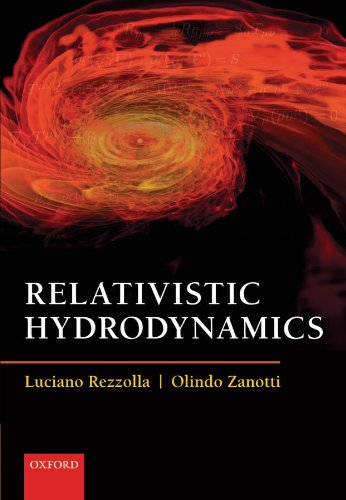
Ebook Info
- Published: 2013
- Number of pages: 768 pages
- Format: PDF
- File Size: 3.80 MB
- Authors: Luciano Rezzolla
Description
Relativistic hydrodynamics is a very successful theoretical framework to describe the dynamics of matter from scales as small as those of colliding elementary particles, up to the largest scales in the universe. This book provides an up-to-date, lively, and approachable introduction to the mathematical formalism, numerical techniques, and applications of relativistic hydrodynamics. The topic is typically covered either by very formal or by very phenomenologicalbooks, but is instead presented here in a form that will be appreciated both by students and researchers in the field.The topics covered in the book are the results of work carried out over the last 40 years, which can be found in rather technical research articles with dissimilar notations and styles. The book is not just a collection of scattered information, but a well-organized description of relativistic hydrodynamics, from the basic principles of statistical kinetic theory, down to the technical aspects of numerical methods devised for the solution of the equations, and over to the applications in modernphysics and astrophysics. Numerous figures, diagrams, and a variety of exercises aid the material in the book. The most obvious applications of this work range from astrophysics (black holes, neutron stars, gamma-ray bursts, and active galaxies) to cosmology (early-universe hydrodynamics and phasetransitions) and particle physics (heavy-ion collisions).It is often said that fluids are either seen as solutions of partial differential equations or as “wet”. Fluids in this book are definitely wet, but the mathematical beauty of differential equations is not washed out.
User’s Reviews
Reviews from Amazon users which were colected at the time this book was published on the website:
⭐“Relativistic Hydrodynamics,” by Luciano Rezzolla and Olindo Zanotti is a book that was much needed. It provides a solid, comprehensive, and up-to-date account of relativistic hydrodynamics. It will be extremely valuable to students interested in learning the subject, and to researches looking for a detailed discussion of the topic and/or a critical review of the current status of the field. In particular, an extensive bibliography is provided, and each chapter finishes with a list of further readings. Those interested in teaching a course on the theme (or on parts of it), will greatly benefit from using the book, which also includes a list of problems in each chapter.The book is divided in three parts. Part I contains a full theoretical treatment of the topic (starting with a review of General Relativity which, albeit not intended to be a full introduction to Einstein’s theory, can be very useful for those who are a little rusty), and includes, among other topics, the kinetic theory of fluids, relativistic perfect fluids, wave hydrodynamics, and non-perfect relativistic fluids. Part II is dedicated to numerical methods, and Part III focuses on applications.As I am completely unacquainted with numerical methods of any sort, I shall not comment on the contents of Part II, except by saying that my impression of it, after skimming through a few of its chapters, is that it would likely be my first choice if I ever decidedto learn about such numerical treatments.Although I am a mathematician, and I suppose that Rezzolla and Zanotti had in mind primarily an audience of physicists, I found the book quite readable and have no quarrels with the content exposition. The presentation develops in a logical fashion. The assumptions behind derivations are always made explicit, there is no hand-waving, and the limit of validity of the results is frequently discussed. This is done, however, without obscuring the underlying physics or the main intuition behind it. Some mathematicians might prefer a more coordinate free notation rather than the usual physicist’s approach with indices, which is naturally employed in the book, although I doubt that this will be a problem for most of the mathematical community working on theevolution problem for Einstein’s equations or in the equations of Fluid Dynamics, since the local approach is widely adopted in these cases.The theory discussion in Part I happens from the ground up, and the authors have accomplished the task of guiding the reader from the basics of fluid dynamics to advanced and even some research level topics without compromising clarity or sweepingsubtleties under the rug. Inevitably, many of the topics covered in the book, especially in part I, have been discussed at length in the literature. Still, the authors succeed in casting some originality in their exposition of some old topics. For instance, I particularly liked their treatment of shocks in chapter 4, and their thorough discussion of relativistic non-perfect fluids in chapter 6. Also inevitable is that chapters and sections are not self-contained, and many times equations, constructions, and arguments of previous sections have to be invoked. In spite of that, references to previous material in the book are usually very precise and to the point, which makes navigating through the text fairly easy.Part III is dedicated to applications, focusing mainly on applications to Astrophysics. In order to eventually incorporate realistic features of relativistic hydrodynamics, an appeal to the numerical methods of Part II is necessary, and many of the results presented in this part are based on numerical simulations. Much of Part III, however, consists of establishing the setting that will then be used in such numerical studies. As such, these parts are essentially theoretical and can be fully understood without knowledge of Part II. Moreover, those interested in the discussion of realistic physical scenarios but who do not have the background of Part II (such as myself) can still greatly benefit from the physical discussion of the numerical results that are presented.Summarizing, Rezzolla and Zanotti have done a great service to the general relativity community. I expect their book to become the standard reference on the physics and applications of relativistic hydrodynamics for years to come.
⭐the book concentrates key concepts of relativistic hydrodynamics
⭐700 pages of top quality topics using math. A collection of results from many teams of researchers over the decades. I am learning from this vast book.
⭐The fields of relativity and hydrodynamics are vast in their own right, and even their intersection constitutes a broad, multidisciplinary area. As a result, most texts on the subject have often focused primarily on 1-2 aspects, skimming over the other parts. This voluminous tome by Rezzolla & Zanotti provides a comprehensive treatment that is simultaneously classical (in the sense of following older monographs) and contemporary (up-to-date on the latest techniques).It opens with a brief review of GR, which is somewhat utilitarian, but gets across all the points clearly, and develops the tools necessary in all the subsequent sections. Chapter 2 is one of the (many) gems in the book as it provides a lucid and self-contained description of kinetic theory, which underlies the theory of fluids. Particularly noteworthy is the extended discussion of the importance of the equation of state, and the many variants employed in the literature. Chapter 3 enters the core areas of the book – namely relativistic perfect fluids, and the section on irrotational fluids and the conservation laws is particularly noteworthy. Chapter 4 on waves is most welcome as not many texts treat this topic in detail and the discussion of shocks and the Riemann problem is well done. Chapter 5 on detonations is somewhat brief, and a more detailed (albeit Newtonian) treatment exists in the marvellous book by Zel’dovich and Raizer. Another unorthodox and timely topic presented is Chapter 6 that deals with non-perfect fluids, and the sections on causality and thermodynamics are highly commendable.Part II of the book is really where the monograph sets itself apart from its predecessors. Chapter 7 opens with a neat account of the Einstein-Euler equations, and the discussion on the ADM formalism is well judged. Chapters 8 and 9 concern themselves with a detailed treatment of the numerical methods employed and distinguish clearly between the finite-difference and HRSC methods. In the latter, the discussion of Riemann solvers deserves a particular mention for its combination of brevity and insight. Chapter 10 moves on to higher-order methods, but the discontinuous Galerkin scheme could have been explained in slightly higher detail.Part III is likely to be of the greatest interest, and importance, to astrophysicists as the applications of the theoretical and numerical methods are presented here. In Chapter 11, a host of topics ranging from blast waves, accretion (spherical and axisymmetric), tori and jets are compactly presented. The book concludes with Chapter 12, with a fine discussion of self-gravitating fluids – the dynamics of binaries is particularly well done. There are also a host of appendices that provide extra mathematical and numerical background, and Appendix C, with a summary of the commonly used tensors, will prove to be particularly useful.On the whole, “Relativistic Hydrodynamics” is an excellent book that should satisfy all three groups – the theoreticians, the numerical relativists and the astrophysicists – as it offers a nice blend of the three. Instead of consulting older monographs on the subject, or current (but incomplete) review papers on the subject, this book represents a unified source from which instructors and/or researchers can pick and choose their content. The only critique, and a minor one, that can be offered is that Part III could be slightly expanded, as it contains practical applications, and is therefore of high relevance.
⭐Questo libro e’ fondamentale per chi voglia imparare l’idrodinamica relativistica. C’e’ una revisione molto esaustiva della Relativita’ Generale, non e’ il testo su cui studiarla, ma la revisione e’ davvero completa, poi viene spiegato tutto su quei processi astrofisici in cui sia l’idrodinamica che la Relativita’ hanno un ruolo fondamentale. Teoria molto ben sviluppata, forse mi aspettavo qualcosa in piu’ sulle simulazioni numeriche e sui codici usati per le simulazioni di processi astrofisici, ma il libro e’ un ottimo punto di partenza per chi voglia fare ricerca in questo campo.Book cover and pages are awesome printed, very soon author of the book and I work together
⭐The content has a perfect balance of numerical methodology and abstract mathematics.
⭐nice book
Keywords
Free Download Relativistic Hydrodynamics in PDF format
Relativistic Hydrodynamics PDF Free Download
Download Relativistic Hydrodynamics 2013 PDF Free
Relativistic Hydrodynamics 2013 PDF Free Download
Download Relativistic Hydrodynamics PDF
Free Download Ebook Relativistic Hydrodynamics