

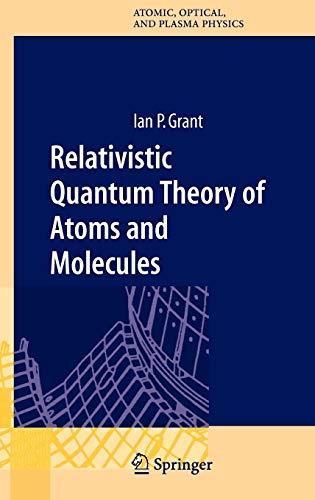
Ebook Info
- Published: 2007
- Number of pages: 824 pages
- Format: PDF
- File Size: 7.37 MB
- Authors: Ian P Grant
Description
This book is intended for physicists and chemists who need to understand the theory of atomic and molecular structure and processes, and who wish to apply the theory to practical problems. As far as practicable, the book provides a self-contained account of the theory of relativistic atomic and molecular structure, based on the accepted formalism of bound-state Quantum Electrodynamics. The author was elected a Fellow of the Royal Society of London in 1992.
User’s Reviews
Editorial Reviews: Review From the reviews:”Relativistic Quantum Theory of Atoms and Molecules is a book that should be on the desk of every atomic-physics student and research scientist. Written by a master of the field, it contains a wealth of information about relativistic atomic and molecular structures.” (Walter Johnson, Physics Today, January, 2008)“In the text, the presentation is usually well balanced, with words and formulas in an appropriate ratio; explanations are frequently supplemented by some sentences that aid the readers’ orientation and motivation. Although the book is particularly tailored towards applications within atomic and molecular theory, several chapters may also be useful for readers whose interests embrace more general aspects of relativistic quantum mechanics. … In summary, Grant’s monograph is more than just a ‘valuable addition’ to the literature on relativistic atomic and molecular theory.” (H. Hogreve, Mathematical Reviews, Issue 2012 c) From the Back Cover This book presents a unified approach to modern relativistic theory of the electronic structure of atoms and molecules which will provide experimental and theoretical scientists and graduate students with a range of powerful computational tools for a growing range of physical, chemical, technological and biochemical applications. Starting from its foundations in quantum electrodynamics, the book contains a careful account of relativistic atomic and molecular structure based on Dirac’s relativistic Hamiltonian, and the numerical algorithms implemented by modern computer programs. The relativistic atomic structure code GRASP, which can compute atomic energy levels, radiative transition rates and other atomic properties using the multiconfigurational Dirac-Hartree-Fock or relativistic configuration interaction methods, is reviewed along with the relativistic R-matrix code DARC, which is used for the high precision modelling of the interactions of atoms and ions with photons and electrons. The recently developed BERTHA relativistic molecular structure code, the first to exploit fully the symmetry properties of Dirac 4-component spinors, provides a new resource for studying the properties of molecules, atomic clusters and other materials, especially those containing heavy elements for which a relativistic model is essential. About the Author Professor Grant first became aware of the need to develop a relativistic theory of atomic and molecular structure some 50 years ago in connection with X-ray absorption by heavy metals. In a 1961 paper, he showed that the Dirac-Hartree-Fock equations for atoms could be written in a simple form which has been used in all subsequent atomic calculations. This early work was generalized to permit more accurate multi-configurational calculations in the next two decades, implemented in the widely used GRASP code for relativistic modeling of electronic wavefunctions, energy levels and radiative transition probabilities of spectral lines. The DARC code, an extension of GRASP which is designed to calculate cross sections for atom/ion collisions with low-energy electrons or photons, was developed mainly in the 1980s and is now becoming more relevant for applications involving target atoms of higher atomic number. The BERTHA code is the first relativistic molecular structure code designed to take advantage of the internal structure of Dirac four-component spinors; its speed and accuracy are now beginning to be appreciated and utilized effectively by quantum chemists. The book is designed for all those who would like to know more about the mathematics and physics of relativistic atomic and molecular theory and who wish to use the computational machinery now available to solve problems in atomic and molecular physics and their applications. Professor Grant was elected a Fellow of the Royal Society of London in 1992. Read more
Reviews from Amazon users which were colected at the time this book was published on the website:
⭐
Keywords
Free Download Relativistic Quantum Theory of Atoms and Molecules: Theory and Computation (Springer Series on Atomic, Optical, and Plasma Physics, 40) 2007th Edition in PDF format
Relativistic Quantum Theory of Atoms and Molecules: Theory and Computation (Springer Series on Atomic, Optical, and Plasma Physics, 40) 2007th Edition PDF Free Download
Download Relativistic Quantum Theory of Atoms and Molecules: Theory and Computation (Springer Series on Atomic, Optical, and Plasma Physics, 40) 2007th Edition 2007 PDF Free
Relativistic Quantum Theory of Atoms and Molecules: Theory and Computation (Springer Series on Atomic, Optical, and Plasma Physics, 40) 2007th Edition 2007 PDF Free Download
Download Relativistic Quantum Theory of Atoms and Molecules: Theory and Computation (Springer Series on Atomic, Optical, and Plasma Physics, 40) 2007th Edition PDF
Free Download Ebook Relativistic Quantum Theory of Atoms and Molecules: Theory and Computation (Springer Series on Atomic, Optical, and Plasma Physics, 40) 2007th Edition