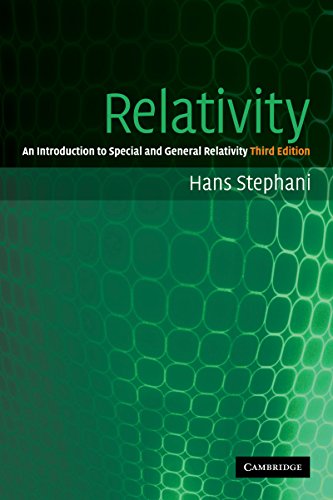
Ebook Info
- Published: 2004
- Number of pages: 420 pages
- Format: PDF
- File Size: 2.00 MB
- Authors: Hans Stephani
Description
Thoroughly revised and updated, this textbook provides a pedagogical introduction to relativity. It is self-contained, but the reader is expected to have a basic knowledge of theoretical mechanics and electrodynamics. It covers the most important features of both special and general relativity, as well as touching on more difficult topics, such as the field of charged pole-dipole particles, the Petrov classification, groups of motions, gravitational lenses, exact solutions and the structure of infinity. The necessary mathematical tools (tensor calculus, Riemannian geometry) are provided, most of the derivations are given in full, and exercises are included where appropriate. Written as a textbook for undergraduate and introductory graduate courses, it will also be of use to researchers working in the field. The bibliography gives the original papers and directs the reader to useful monographs and review papers.
User’s Reviews
Reviews from Amazon users which were colected at the time this book was published on the website:
⭐It is a very difficult book, I think. It covers lots of topics, like Petrov Classification, Conformal Infinity, Kerr Metric, Null geodesic congruence and so forth, but it is fairly tough to read. I can only find very concise derivation in the book – that means I have to do lots of calculation on my own. When I read the algebraic characteristics of Eletromagnetic field, and null tetrad, the derivation is so hard for me ( I need to work whole morning to get through 4 pages) When I come to Petrov Classification, I cannot move any further. Although the book clearly shows you the motivation for some steps, but it omits too much mathematical details. I recommend Ray.d’Inverno’s book or even more introductory like W. Rindler’s book, which are much more friendly to readers than this one. To Stephani’s, I can only address it as an inventory of useful conclusions.I am not sure anyone have good recommendation on Petrov classification which bothered me quite a lot…
⭐I bought this because my copy of Misner Thorne & Wheeler was in a box 1400 miles away, and i wanted to toy around with some ideas in GTR. I needed a good text on GTR, not a watered-down no-math pop-level book, not a specialized research monograph omitting the basics, not a math formulas reference with no more content than an average cheat sheet, but something for those who already are familiar with GTR but lacking any of the usual academic works in their personal library. This book served my purpose perfectly. It comes with some bonuses – a better explanation of Petrov classification than i had seen anywhere else, more on electromagnetics and stress-energy tensors than i was shopping for, and conveniently sized to carry easily about town along with other stuff, something i can’t say for the classic MT&W.I imagine this would be an okay book for someone who doesn’t know GTR but has already studied special relativity and is comfortable with senior undergraduate level physics. GTR is by nature a mind-bending subject, and a total newbie may want to get a taste of the main ideas elsewhere. MT&W, in contrast, is full of illustrations, exercises, and other goodies that make it an excellent choice for GTR beginners. Wald’s book on General Relativity is another good choice, but my copy of this too is 1400 miles away…Good features of this book are that it does not loose the physics behind a forest of math, and that it touches on many important areas – gravitational waves, the Kerr metric, tensor maths, cosmology. None in too much depth – but enough to understand the key concepts and see how different areas of general relativity are related. The bibliography seems shortish but appears sufficient for further pursuits. Some areas not covered include alternatives to GTR, string theory, quantization of GTR. Spinors are mentioned briefly; if one is interested in this important topic, Penrose & Rindler should be your destination.There is no mention of the weak or strong energy conditions in the index. Perhaps these are mentioned somewhere, but the reader wanting to study this vital topic is better off with the book by Wald.One area that could stand improvement are the exercises. There are exercised, but it would be nice to have more. A student relying on this book alone might end up feeling underexercised, wanting to pump more mental iron elsewhere. More numerical/quantitative exercises to give a feel for how much, how strong are special relativistic and GTR effects in everday and astrophysical applications, would be especially beneficial to this book’s usefulness in an undergraduate course context. When used as a reference text, though, such exercises are not important; given my purpose, i am not disappointed.
⭐
Keywords
Free Download Relativity: An Introduction to Special and General Relativity 3rd Edition in PDF format
Relativity: An Introduction to Special and General Relativity 3rd Edition PDF Free Download
Download Relativity: An Introduction to Special and General Relativity 3rd Edition 2004 PDF Free
Relativity: An Introduction to Special and General Relativity 3rd Edition 2004 PDF Free Download
Download Relativity: An Introduction to Special and General Relativity 3rd Edition PDF
Free Download Ebook Relativity: An Introduction to Special and General Relativity 3rd Edition