

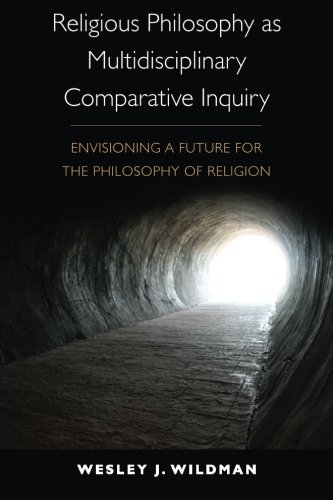
Ebook Info
- Published: 2011
- Number of pages: 400 pages
- Format: PDF
- File Size: 6.40 MB
- Authors: Wesley J. Wildman
Description
Argues that philosophy, as multidisciplinary comparative inquiry, is essential to the contemporary academic study of religion.
User’s Reviews
Editorial Reviews: Review “…Religious Philosophy as Multidisciplinary Comparative Inquiry has the potential to be a significant game changer for scholars of theology, philosophy, and religion.” ― American Journal of Theology and Philosophy“Wildman offers a bold and sweeping work that defends the relevance and necessity of the enterprise traditionally known as philosophy of religion by offering a comprehensive overhaul of its basic methods and self-understanding.” ― CHOICE“This is an immensely ambitious and wide-ranging book, advocating ‘religious philosophy’ as a multidisciplinary comparative inquiry, with an important part to play in any liberal college education. It expounds a view of rational inquiry as fallibilist, hypothetical and pragmatic. Although it is primarily an inquiry into the methodology of religious philosophy, in fact it provides a mine of information about postmodernity, comparative religion, and trends in modern philosophy of religion, among other things. The book sets a positive agenda for future work in theology, religious studies, and comparative philosophy. It is an agenda that is new, well argued, and which I hope will be very influential in higher education, and it is set to be a formative work in the field.” ― Keith Ward, author of The Word of God? The Bible after Modern Scholarship About the Author Wesley J. Wildman is Associate Professor of Philosophy, Theology, and Ethics at Boston University. His books include Fidelity with Plausibility: Modest Christologies in the Twentieth Century, also published by SUNY Press, and Science and Religious Anthropology: A Spiritually Evocative Naturalist Interpretation of Human Life.
Reviews from Amazon users which were colected at the time this book was published on the website:
⭐In this ambitious (and successful) book, Wildman provides a comprehensive review and reorientation of the fields of theology and religious studies, proposing to recast them as a cooperative inquiry treating claims as hypotheses to be evaluated and revised by bringing to bear the widest possible range of evidence, from metaphysics and high theology to biology and brains. He shows an astounding command of an extensive range of materials himself, and evaluates alternatives with perspicacious fairness and reasonable judgment. It is a hard book to fault and an easy book to learn a great deal from.
⭐I can hardly believe that this is the first review of this incredible work. I am a graduate student who is constantly reading philosophic works, and without question Wildman is one of the most exciting and innovative philosophers alive. I just finished this book today and I plan on re-reading it soon to let it sink in even more deeply. Rather than trying to simplify Wildman’s argument in a needlessly long review, I’ll merely highlight the purpose of the book and its strengths.The purpose for this work is to articulate and defend what he calls a “fallible, multidisiciplinary, pragmatic theory of inquiry” by which philosophy can attend to the “big questions” of life – that is, the questions that are “existentially potent” and have puzzled thinkers throughout the centuries. He does so in a dizzying display of erudition through a number of fields – himself a exemplary of the multidisciplinary approach he advocates – including many different kinds and opposing kinds of philosophy, theology, science, and even literature. Furthermore, this inquiry he argues for and displays is certainly not limited by ideological biases of contemporary Western thought. Far from it! He’s incredibly sensitive and seeks to expand the strengths of scientific methodology to lend help to the areas of inquiry that do not naturally lend themselves to clear interpretation – what he calls a situation of “weak feedback potential”.While Wildman is thoroughly grounded in the philosophical traditions of pragmatism and naturalism, he reaches far beyond anything that could be called a reductionistic bias or fence-building parochialism with his argument. Simply put – Wildman pulls no punches and is clear when he placing his bet in a particular side – even when he admits that his inclination may, in the end, not prove fruitful. As a true pragmatist, his methodology is genuinely fallibilistic, open-ended, and subject to correction and/or revision. But he’s incredibly judicious with this method, both for himself and when he engages in analyzing and evaluating the strengths and weaknesses the various strands of inquiry that contribute to his method. Perhaps above all, this book is incredibly clear.Unlike other philosophical traditions, he does not wish to obfuscate or intentionally confuse the ideas or the reader. He lays open the argument and is genuinely concerned about dialogue for the best practice of attending the “big questions” that philosophers have always been haunted by. Wildman is under no illusion that this book could settle such matters decisively, but he is imminently concerned with making a strong argument for how philosophy should go about this business. Would that all philosophers would read this book and take him seriously instead of making unexamined assumptions and poor arguments in and about fields they have not taken seriously! Indeed, what Wildman is arguing for in this book is no less than a dramatic restructuring of how philosophers, departments, and universities think about, research, and fund those tackling the “big questions” of life.If you read nothing else in this review, know that this book is as exciting and daring as it is grounded and robust. It will not disappoint if you care at all about the relationship between philosophy and religion (in any sense of those words – including and especially as theological engagement). I cannot recommend it enough.
⭐
Keywords
Free Download Religious Philosophy as Multidisciplinary Comparative Inquiry: Envisioning a Future for the Philosophy of Religion in PDF format
Religious Philosophy as Multidisciplinary Comparative Inquiry: Envisioning a Future for the Philosophy of Religion PDF Free Download
Download Religious Philosophy as Multidisciplinary Comparative Inquiry: Envisioning a Future for the Philosophy of Religion 2011 PDF Free
Religious Philosophy as Multidisciplinary Comparative Inquiry: Envisioning a Future for the Philosophy of Religion 2011 PDF Free Download
Download Religious Philosophy as Multidisciplinary Comparative Inquiry: Envisioning a Future for the Philosophy of Religion PDF
Free Download Ebook Religious Philosophy as Multidisciplinary Comparative Inquiry: Envisioning a Future for the Philosophy of Religion