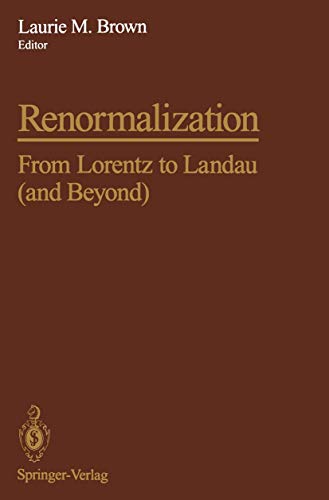
Ebook Info
- Published: 1993
- Number of pages: 192 pages
- Format: PDF
- File Size: 9.19 MB
- Authors: Laurie M. Brown
Description
The purpose of this section is to give you a sketch of how quantum field theory works, where Feynman graphs come from and why they are so useful, where the infinities come from, and how we have learned to deal with them without compromising the physical principles involved. I am purposely treating the problem at the level of the 1940s and 1950s, so as to keep the basic ideas clear and avoid the more difficult problems and more sophisticated methods of recent years. I shall relate my discussion simply to quantum electrodynamics (QED) since that is the most familiar case and the case that was in the forefront from the beginning (though in fact I shall ignore many of the special complications that have to be dealt with when you quantize a gauge field). The methods I shall be describing are applicable to all sorts of quantized fields: the detailed factors are different but the structure of the logical development isjust the same. Not surprisingly, though, the renormalization procedure breaks down if the theory in question is nonrenormalizable. Whether nonrenormalizable theories are theories at all is a matter for debate; in any case, they hold no practical interest for physicists since they are essentially unusable. Quantum electrodynamics was devised in 1927 by Dirac, less than a year after the Schrodinger equation appeared and before the Dirac equa tion for the relativistic electron had been invented.
User’s Reviews
Reviews from Amazon users which were colected at the time this book was published on the website:
⭐Essays presented at the American Physical Society meeting in April 1990. A compendium of historical and pedagogic material. I comment upon the book, if only to correct a miscarriage of justice– the neglect of one of the finest pieces of physics exposition ever put to paper: “Tutorial On Infinities in QED” by Robert Mills (pages 57-86). Google-Scholar returns ten citations to this paper as of 2017 ! Much more awaits !(1) Laurie Brown provides for Introduction (pages 1-28). Read: “Both Schwinger and Tomonaga have said that they were influenced early in their careers by Dirac.” (page 14).(2) Max Dresden provides for historical perspective (pages 29-56). Read: “Actually, Schwinger was the only one who recognized that Kramers, in his 1938 textbook, had constructed a non-relativistic classical theory in which he tried to eliminate the self-field…Schwinger liked this approach.” (page 53).(3) Robert Mills’ pedagogic masterpiece on infinities in quantum electrodynamics (pages 57-86). Read: “…to give you a sketch of how quantum field theory works, where Feynman graphs come from, and how we have learned to deal with them without compromising the physical principles involved.” (page 59).(4) Tian Yu Cao’s exceptional essay on effective field theory and renormalization group (pages 87-134). Read: “In a changed conceptual situation, the most perspicacious of theorists–Steven Weinberg– began to realize that Schwinger’s ideas are essential to the shift of outlook in fundamental physics.” (page 103).(5) Silvan Schweber presents discussion of renormalization from historical roots (pages 137-166). Read: “By exhibiting a formalism that eliminated the divergencies in low orders of perturbation theory in a relativistically and gauge-invariant fashion, Schwinger firmly established the validity of relativistic quantum field theories.”(6) An appendix, written by Shirkov, provides for more history (pages 167-182). Read: “Renormalization group itself was discovered by Stueckelberg and Petermann as a group of transformations…” (page 170).Concluding: This brief book is highly recommended for enrichment. Now, peruse the pedagogic text by Robert Mills: Propagators For Many-Particle Systems: An Elementary Treatment (Gordon & Breach,1969).
⭐Laurie Brown, the editor of this 192-page book, had Feynman as his Ph.D. adviser at Cornell in the late 1940’s, and had also collaborated with Hans Bethe. I suspect that Brown might also have attended the Shelter Island Conferences of the late 1940’s where many of the ideas, that came to constitute quantum field theory, were first presented. Drawing on his deep background as a physicist present and active in the early days of QTF, Brown chaired a session of invited papers on renormalization at the meeting of the American Physical Society in April 1990 in Washington DC. This book is the distillation of these presentations.The papers of Laurie M. Brown, Tian Yu Cao, Max Dresden, Robert Mills, Silvan S. Schweber, and Dmitri V. Shirkov included in this book, treat the reader to a number of interesting perspectives on the development of QTF in general and renormalization in particular. The authors often point out that the terms that correspond to Feynman diagrams may be visualized as both virtual particles and mathematical abstractions, and that terms first introduced as convenient placeholders were eventually seen to correspond to the sort of particles that play significant roles in the Standard Model.The most surprising revelation to be found in this book (for me, at least) is addressed by Max Dresden’s paper “Renormalization in Historical Perspective–The First Stage.” Of particular interest is his discussion of two presentations given by Kramers: first at the Shelter Island Conference in 1947, the second at the Solvay Conference in 1948. Kramers, in part due to his respect for the work of fellow Dutch physicist Lorentz, expressed a view still firmly ensconced in the belief and properties of the all-but-bygone notion known as luminiferous aether. Evidently many of the alleged properties of the aether have as their source classical hydrodynamics–which I suppose is reflected by the concept “aether drag” that was once thought to cause Lorentz contraction. Apparently one of the interesting facets of hydrodynamics is the tendency for the mass of an object moving through a fluid to effectively change (or renormalize) due to this interaction. By a somewhat analogous approach, Kramers developed a scheme for a renormalized electron mass designed to avoid infinite self-energy terms.Kramer’s ideas met with a mixed reception at the 1947 Shelter Island Conference. Max Dresden’s comment on the reception and influence of Kramers’ talk is the following: “Whereas Schwinger and some others were familiar with the renormalization idea, Bethe heard of Kramers’ renormalization at Shelter Island for the first time. With his usual incisive insight Bethe recognized instantly that Kramers’ method would provide an explanation for the Lamb Shift.” For more on Kramers’ contribution to quantum physics and quantum field theory, I recommend Max Dresden’s book
⭐.As a final note, I should observe that this book is appropriate for those whose have read and digested most of a textbook on QTF such as Ryder’s
⭐. This book personalizes many of the ideas found in such textbooks and gives the student a better appreciation of important concepts and how they evolved.
Keywords
Free Download Renormalization: From Lorentz to Landau (and Beyond) in PDF format
Renormalization: From Lorentz to Landau (and Beyond) PDF Free Download
Download Renormalization: From Lorentz to Landau (and Beyond) 1993 PDF Free
Renormalization: From Lorentz to Landau (and Beyond) 1993 PDF Free Download
Download Renormalization: From Lorentz to Landau (and Beyond) PDF
Free Download Ebook Renormalization: From Lorentz to Landau (and Beyond)