

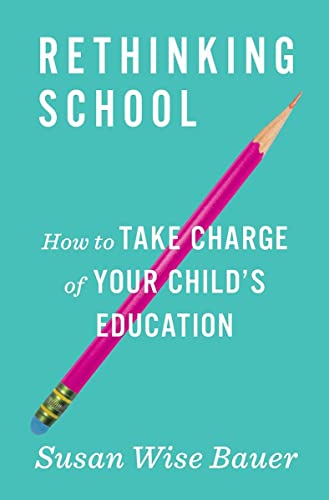
Ebook Info
- Published: 2018
- Number of pages: 288 pages
- Format: PDF
- File Size: 9.37 MB
- Authors: Susan Wise Bauer
Description
A best-selling expert on education shows how to make the school system work for your child.Our K–12 school system is an artificial product of market forces. It isn’t a good fit for all―or even most―students. It prioritizes a single way of understanding the world over all others, pushes children into a rigid set of grades with little regard for individual maturity, and slaps “disability” labels over differences in learning style.Caught in this system, far too many young learners end up discouraged, disconnected, and unhappy. And when they struggle, school pressures parents, with overwhelming force, into “fixing” their children rather than questioning the system.With boldness, experience, and humor, Susan Wise Bauer turns conventional wisdom on its head: When a serious problem arises at school, the fault is more likely to lie with the school, or the educational system itself, than with the child.In five illuminating sections, Bauer teaches parents how to flex the K–12 system, rather than the child. She closely analyzes the traditional school structure, gives trenchant criticisms of its weaknesses, and offers a wealth of advice for parents of children whose difficulties may stem from struggling with learning differences, maturity differences, toxic classroom environments, and even from giftedness (not as much of a “gift” as you might think!).As the author of the classic book on home-schooling, The Well-Trained Mind, Bauer knows how children learn and how schools work. Her advice here is comprehensive and anecdotal, including material drawn from experience with her own four children and more than twenty years of educational consulting and university teaching.Rethinking School is a guide to one aspect of sane, humane parenting: negotiating the twelve-grade school system in a way that nurtures and protects your child’s mind, emotions, and spirit.
User’s Reviews
Editorial Reviews: From School Library Journal Bauer, coauthor of The Well-Trained Mind and an advocate for aclassical education through homeschooling, offers a detailed look at how modern schooling can be a mismatch for student’s needs. For those with a disability, a developmental delay, or giftedness, the structure of age-based classes focused on a single way of understanding and behaving may not work. Bauer breaks down ways in which this system is failing these students and offers advice on how to work around it to find better options for students. While Bauer does advocate for ways to help the system accommodate individuals, including having frank discussions with principals and teachers, she also advocates for getting out of it entirely. This bias toward homeschooling influences everything Bauer presents; however, even with this partiality, the balance of firsthand stories of school failure combined with the author’s own experiences and practical tips make this book very straightforward and informative. VERDICT For parents seeking support and advice for ways to address their discontent with their children’s schooling.—Rachel Wadham, Brigham Young University Libraries, Provo, UT Review “A detailed look at how modern schooling can be a mismatch for students’ needs … very straightforward and informative.” ― Library Journal”A welcome operator’s manual for parents of school-age children, inside or outside the K-12 paradigm.” ― Kirkus”Bauer makes a passionate case for why the K-12 system desperately needs to be rethought . . . comforting and instructive.” ― Publisher’s Weekly About the Author Susan Wise Bauer is a writer, educator, and historian. Her previous books include the Writing With Ease, Writing With Skill, and Story of the World series from Well-Trained Mind Press, as well as The Well-Trained Mind: A Guide to Classical Education at Home, The Well-Educated Mind: A Guide to the Classical Education You Never Had, Rethinking School, The Story of Western Science: From the Writings of Aristotle to the Big Bang Theory, and the History of the World series, all from W. W. W. Norton. She has a Ph.D. in American Studies from the College of William & Mary in Virginia, as well as an M.A. in seventeenth-century literature and a Master of Divinity in Ancient Near Eastern Languages and Literature. For fifteen years, she taught literature and composition at the College of William and Mary. Read more
Reviews from Amazon users which were colected at the time this book was published on the website:
⭐The single most important lesson that this amazing book teaches is this: as a parent, you are not an employee of the school system, or of the school. Your child does not work for the school system. You are a contributor to it, through your taxes and participation, but it is ultimately there to provide a service, and you have every right and ability to use the full spectrum of options in that system to do what’s best for your child. Your job is not to make the school “look good” or increase its funding or national standings. Your options are wider and greater than you might think. This book isn’t about learning to “exploit loopholes” or “game” the system, it’s about understanding how the system actually works, the and how to get the most out of it for your child(ren)’s optimal growth and development.The second most important lesson this book teaches, through analysis and research-backed discussions of the peculiar origins and history of mass schooling in the US, is expectation management. The author helps the reader discover, perhaps for the first time, realistic assessments of what our system can and can’t do. And maybe, just maybe, what to do when your child/children are just incompatible with that system, due to gifts, disabilities, age, maturity, psychological development and other factors. While not a direct advertisement for homeschooling, at least in the 2/3rds of the book, the author sets the reader with a “if all else fails, consider this” methodology if homeschooling is a viable or even preferred option.
⭐I was excited to get my copy of Rethinking School as I am a fan of Susan Wise Bauer’s other work. I just finished, and, unfortunately, I was disappointed.The most persistent problem with the book is that it is clear that the author has stepped out of her realm of expertise. The text is riddled with factual errors, some minor, some not so minor. An example of the latter would be where the author claims that a high school diploma is utterly unnecessary, and for the most part this is true, if a person ends up getting a college degree. However, many jobs that don’t require a college degree do require a high school diploma, and some employers can be quite inflexible about it. What’s interesting here is that later in the book the author strenuously recommends that kids whose talents lie in areas other than the academic realm not attend college—and these are the very kids who are most likely to need a high school diploma. But the deeper issue with regard to the author’s expertise is that she makes claims about schools, what happens inside them, and how to deal with them having never attended a school herself and never being the parent of a child who has attended school. This discrepancy between the author’s expertise and her subject matter is painfully obvious particularly in the first two sections.While the book on its surface claims to be about reimagining school, it is really an argument for homeschooling. The author’s ideas for how to work with teachers and the “system” are not unique. In addition, she doesn’t give enough attention to the very real issues involved in “reimagining school” for high school students. Yes, you can be as free-form as you want in K-8, declining homework, tests, and so forth, but once kids hit high school, the game changes.Finally, the quotations that are liberally sprinkled throughout the book are interesting, but readers should be aware that most, if not all, of them were obtained from the forums the author hosts that target homeschoolers, and as such, were coming from that perspective.All of that said, the book raises some important issues about the purpose of education and where it fits in the work of helping our children grow into themselves.
⭐Many parts of this book delighted me, but a few parts frustrated me. I have been a member of the Well Trained Mind forum community for many years, and am long familiar with the author and her philosophy. It was refreshing to see that she has changed how she views many things about what and in what way kids should learn. Experience is a good teacher and kids do not all learn the same way. It’s good that she realized this; it is something I also had to reckon with in my own decade-and-a-half homeschooling three kids with different learning styles, strengths, gifts, goals.The part that frustrates me -and this may be more a weakness of mine than of the book – is that it is all well and good to recommend your differently-learning students have tailored learning activities, but it is quite another to actually make that happen and fit it in. It takes tons of time to do non-traditional methods of learning, which is the most obvious reason why schools can’t do them much.Also that bit about the steps and stages for helping children move into much less dependent homeschooling frustrates me because for two of my kids, this simply has not worked. They need explicit instruction, unlike the one child who learns well implicitly. So, I currently have a seventh grader who is still mostly in the Parent-at-Elbow or Hovering Parent stage for every subject. *sigh*
⭐This book is a great first step for parents who have concerns about certain aspects of the K-12 school realm, who question the necessities of certain “traditions”- testing, loads of homework, etc.- or have a struggling child. It doesn’t have all of the answers, but it provides much to think about and gives some great starting tactics for parents struggling with how to address an overpowering and intimidating administrative school system. It is definitely not trying to sell homeschooling as the be all end all solution, but rather provides parents with a starting point to advocate for their child within the system. I would consider it a very valuable resource, particularly for parents who do not have the options of simply switching schools, moving to a private school, or homeschooling. If you need advice for working (at least initially) within the system, yet being a strong advocate for your child, Rethinking School is a great starting place, and provides lists of further resource recommendations for specific issues.
Keywords
Free Download Rethinking School: How to Take Charge of Your Child’s Education in PDF format
Rethinking School: How to Take Charge of Your Child’s Education PDF Free Download
Download Rethinking School: How to Take Charge of Your Child’s Education 2018 PDF Free
Rethinking School: How to Take Charge of Your Child’s Education 2018 PDF Free Download
Download Rethinking School: How to Take Charge of Your Child’s Education PDF
Free Download Ebook Rethinking School: How to Take Charge of Your Child’s Education