

Ebook Info
- Published: 2015
- Number of pages: 232 pages
- Format: PDF
- File Size: 2.83 MB
- Authors: Catherine M. Pittman PhD
Description
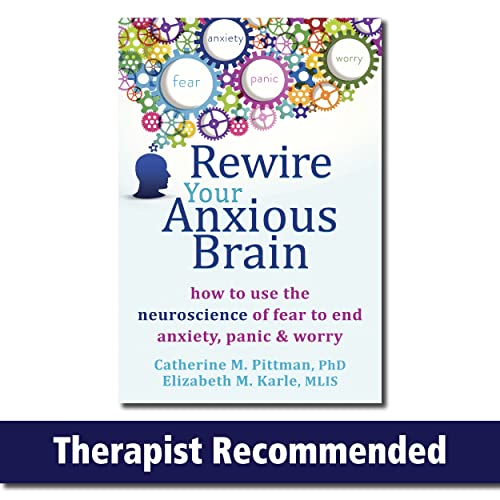
Do you ever wonder what is happening inside your brain when you feel anxious, panicked, and worried? In Rewire Your Anxious Brain, psychologist Catherine Pittman and author Elizabeth Karle offer a unique, evidence-based solution to overcoming anxiety based in cutting-edge neuroscience and research. In the book, you will learn how the amygdala and cortex (both important parts of the brain) are essential players in the neuropsychology of anxiety. The amygdala acts as a primal response, and oftentimes, when this part of the brain processes fear, you may not even understand why you are afraid. By comparison, the cortex is the center of “worry.” That is, obsessing, ruminating, and dwelling on things that may or may not happen. In the book, Pittman and Karle make it simple by offering specific examples of how to manage fear by tapping into both of these pathways in the brain. As you read, you’ll gain a greater understanding how anxiety is created in the brain, and as a result, you will feel empowered and motivated to overcome it. The brain is a powerful tool, and the more you work to change the way you respond to fear, the more resilient you will become. Using the practical self-assessments and proven-effective techniques in this book, you will learn to literally “rewire” the brain processes that lie at the root of your fears.
User’s Reviews
Editorial Reviews: Review “From fears to phobias and panic, this how-to guide unravels the mysteries of worry, then delivers strategies that will lead you to a resilient life.”―Reid Wilson, PhD, author of Don’t Panic “Fear, worry, anxiety, panic, and depression block individuals from living fully. This book does an excellent job of unraveling the mysteries of the brain and how it causes anxiety, thus allowing individuals to take control of their symptoms and manage their lives more effectively. I have used the concepts in this book in treating veterans with PTSD and have seen people become much more functional. Highly-recommended reading.”―Susan Myers, RN, LCSW, BCD, holistic nurse and board certified diplomate in clinical social work”This is a unique contribution to a wide array of self-help books for those who suffer with anxiety. The authors explain what we know about the workings of the brain in a fluid style that neither talks down to nor overwhelms the reader. This science becomes the foundation for decreasing bewilderment, fear, and shame. There are straightforward and logical recommendations for modifying patterns of anxiety that originate from, and are maintained by, differing brain circuitry.”―Sally Winston PsyD, codirector of the Anxiety and Stress Disorders Institute of Maryland”Catherine Pittman, a trained behavioral scientist, brings her deep scientific understanding of fear, anxiety, and learning to the world of personal experiences. Few scientists can make this transition from scientific communication to public communication. Pittman, along with coauthor Elizabeth Karle, does this very well indeed. Readers should not be put off by the early presentations of brain mechanisms, because they are surprisingly readable and informative. Moreover, it is information that provides a foundation for readers who have anxiety challenges to use later as they develop effective coping strategies. Readers should find the clear expositions of the where’s, why’s, and how’s of anxiety and its management to be an anxiety-reducingread.”―J. Bruce Overmier, PhD, professor emeritus in the graduate faculties of psychology, neuroscience, and cognitive science at the University of Minnesota About the Author Catherine M. Pittman, PhD, is associate professor at Saint Mary’s College in Notre Dame, IN. As a licensed clinical psychologist in private practice in South Bend, IN, she specializes in the treatment of brain injuries and anxiety disorders. She is a member of the Anxiety and Depression Association of America (ADAA), and provides workshops and seminars on the topics of anxiety and stress. Elizabeth M. Karle, MLIS, is collection management supervisor at the Cushwa-Leighton Library at Saint Mary’s College in Notre Dame, IN. In addition to supplying research for this book, she has personal experience with anxiety disorders―providing a first-hand perspective that focuses the book on what is most useful for the anxiety sufferer. Originally from Illinois, she currently resides in South Bend, IN, and holds degrees or certificates from the University of Notre Dame, Roosevelt University, and Dominican University. She is author of Hosting a Library Mystery.
Reviews from Amazon users which were colected at the time this book was published on the website:
⭐Absolutely amazing book the the therapist to gain a deeper understanding and how to explain what is occurring neurologically for their clients! Also, I believe it’s a very easy and informative read for the person trying to find relief. There are so many practical methods that are easily explained for finding freedom from anxiety.
⭐Anxiety comes in many forms, and this book has practical, easy-to-use strategies for handling them all. I was fascinated to learn about the different triggers for anxiety and why some strategies work well, and others don’t, depending on where in your brain the anxiety is coming from. It is full of research, yet written in a very approachable and easy-to-understand way. My copy is marked up with notes, and I’m buying extras to share with people I know. I highly recommend this book!
⭐As a 38 yr old male who served in the military, anxiety was not much of an issue for most of my life, but that changed. As my anxiety took over it was hard for me to understand why it was happening and what to do. This book was amazing at revealing how our brains work and deal with anxiety. Recommend to anyone who deals with stress and anxiety no matter how minimal.
⭐This book is helping meUnderstand where anxiety starts from and giving me tools to incorporate when I’m anxious. Thank you for writing this book!
⭐I like it
⭐i have been having very bad anxiety and panic attacks recently, but my therapist recommended this book because it helps looking at what’s really going on when you’re feeling so anxious. it’s been helping so much so far because 1. reading is helpful and 2. looking at the facts vs the fears of your anxiety can and will help you overcome this. you’re not alone! seriously buy this book
⭐The author’s words and recommendations are great tools. While many of the tools have been presented to me over my mental health journey, the presentation in this book helps me understand the ‘why’ and what I need my focus on for improvement.
⭐honestly it’s a great book…I would highly recommend that everyone read this
⭐While I don’t believe that this book is “a lot of mumbo-jumbo” as one reviewer says, it is a major question as to whom this book is aimed. It gives a concise and clear account of the role of the amygdala and the cortex in determining states of anxiety. Were it offered as a straight forward textbook for would be neurologists, the scientific content would be most valuable. However, the sub-title claims that this book will help those of us who suffer from anxiety “to use the neuroscience of fear to end anxiety, panic and worry.”The first warning light comes on when the authors speak of “the more effective approach is to change your thoughts and images to decrease the resulting amygdala activation.” Behind the scientific language lurks what later is to be made explicit, that the best route to dealing with anxiety is through cbt: – cognitive behavioural therapy. This method has been largely discredited by major thinkers in the field of psychotherapy. As one who underwent such ”treatment” in a variety of forms, I can testify to their claims that it a facile, simplistic technique, full of activities, some of them useful enough in themselves for mild cases of anxiety, but mainly widely deployed here in the UK because it is cheap and easy to provide. It rests on a false premise, almost an inversion of the truth; that if we alter our thought patterns then our emotional states will respond positively. That is a simplification but close to the reality, nonetheless. It is interesting that the two authors speak only of present circumstances when anxiety is deeply rooted in the past. Rather it seems to me that the more radical method of reaching to the pain behind anxiety is the only way forward. Yes, it may take longer, is not without it’s own share of pain in confronting past experiences and certainly more expensive.The book largely side-steps the question of medication. It does little more than briefly acknowledge this form of treatment and seems to be largely opposed to it on all but a minimal scale. That argument may hold water, but it needs far more rigorous attention than it receives here. A great deal of the substance of the text is given over to describing in list form manifestations of anxiety and extraordinarily straightforward and familiar ways of coping with it.It is a strange book in combining quite sophisticated theories of the functioning of the brain with naïve, sometimes banal, practical suggestions for dealing with complex emotional states. I can’t recommend it to those seeking genuine help with this painful disorder.
⭐Good information in layman’s terms about the brain’s workings and origins of panic, fear, and anxiety. However, no new ideas on resolving these issues, the usual deep breathing tecniques, meditaton, visualisation and mindfulness (not that I’m saying these things don’t work) just that I was hoping for more.
⭐Lockdown has been super tough for so many of us so if you are on this page looking at these reviews, you are likely suffering anxiety and are searching for something to help, something to help ease the constant worry. Whether this book will work for you is hard to say and it depends on what kind of person you are. If you seek understanding and knowledge, then this book is great. It really breaks down what actually is happening when you worry and knowing this, can help.This didn’t help me, unfortunately. I get it, I know why I am anxious and what causes it to some extent but it doesn’t necessarily help negate it. The exercises and examples in this book, whilst valid, can be found on any “top 10 ways to deal with anxiety” list. To me, there is nothing new or groundbreaking in this book outside of its scientific breakdown.This book may help you, but don’t pin all your hopes on it. Regardless, good luck friend. Sometimes all we can do is put one foot in front of the other, so get your walking shoes on!
⭐Although the book is very good at explaining the ins and outs of WHY we feel anxiety, it isn’t much help in explaining how to combat that anxiety. Most of the suggestions were simply things like ‘deep breathing’ that we’ve heard hundreds of times before – and which, for me, actually make the anxiety worse. We’re told that trying to look at the source of anxiety logically won’t help, but I find that that is precisely what does help. Try writing down the facts about what’s actually going on, instead of letting it be a shapeless cloud of fear in your head. Ask yourself what’s the worst that could possibly happen – which almost certainly isn’t as bad as you think! – and put a contingency plan in place so that you’ll know ahead of time how you’re going to cope with even that if it arises.
⭐This book was perfectly pitched in that it explains how the brain works to produce anxiety in a way that is accessible but not patronising. It explains the difference between cortex-induce anxiety and amygdala-induced anxiety in a way that will make you realise your brain and body are not only trying to do you a favour, but that there are ways to control them. If you struggle with physical symptoms of anxiety that you think are impossible to change, think again. This book clearly explains how to overcome them…and it works
Keywords
Free Download Rewire Your Anxious Brain: How to Use the Neuroscience of Fear to End Anxiety, Panic, and Worry in PDF format
Rewire Your Anxious Brain: How to Use the Neuroscience of Fear to End Anxiety, Panic, and Worry PDF Free Download
Download Rewire Your Anxious Brain: How to Use the Neuroscience of Fear to End Anxiety, Panic, and Worry 2015 PDF Free
Rewire Your Anxious Brain: How to Use the Neuroscience of Fear to End Anxiety, Panic, and Worry 2015 PDF Free Download
Download Rewire Your Anxious Brain: How to Use the Neuroscience of Fear to End Anxiety, Panic, and Worry PDF
Free Download Ebook Rewire Your Anxious Brain: How to Use the Neuroscience of Fear to End Anxiety, Panic, and Worry