

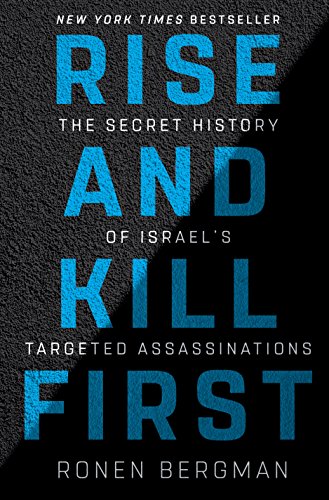
Ebook Info
- Published: 2018
- Number of pages: 784 pages
- Format: PDF
- File Size: 10.31 MB
- Authors: Ronen Bergman
Description
NEW YORK TIMES BESTSELLER • The first definitive history of the Mossad, Shin Bet, and the IDF’s targeted killing programs, hailed by The New York Times as “an exceptional work, a humane book about an incendiary subject.”WINNER OF THE NATIONAL JEWISH BOOK AWARD IN HISTORYNAMED ONE OF THE TEN BEST BOOKS OF THE YEAR BY JENNIFER SZALAI, THE NEW YORK TIMES NAMED ONE OF THE BEST BOOKS OF THE YEAR BY The Economist • The New York Times Book Review • BBC History Magazine • Mother Jones • Kirkus Reviews The Talmud says: “If someone comes to kill you, rise up and kill him first.” This instinct to take every measure, even the most aggressive, to defend the Jewish people is hardwired into Israel’s DNA. From the very beginning of its statehood in 1948, protecting the nation from harm has been the responsibility of its intelligence community and armed services, and there is one weapon in their vast arsenal that they have relied upon to thwart the most serious threats: Targeted assassinations have been used countless times, on enemies large and small, sometimes in response to attacks against the Israeli people and sometimes preemptively.In this page-turning, eye-opening book, journalist and military analyst Ronen Bergman—praised by David Remnick as “arguably [Israel’s] best investigative reporter”—offers a riveting inside account of the targeted killing programs: their successes, their failures, and the moral and political price exacted on the men and women who approved and carried out the missions. Bergman has gained the exceedingly rare cooperation of many current and former members of the Israeli government, including Prime Ministers Shimon Peres, Ehud Barak, Ariel Sharon, and Benjamin Netanyahu, as well as high-level figures in the country’s military and intelligence services: the IDF (Israel Defense Forces), the Mossad (the world’s most feared intelligence agency), Caesarea (a “Mossad within the Mossad” that carries out attacks on the highest-value targets), and the Shin Bet (an internal security service that implemented the largest targeted assassination campaign ever, in order to stop what had once appeared to be unstoppable: suicide terrorism). Including never-before-reported, behind-the-curtain accounts of key operations, and based on hundreds of on-the-record interviews and thousands of files to which Bergman has gotten exclusive access over his decades of reporting, Rise and Kill First brings us deep into the heart of Israel’s most secret activities. Bergman traces, from statehood to the present, the gripping events and thorny ethical questions underlying Israel’s targeted killing campaign, which has shaped the Israeli nation, the Middle East, and the entire world.“A remarkable feat of fearless and responsible reporting . . . important, timely, and informative.”—John le Carré
User’s Reviews
Editorial Reviews: Review “Ronen Bergman has set out in incontestable detail the history and scale of Israel’s use of extrajudicial killing as an instrument of defense and foreign policy. His material is stark and sensational, but he steers a steady course through it, even pausing along the way to debate the effectiveness and morality of his subject. The result is a compelling read whatever your point of view.”—John le Carré“This remarkable account of Israel’s targeted-killing programs is the product of nearly eight years of research into what is arguably the most secretive and impenetrable intelligence community in the world. Bergman, an investigative reporter and military analyst, interviewed hundreds of insiders, including assassins, and obtained thousands of classified documents.”—The New Yorker “America’s difficult relationship with targeted killing and the dilemmas we may face in the future are beautifully illuminated by the longer story of Israel’s experiences with assassination in its own endless war against terrorism. . . . Americans now have a terrific new introduction to that story with publication of Ronen Bergman’s Rise and Kill First. . . . It moves at a torrid pace and tells stories that would make Jason Bourne sit up and say ‘Wow!’ It is smart, thoughtful and balanced, and the English translation is superb. It deserves all of the plaudits it has already received.”—The New York Times Book Review“Blending history and investigative reporting, Bergman never loses sight of the ethical questions that arise when a state, founded as a refuge for a stateless people who were targets of a genocide, decides it needs to kill in order to survive. . . . This book is full of shocking moments, surprising disturbances in a narrative full of fateful twists and unintended consequences.”—The New York Times “Authoritative . . . a chilling portrait of the evolution of the assassination program . . . Bergman has a reputation as an indefatigable journalist who has developed hundreds of informed sources in the defense establishment over the past two decades. . . . Since World War II, Bergman calculates, the Jewish state and its pre-state paramilitary organizations have assassinated more people than any other country in the Western world.”—The Washington Post “A must-read . . . [Bergman is] Israel’s premier chronicler of the country’s principal spy services—the Mossad (Israel’s CIA), Shin Bet (its internal security organ) and Aman (military intelligence).”—Newsweek “A textured history of the personalities and tactics of the various secret services . . . makes the case that Israel has used assassination in the place of war, killing half a dozen Iranian nuclear scientists, for instance, rather than launching a military attack . . . [Bergman] says that while the [United States] has tighter constraints on its agents than does Israel, President George W. Bush adopted many Israeli techniques after the terrorist attacks of September 11, 2001, and President Barack Obama launched several hundred targeted killings.”—Bloomberg“Leading any list of notable nonfiction books—Jewish or not—must be Ronen Bergman’s Rise and Kill First, a massive and extravagantly well-sourced history of the use of the tool of assassination by Israel’s intelligence services. . . . One’s mouth is often agape with amazement, even shock, while reading.”—Haaretz About the Author Ronen Bergman is the senior correspondent for military and intelligence affairs for Yedioth Ahronoth, Israel’s largest daily paid newspaper, and a contributing writer for The New York Times Magazine, where he reports on intelligence, national security, terrorism, and nuclear issues. Bergman is the author of five bestselling Hebrew-language nonfiction books and The Secret War with Iran, which was published in the United States by Free Press. Bergman is the recipient of the Sokolow Prize, Israel’s most esteemed award for journalism, and the B’nai B’rith International Press Award, among other honors. A member of the Israeli bar, he graduated with honors from the University of Haifa Faculty of Law and clerked in the attorney general’s office. A winner of a Chevening Scholarship from the British Foreign Office, he received a master’s in international relations from Cambridge University, where he was also awarded his PhD in history. Excerpt. © Reprinted by permission. All rights reserved. Chapter 1In Blood and FireOn September 29, 1944, David Shomron hid in the gloom of St. George Street, not far from the Romanian Church in Jerusalem. A church building was used as officers’ lodgings by the British authorities governing Palestine, and Shomron was waiting for one of those officers, a man named Tom Wilkin, to leave.Wilkin was the commander of the Jewish unit at the Criminal Investigation Department (CID) of the British Mandate for Palestine, and he was very good at his job, especially the part that involved infiltrating and disrupting the fractious Jewish underground. Aggressive, yet also exceptionally patient and calculating, Wilkin spoke fluent Hebrew, and after thirteen years of service in Palestine, he had an extensive network of informants. Thanks to the intelligence they provided, underground fighters were arrested, their weapons caches were seized, and their planned operations, aimed at forcing the British to leave Palestine, were foiled.Which was why Shomron was going to kill him.Shomron and his partner that night, Yaakov Banai (code-named Mazal—“Luck”), were operatives with Lehi, the most radical of the Zionist underground movements fighting the British in the early 1940s. Though Lehi was the acronym for the Hebrew phrase “fighters for the freedom of Israel,” the British considered it a terrorist organization, referring to it dismissively as the Stern Gang, after its founder, the romantic ultra-nationalist Avraham Stern. Stern and his tiny band of followers employed a targeted mayhem of assassinations and bombings—a campaign of “personal terror,” as Lehi’s operations chief (and later Israeli prime minister), Yitzhak Shamir, called it.Wilkin knew he was a target. Lehi already had tried to kill him and his boss, Geoffrey Morton, nearly three years earlier, in its first, clumsy operation. On January 20, 1942, assassins planted bombs on the roof and inside the building of 8 Yael Street, in Tel Aviv. Instead they ended up killing three police officers—two Jews and an Englishman—who arrived before Wilkin and Morton and tripped the charges. Later, Morton fled Palestine after being wounded in another attempt on his life—that one in retribution for Morton having shot Stern dead.None of those details, the back-and-forth of who killed whom and in what order, mattered to Shomron. The British occupied the land the Zionists saw as rightfully theirs—that was what mattered, and Shamir had issued a death sentence against Wilkin.For Shomron and his comrades, Wilkin was not a person but rather a target, prominent and high-value. “We were too busy and hungry to think about the British and their families,” Shomron said decades later.After discovering that Wilkin was residing in the Romanian Church annex, the assassins set out on their mission. Shomron and Banai had revolvers and hand grenades in their pockets. Additional Lehi operatives were in the vicinity, smartly dressed in suits and hats to look like Englishmen.Wilkin left the officers’ lodgings in the church and headed for the CID’s facility in the Russian Compound, where underground suspects were held and interrogated. As always, he was wary, scanning the street as he walked and keeping one hand in his pocket all the time. As he passed the corner of St. George and Mea Shearim Streets, a youngster sitting outside the neighborhood grocery store got up and dropped his hat. This was the signal, and the two assassins began walking toward Wilkin, identifying him according to the photographs they’d studied. Shomron and Banai let him pass, gripping their revolvers with sweating palms.Then they turned around and drew.“Before we did it, Mazal [Banai] said, ‘Let me shoot first,’ ” Shomron recalled. “But when we saw him, I guess I couldn’t restrain myself. I shot first.”Between them, Banai and Shomron fired fourteen times. Eleven of those bullets hit Wilkin. “He managed to turn around and draw his pistol,” Shomron said, “but then he fell face first. A spurt of blood came out of his forehead, like a fountain. It was not such a pretty picture.”Shomron and Banai darted back into the shadows and made off in a taxi in which another Lehi man was waiting for them.“The only thing that hurt me was that we forgot to take the briefcase in which he had all his documents,” Shomron said. Other than that, “I didn’t feel anything, not even a little twinge of guilt. We believed the more coffins that reached London, the closer the day of freedom would be.”The idea that the return of the People of Israel to the Land of Israel could be achieved only by force was not born with Stern and his Lehi comrades.The roots of that strategy can be traced to eight men who gathered in a stifling one-room apartment overlooking an orange grove in Jaffa on September 29, 1907, exactly thirty-seven years before a fountain of blood spurted from Wilkin’s head, when Palestine was still part of the Turkish Ottoman Empire. The flat was rented by Yitzhak Ben-Zvi, a young Russian who’d immigrated to Ottoman Palestine earlier that year. Like the others in his apartment that night—all emigrants from the Russian empire, sitting on a straw mat spread on the floor of the candlelit room—he was a committed Zionist, albeit part of a splinter sect that had once threatened to rend the movement.Zionism as a political ideology had been founded in 1896 when Viennese Jewish journalist Theodor Herzl published Der Judenstaat (The Jewish State). He had been deeply affected while covering the trial in Paris of Alfred Dreyfus, a Jewish army officer unjustly accused and convicted of treason.In his book, Herzl argued that anti-Semitism was so deeply ingrained in European culture that the Jewish people could achieve true freedom and safety only in a nation-state of their own. The Jewish elite of Western Europe, who’d managed to carve out comfortable lives for themselves, mostly rejected Herzl. But his ideas resonated with poor and working-class Jews of Eastern Europe, who suffered repeated pogroms and continual oppression and to which some of them responded by aligning themselves with leftist uprisings.Herzl himself saw Palestine, the Jews’ ancestral homeland, as the ideal location for a future Jewish state, but he maintained that any settlement there would have to be handled deliberately and delicately, through proper diplomatic channels and with international sanction, if a Jewish nation was to survive in peace. Herzl’s view came to be known as political Zionism.Ben-Zvi and his seven comrades, on the other hand, were—like most other Russian Jews—practical Zionists. Rather than wait for the rest of the world to give them a home, they believed in creating one themselves—in going to Palestine, working the land, making the desert bloom. They would take what they believed to be rightfully theirs, and they would defend what they had taken.This put the practical Zionists in immediate conflict with most of the Jews already living in Palestine. As a tiny minority in an Arab land—many of them peddlers and religious scholars and functionaries under the Ottoman regime—they preferred to keep a low profile. Through subservience and compromise and bribery, these established Palestinian Jews had managed to buy themselves relative peace and a measure of security.But Ben-Zvi and the other newcomers were appalled at the conditions their fellow Jews tolerated. Many were living in abject poverty and had no means of defending themselves, utterly at the mercy of the Arab majority and the venal officials of the corrupt Ottoman Empire. Arab mobs attacked and plundered Jewish settlements, rarely with any consequences. Worse, as Ben-Zvi and the others saw it, those same settlements had consigned their defense to Arab guards—who in turn would sometimes collaborate with attacking mobs.Ben-Zvi and his friends found this situation to be unsustainable and intolerable. Some were former members of Russian left-wing revolutionary movements inspired by the People’s Will (Narodnaya Volya), an aggressive anti-tsarist guerrilla movement that employed terrorist tactics, including assassinations.Disappointed by the abortive 1905 revolution in Russia, which in the end produced only minimal constitutional reforms, some of these socialist revolutionaries, social democrats, and liberals moved to Ottoman Palestine to reestablish a Jewish state.They all were desperately poor, barely scraping by, earning pennies at teaching jobs or manual labor in the fields and orange groves, often going hungry. But they were proud Zionists. If they were going to create a nation, they first had to defend themselves. So they slipped through the streets of Jaffa in pairs and alone, making their way to the secret meeting in Ben-Zvi’s apartment. That night, those eight people formed the first Hebrew fighting force of the modern age. They decreed that, from then forward, everything would be different from the image of the weak and persecuted Jew all across the globe. Only Jews would defend Jews in Palestine.They named their fledgling army Bar-Giora, after one of the leaders of the Great Jewish Revolt against the Roman Empire, in the first century. On their banner, they paid homage to that ancient rebellion and predicted their future. “In blood and fire Judea fell,” it read. “In blood and fire Judea will rise.”Judea would indeed rise. Ben-Zvi would one day be the Jewish nation’s second president. Yet first there would be much fire, and much blood.Bar-Giora was not, at first, a popular movement. But more Jews arrived in Palestine from Russia and Eastern Europe every year—35,000 between 1905 and 1914—bringing with them that same determined philosophy of practical Zionism.With more like-minded Jews flooding into the Yishuv, as the Jewish community in Palestine was called, Bar-Giora in 1909 was reconstituted into the larger and more aggressive Hashomer (Hebrew for “the Guard”). By 1912, Hashomer was defending fourteen settlements. Yet it was also developing offensive, albeit clandestine, capabilities, preparing for what practical Zionists saw as an inevitable eventual war to take control of Palestine. Hashomer therefore saw itself as the nucleus for a future Jewish army and intelligence service.Mounted on their horses, Hashomer vigilantes raided a few Arab settlements to punish residents who had harmed Jews, sometimes beating them up, sometimes executing them. In one case, a special clandestine assembly of Hashomer members decided to eliminate a Bedouin policeman, Aref al-Arsan, who had assisted the Turks and tortured Jewish prisoners. He was shot dead by Hashomer in June 1916.Hashomer did not recoil from using force to assert its authority over other Jews, either. During World War I, Hashomer was violently opposed to NILI, a Jewish spy network working for the British in Ottoman Palestine. Hashomer feared that the Turks would discover the spies and wreak vengeance against the entire Jewish community. When they failed to get NILI to cease operations or to hand over a stash of gold coins they’d received from the British, they made an attempt on the life of Yosef Lishansky, one of its members, managing only to wound him.In 1920, Hashomer evolved again, now into the Haganah (Hebrew for “Defense”). Though it was not specifically legal, the British authorities, who had been ruling the country for about three years, tolerated the Haganah as the paramilitary defensive arm of the Yishuv. The Histadrut, the socialist labor union of the Jews in Israel that was founded in the same year, and the Jewish Agency, the Yishuv’s autonomous governing authority, established a few years later, both headed by David Ben-Gurion, maintained command over the secret organization.Ben-Gurion was born David Yosef Grün in Pło´nsk, Poland, in 1886. From an early age, he followed in his father’s footsteps as a Zionist activist. In 1906, he migrated to Palestine and, thanks to his charisma and determination, soon became one of the leaders of the Yishuv, despite his youth. He then changed his name to Ben-Gurion, after another of the leaders of the revolt against the Romans.Haganah in its early years was influenced by the spirit and aggressive attitude of Hashomer. On May 1, 1921, an Arab mob massacred fourteen Jews in an immigrants’ hostel in Jaffa. After learning that an Arab police officer by the name of Tewfik Bey had helped the mob get into the hostel, Haganah sent a hit squad to dispose of him, and on January 17, 1923, he was shot dead in the middle of a Tel Aviv street. “As a matter of honor,” he was shot from the front and not in the back, according to one of those involved, and the intention was “to show the Arabs that their deeds are not forgotten and their day will come, even if belatedly.”The members of Hashomer who led the Haganah at the outset were even willing to commit acts of violence against fellow Jews. Jacob de Haan was a Dutch-born Haredi—an ultra-Orthodox Jew—living in Jerusalem in the early 1920s. He was a propagandist for the Haredi belief that only the Messiah could establish a Jewish state, that God alone would decide when to return the Jews to their ancestral homeland, and that humans trying to expedite the process were committing a grave sin. In other words, de Haan was a staunch anti-Zionist, and he was surprisingly adept at swaying international opinion. To Yitzhak Ben-Zvi, by now a prominent Haganah leader, that made de Haan dangerous. So he ordered his death.On June 30, 1924—just a day before de Haan was to travel to London to ask the British government to reconsider its promise to establish a Jewish nation in Palestine—two assassins shot him three times as he emerged from a synagogue on Jaffa Road in Jerusalem.Ben-Gurion, however, took a dim view of such acts. He realized that in order to win even partial recognition from the British for Zionist aims, he would have to enforce orderly and more moderate norms on the semi-underground militia under his command. Hashomer’s brave and lethal lone riders were replaced after the de Haan murder by an organized, hierarchical armed force. Ben-Gurion ordered Haganah to desist from using targeted killings. “As to personal terror, Ben-Gurion’s line was consistently and steadily against it,” Haganah commander Yisrael Galili testified later, and he recounted a number of instances in which Ben-Gurion had refused to approve proposals for hits against individual Arabs. These included the Palestinian leader Hajj Amin al-Husseini and other members of the Arab Higher Committee, and British personnel, such as a senior official in the Mandate’s lands authority who was obstructing Jewish settlement projects.Not everyone was eager to acquiesce to Ben-Gurion. Avraham Tehomi, the man who shot de Haan, despised the moderate line Ben-Gurion took against the British and the Arabs, and, together with some other leading figures, he quit Haganah and in 1931 formed the Irgun Zvai Leumi, the “National Military Organization” whose Hebrew acronym is Etzel, usually referred to in English as IZL or the Irgun. This radical right-wing group was commanded in the 1940s by Menachem Begin, who in 1977 was to become prime minister of Israel. Inside the Irgun, too, there were clashes, personal and ideological. Opponents of Begin’s agreement to cooperate with Britain in its war against the Nazis broke away and formed Lehi. For these men, any cooperation with Britain was anathema. Read more
Reviews from Amazon users which were colected at the time this book was published on the website:
⭐“Rise and Kill First,” Ronen Bergman’s revelatory and astonishing history of Israel’s targeted assassinations, is a brilliant and prodigiously researched work. Readers will be riveted and amazed both by the scale of the killings carried out by the Israeli security services and by their tactical genius. They will likewise be appalled by the price in human lives, both innocent and not so innocent, at which Israel’s survival has been purchased. And they will be profoundly saddened as they comprehend how that survival has required the best and bravest of Israel’s young men and women to steel themselves against the fundamental moral precepts that govern ordinary life.Bergman bluntly tells us – and most readers will agree – that the targets of Israel’s assassinations deserve to die. They have planned andexecuted the cold-blooded murder of hundreds of Israeli civilians – men, women, children and infants – as they go about the activities of their daily lives. No cause, no grievance, can ever mitigate such atrocities. And in war, where there is no realistic possibility of arresting and trying the perpetrators, the justice of striking them down is, at least to this reader, not open to serious moral question.But things are not always so simple, even when the target of an assassination is a terrorist murderer. As in one instance recounted by Bergman, it may happen that, despite the best efforts of counter-terror forces to ensure that the target will be at home alone when the hit occurs, he must be shot in front of his wife and teenage daughter. Unpleasant, says the operative in relating the story to Bergman, but the job must be done. And he does not hesitate to do it.Infinitely worse, of course, is the loss of totally innocent life that is the virtually inevitable by-product of assassinations carried out from the air or by explosive. As detailed by Bergman, Israel does try to prevent this, and countless operations have been aborted because of the likelihood that unacceptable “collateral damage” will occur. But if no harm to innocents were deemed tolerable, many operations could simply not be carried out.And that would not be without consequence to innocent Israelis. As Bergman shows, in some cases where operations were called off because of the likelihood of harm to innocent bystanders, the terrorists thus spared have gone on to commit attacks in which dozens of Israeli civilians were killed. That causes one security officer to tell Bergman that although it causes him genuine pain when an Arab child is killed in an Israeli operation, if a child is going to be harmed, he would prefer that the child not be Israeli. Is it wrong, or natural, to care for one’s own people first?The Israeli government has no doubt about the answer. And although many innocent Arab lives were lost in the unprecedented number of Israeli assassinations that took place in response to the horrific wave of terrorism that struck Israel during the Second Intifada, those operations, together with the IDF’s Defensive Shield offensive in the West Bank, gave the lie to the familiar bromide that there is no military solution to terrorism. The Israelis found one, putting down the Second Intifada by force of arms. In winning that victory, Israel’s program of targeted assassinations played an important part.More recently, Israel has targeted Iranian scientists working on the country’s nuclear program for elimination. That caused a female Mossad agent to stand up at one meeting and declare that her father was a scientist who had helped develop Israel’s nuclear capacity and ask her colleagues whether they would consider him a legitimate target for assassination by the enemy. Her question did not receive much by way of an answer, but the killing of Iranian nuclear scientists continued.Unfortunately, the dazzling feat of groundbreaking reportage and riveting narrative achieved by Bergman in “Rise and Kill First” is marred in the book’s final pages by some unaccountable and highly misleading statements about the agreement concerning Iran’s nuclear program (formally known as the “Joint Comprehensive Plan of Action”(“JCPOA”))reached between Iran and six world powers in July 2015. Relating the prior clash between former Mossad chief Meir Dagan and Prime Minister Benjamin Netanyahu over the feasibility and wisdom of an Israeli military strike on Iran’s nuclear facilities, Bergman writes that the JCPOA , which mooted their debate, was”an Iranian capitulation to a number of demands that the ayatollahs had been rejecting for years. Iran agreed to dismantle the nuclear project almost entirely and to be subject to strict limits and supervision for many years into the future”In view of the heated controversy then raging in the United States over whether the JCPOA would effectively restrain Iran’s nuclear program, or put it on a glide path to becoming a nuclear-armed power, Bergman’s characterization of the agreement as an “Iranian capitulation” is nothing less than startling. And while one might argue that whether the deal was a good one or a bad one is a matter of opinion, Bergman misstates the underlying facts on which his opinion is based.Thus, contrary to his assertion, the deal did not require Iran to “dismantle” anything, let alone its “entire[ ]” nuclear project; it only required that Iran mothball centrifuges that exceeded the agreement’s limits during its term. And the agreement provided that its restrictions on Iran’s enrichment of uranium to near-fissile purity would sunset after 15 years, hardly a prohibitive period to religious fanatics playing a long game.Further, the agreement placed no restrictions on Iran’s development of ballistic missiles, and its research on high speed centrifuges was allowed to continue. As to the latter, even Barack Obama acknowledged that, after the agreement’s sunset, high-speed centrifuges could “[shrink] breakout times [for Iran to construct a nuclear bomb] . . . almost down to zero.”Bergman refers to none of this in characterizing the JCOPA as an “Iranian capitulation.” Similarly, while asserting (without much explication) that the agreement represented “a double triumph” for Meir Dagan, he fails to mention that the JCPOA was opposed not only by Benjamin Netanyahu, but also by opposition leaders Isaac Herzog and Tzipi Livni, in very strong terms.The result is that a not otherwise-informed reader could well come away with a false, or at best incomplete, picture of the issues surrounding the Iran nuclear agreement. To me that is a grievous fault, but one paragraph in a book of more than 600 pages cannot affect its overall quality.Bergman ends his book with a lament that Israel’s intelligence and security agencies have been so successful as to foster “the illusion among most of the nation’s leaders that covert operations . . . could be used in place of real diplomacy.” Toward the end of his life, Bergman writes, Meir Dagan (who is the deserved hero of this book) realized “that only a political solution with the Palestinians – the two-state solution – could end the 150-year conflict.” Ill with cancer, Dagan tried with his last energy to persuade the Israeli public to elect a leadership that would vigorously pursue that aim. But, Bergman writes, his efforts were to no avail:”Despite the enormous adulation he enjoyed as the ultimate Israeli master spy, Dagan’s speech, as well as the calls of many other former heads of the intelligence and military establishments for a compromise agreement with the Palestinians. . . have all fallen on deaf ears.”One can easily imagine what may animate the longing for peace of retired heroes like Meir Dagan. They have dedicated their lives to protecting Israeli civilians from the remorseless terrorists who would murder them, and that has required them to do terrible things. Reflecting on what they have seen and done, it would not be surprising for them to feel moral qualms and wish there was another way. As one former head of the security service observed in the film The Gatekeepers, “[w]hen you leave Shin Bet, you become a bit of a leftist.”Being removed from the dirty business of targeted assassinations, the average Israeli voter may see things more dispassionately. What he sees is the Palestinians’ unremitting intransigence, their rejection without counteroffer of generous Israeli proposals for a two-state solution, the Palestinian Authority’s pension payments for the murder of Israeli men, women and children, and the Holocaust denial and gross anti-Semitism of Mahmoud Abbas, the supposedly moderate president of the PA.What exactly can be done to persuade such people to negotiate in good faith about peace? Ronen Bergman doesn’t say.
⭐I have read innumerable books on the Holocaust… read books on capturing Eichmann… capturing “The Angel of Death”… on Moshe Dayan… on one of my many personal Israeli heroes… Ariel Sharon… the awe-inspiring *BRIGADE”… and countless others… I studied Hebrew for four years as a child… I used my allowance to buy trees for Israel in its infancy…. I was given An Israeli savings bond when I was young and asked my Dad how long it took to mature… and he sternly and lovingly told me… “you should never cash that in… you’re investing in Israel!”… And I never have!Well… with all the above study and dedication to my ancestral homeland… I wholeheartedly say… that this book by Ronen Bergman… is the “Granddaddy”… of books that I’ve read (separately from the Holocaust) about Judaism… Israel… and how *WE*… CAN NEVER… HAVE NEVER…. AND WILL NEVER… allow another Holocaust to take place. This earth-shaking book… is the detailed… explanation…. and proof… (And Reminder) that the Jewish people… will use every means necessary… to insure… ***NEVER-AGAIN**… L’CHAIM! This book is so well written… and so well researched… both from archives… and filled with exhaustive interviews with Prime Ministers… Mossad directors and front line “foot soldiers”… Shin Bet directors and“water” carriers… and every level of the IDF (Israel Defense Forces). The story goes back to before Israel became a state.. and reports on the underground forces fighting the British and Arabs for the right to live and return to their homeland… and of course overcoming the Nazi’s and the Holocaust. This epic tale… never slows down to take a breath… and continues to May 14, 1948… when Israel finally became a state… and then within hours the new State of Israel was attacked simultaneously by SEVEN ARMIES! Israel wins this war… but their mantra… our mantra… to this day is… “IT’S PEOPLE ARE PERPETUALLY IN DANGER OF ANNIHILATION AND THAT AS IN THE HOLOCAUST, NO ONE WILL COME TO THEIR AID WHEN THAT HAPPENS.” And that core belief… is why the State of Israel survives to this day.The title of this book was inspired by the Talmud… which says: “IF SOMEONE COMES TO KILL YOU, RISE UP AND KILL HIM FIRST.” Israel’s leaders knew early on that *INTELLIGENCE* and pre-emptive TARGETED… as well as retaliatory strikes… was how they had to operate to survive. They were also prescient enough to realize that intelligence and security outside their territorial borders was just as… if not more important than… within their borders. And that has been proven to be absolutely correct… time… after time… after time.The author takes you deep within Israel’s security and intelligence forces. Their intelligence capability and performance is without a doubt… one of the greatest in the world. An example of how good Israeli intelligence is… would be in January 2007 when the Mossad had a female operative at a hotel bar in Vienna where the director of the Syrian Atomic Energy Commission was staying. She kept him busy talking about his beloved poodles… while an Israeli Mossad team broke into his room and had to unlock a briefcase with time ticking down and the Syrian was coming back to his room… they didn’t have time to look at the documents… they just photographed what was in there… and barely got out SECONDS BEFORE… the Syrian came back to the room. It turns out the pictures were of a nuclear reactor already created in Syria to make nuclear weapons. The Israeli’s shared this with the CIA… AND THE CIA HAD NO IDEA THAT SYRIA HAD THIS CAPABILITY! The plant was ready to go “hot” within six months. When this evidence was verified by the unknowing United States… Vice-President Cheney wanted to attack… but President George W. Bush did not want to do anything at that time. At 3:00AM Thursday September 6th… SEVEN ISRAELI F-151 FIGHTER JETS FLEW WITHIN THIRTY MILES OF SYRIAN AIR SPACE AND LAUNCHED TWENTY-TWO MISSILES AT THE THREE SITES WITHIN THE NUCLEAR COMPLEX… “shortly afterward, American and Israeli satellites hovering above Syria documented the total destruction of the site,” Israel then through a backdoor connection in Turkey… told Assad they wouldn’t publicize it to the world… and he shouldn’t retaliate or among other things they’d let their ally Russia know (along with the world) “that Syria had acted in gross violation of the Non-Proliferation Treaty, to which it was a signatory”… which Russia didn’t know they signed… and they wouldn’t have to be embarrassed that “Syria had just gotten years’ worth of expensive military research and technology blown up by the Jewish state.”Personal Heads Up To Readers Of This Review: Syria purchased the nuclear reactor FROM NORTH KOREA… WITH IRANIAN FUNDING!This book is a classic from cover to cover… and it is written meticulously… many… many… individual events could be full length movies… but no movie could be as good as this book. I could highlight countless individual stories that appear within… but then my review would be as long as the book… and by the way… this is not a book you will read in one sitting. This book is seven-hundred-fifty-three pages long… including exquisitely detailed… notes… bibliography… and index. Another reason… in addition… to the length… for not reading in one sitting… is it weighs 2 ½ pounds… and even with my Adrenalin running during every read page… my arms got tired from holding the book and I had to take a break.This book is worthy of being a text book for a master’s degree in Israeli Military and Security History.
⭐Very detailed and well documented history of the achievements and failures of our secret service.Something to be proud of
⭐This book begins with a blunt statement: ‘Since World War II, Israel has assassinated more people than any other country in the Western world.’ How you respond to this fact will depend on whatever political perspective the reader brings to the enduring violence of the Israeli state against its Palestinian population.The book is a very well-written and valuable account of Israel’s various intelligence agencies and their use of assassinations and terror tactics against the Palestinian resistance and its supporters over the period 1948-2016. This is the kind of narrative where one person’s freedom fighter is another person’s terrorist. The author is an Israeli and writes from a liberal Zionist point of view.The book is substantially sourced from material provided by members of the Israeli intelligence community, some of whom became disillusioned. It is basically a lengthy inventory of extra-judicial killings, interspersed with occasional commentary from those involved in them. Although there is always the danger of misinformation, this is probably as authoritative an account as anyone could hope for at the present time.The book also provides a broader historical context, looking at the origins of these agencies in various Zionist terror groups, which murdered anti-Zionist Jews as well as other opponents of the future Jewish state. As Bergman puts it, ‘guerrillas, assassins [and] terrorists’ were at the heart of the new Jewish state’s army and intelligence community.The book exposes the Israeli state’s determination to extinguish all forms of Palestinian opposition, including the political wing of various organisations. Bergman describes the fate of one Hamas intellectual, who was an Islamic theorist and historian, a dentist and a university lecturer. He was murdered, along with some associates and a child playing in the street, when two Apache helicopters fired four hellfire missiles at his car when he was on his way to give a lecture to students at the Islamic University of Gaza. As Bergman makes clear this kind of state terrorism is colluded in by the west.Another of Israel’s innumerable crimes was the murder of the Palestinian novelist and poet Ghassan Kanafani. This was one of the great cultural crimes of the twentieth century, although it has been largely written out of history, like so much Palestinian suffering. Kanafani was accompanied by his teenage niece when Israeli agents blew up his car, killing them both. The calculated murder of a child, Bergman notes, ‘was never discussed or investigated’.The book ends by acknowledging ‘the limits of force’. The Palestinians are a people broken by extreme violence but whose spirit of resistance to the dispossession of their land remains intact. By the end of his career the head of the Mossad, Meir Dagan, was in despair. He believed that the Two State solution could have brought peace and bitterly regretted that this solution was repeatedly rejected by Israel’s political elite and its voters. In its place was the rising power of the global calls for an economic and cultural boycott of Israel, together with the proposal for ‘a binational state with parity between Arabs and Jews’. This would be, said Dagan, ‘the end of the Zionist dream’.That equality should be seen as a bad thing aptly sums up the Zionist mind-set which lies behind the programme of assassinations which Bergman describes in this highly readable although heavily factual book.
⭐This is a detailed description of how the policy of assassination gradually came to be a central Israeli policy both internally (against the Palestine opponents of Israel) and externally (against Lebanese, Syrian and Iranian enemies of Israel). It starts from the period before the founding of Israel, with the King David Hotel bombing (still the largest terrorist act in the territory of current day Israel in terms of the number killed) executed by the Haganah, led by Israel’s future prime minister Menachem, Begin. There is a lot of detail as we go from year to year and the policy develops bit by bit. The overall message is one of short run tactical success but long term strategic failure. The book closes with former Mossad director Mehr Dagan’s blistering critique of the policy in relation to Iran. Just to give a couple of examples. The 1982 Lebanese invasion by Israel started as a short term intervention to stop rockets being fired into northern Israel, but ended up as an occupation of parts of southern Lebanon. This gave rise to Hezbollah, which had previously been only a small and ineffectual force but which grew to become a very strong and powerful opponent of the Israeli occupation, eventual forcing Israel and its proxies out and also defeating the attempted Israeli invasion in 2006. Another example is the assassination of the Hamas leader Ahmed Yassin in 2004. Under Yassin. the Sunni Hamas had kept clear of Shia Iran. However, after Yassin’s assassination subsequent Hamas leaders turned to Iran and as a result Hamas became a much more dangerous and effective organisation which has proven impossible for Israel to stamp out. There is no doubt as to the effectiveness of Shin Bet and Mossad at being able to “take out” Israel’s opponents, but use of this weapon has led to a failure to seek the political solution which is the only long-run guarantor of Israel’s security and even existence (at as a primarily Jewish state).The book is also fascinating it its detail and like a thriller to read. The Israeli use of IEDs and roadside bombs, later copied by the opponents it was used against in Lebanon and Israel-Palestine. The first ever use of drones to kill and the development of real time “war rooms”. The detail of many news-worthy items from the past including botched assassination attempts. All of the leaders of Israel were involved in the development and planning of assassinations, since assassination required a “red letter” from the prime minister. Some, like Sharon, Begin and Ehud Barak were involved in planning and executing assassinations before they became ministers.Anyone who is interested in middle eastern affairs should read this book. Whether you are “pro” or “anti” Israeli policy, this is the best book to give a comprehensive account of this aspect of Israeli policy. He has interviewed and talked to many of the people involved and the book contains much material that is to be found nowhere else.
⭐They say that sometimes truth is stranger than fiction . This book is full of stranger than fiction stories. I loved this book, couldn’t put down. It’s hard to say if the author is in favour of the intelligence services, or if he loathes them. He writes about targeted killings as if he admires the courage it required from the men who carried them out.Then you get the feeling that he despises, these very same men, for killing without mercy.Whatever your political leanings this book will open your eyes to the “Middle East question ” that greater men with intelligence have ever managed to explain.Simply put this book will leave you with questions , and a respect of these brave men whose lives are lived at 100 miles an hour.
⭐An unbiased account of a sensitive subject which no other intelligence agency in the world would confirm or deny. Ronen Bergman has thoroughly investigated each chapter and story lead to provide an account of targeted killings which is refreshing to the moral fibres of humanity. Israel is the only country to take pride in their failures, learning from them and moving on to achieve success with sheer determination. This book discusses real people, their lives, beliefs, moral codes, back stories of potential terrorists, would be assassins, agents, soldiers and politicians, which is delicately balanced, making the reader excited for more information. And you will not be disappointed since Ronen intricately covers each chapter with great detail, explaining the who, what, where, when, why and how. A must read!”Israel contested with God and with men yet prevailed” Genesis 32:28.
⭐Fantastic book, utterly fascinating , packed with accounts of daring operations ,but also doesn’t hide the mistakes and horror of collateral damage to civilians , it paints a picture of an Israeli nation permanently under siege , often fighting for their existence but also doesn’t leave out the plight of the Palestinians and it pulls no punches about the brutality of both sides and the cynicism of external actors using the conflict to further their own geopolitical goals .
Keywords
Free Download Rise and Kill First: The Secret History of Israel’s Targeted Assassinations in PDF format
Rise and Kill First: The Secret History of Israel’s Targeted Assassinations PDF Free Download
Download Rise and Kill First: The Secret History of Israel’s Targeted Assassinations 2018 PDF Free
Rise and Kill First: The Secret History of Israel’s Targeted Assassinations 2018 PDF Free Download
Download Rise and Kill First: The Secret History of Israel’s Targeted Assassinations PDF
Free Download Ebook Rise and Kill First: The Secret History of Israel’s Targeted Assassinations