Ebook Info
- Published: 1999
- Number of pages: 277 pages
- Format: PDF
- File Size: 3.33 MB
- Authors: Susan P. Mattern
Description
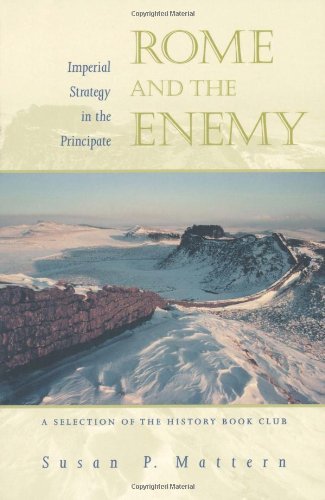
How did the Romans build and maintain one of the most powerful and stable empires in the history of the world? This illuminating book draws on the literature, especially the historiography, composed by the members of the elite who conducted Roman foreign affairs. From this evidence, Susan P. Mattern reevaluates the roots, motivations, and goals of Roman imperial foreign policy especially as that policy related to warfare. In a major reinterpretation of the sources, Rome and the Enemy shows that concepts of national honor, fierce competition for status, and revenge drove Roman foreign policy, and though different from the highly rationalizing strategies often attributed to the Romans, dictated patterns of response that remained consistent over centuries.Mattern reconstructs the world view of the Roman decision-makers, the emperors, and the elite from which they drew their advisers. She discusses Roman conceptions of geography, strategy, economics, and the influence of traditional Roman values on the conduct of military campaigns. She shows that these leaders were more strongly influenced by a traditional, stereotyped perception of the enemy and a drive to avenge insults to their national honor than by concepts of defensible borders. In fact, the desire to enforce an image of Roman power was a major policy goal behind many of their most brutal and aggressive campaigns.Rome and the Enemy provides a fascinating look into the Roman mind in addition to a compelling reexamination of Roman conceptions of warfare and national honor. The resulting picture creates a new understanding of Rome’s long mastery of the Mediterranean world.
User’s Reviews
Reviews from Amazon users which were colected at the time this book was published on the website:
⭐By the end of the second century AD, Rome held political sway over much of the civilized world. In some places, such as northern Britain or eastern Europe, the limits of the empire were clearly demarcated by defensive walls or natural boundaries like rivers. In most places, however, Roman authority simply stretched on amorphously into the distance. How did this far-flung, multifaceted, yet coherent empire come into being? Was there any logical policy that welded everything together? Specifically, what does classical literature tells us about Roman views on war and peace? That is the question that Susan Mattern seeks to answer in “Rome and the Enemy: Imperial Strategy in the Principate.”The Roman Empire may have been vast and complicated, but the Roman national security and foreign policy apparatus were not. There was no national security council for making strategic policy decisions; no intelligence agencies for assessing threats; there weren’t even reliable maps for understanding the geography of military theaters of operations. “They pictured a schematic, oval-shaped world, formed by zones of bitter frost and scorching heat, surrounded by the ancient, impassable ocean and inhabited at its edged by primitive, exotic, sometimes mythical people.” Those from the north were thought to be tougher and more belligerent, stereotyped in the literary sources as “nomadic, fierce, cruel, treacherous, disorganized in battle, drunken, greedy for plunder, lacking in discipline.” Meanwhile, those from milder climates were viewed as effete, docile, and more civilized. Beyond was terra incognita, an “outer limit…alien and unknown but within reach.”Mattern stresses that all decision-making authority was vested in one man, the emperor, who might rely on a select inner circle of friends when making critical decisions of war and peace. He personally directed an army of 28 legions numbering perhaps 150,000 well-trained soldiers with a similar number of auxiliary troops supplied by the empire’s allies. “The army of empire, then, was not especially large,” Mattern writes, “and warfare on two fronts posed a dangerous problem.” So what then was the emperor’s strategy for maintaining, and possibly growing, the empire with such limited resources, both manpower and imperial infrastructure? Mattern claims that for the Romans everything came down to image – “the image of the force it could wield and on its apparent willingness to use that force at whatever cost.” Thus, the author maintains, Roman policy worked mainly on a psychological level; “it was a strategy of deterrence by terror.”“As a state, Romans behaved like Homeric heroes, Mafia gangsters, or individuals in any society based on violent competition for honor and respect.” Deference from the enemy was a critical goal of Roman foreign policy. They held a close link between Roman dignity – or the appearance of greatness – and its security. “Any military defeat, breach of treaty, or revolt should be paid vigorously and aggressively with invasion, conquest, and humiliation,” she writes. Policy, therefore, was built around the need to repress what the Romans called “superbia,” arrogance or brazen effrontery by the enemy; to avenge “iniuriae,” any perceived injustice committed by the enemy; and above all the need to maintain “decus,” or what we may today call “saving face.” “It was on these things that, as they believed, their security depended; it was for these things that they fought.”Personal glory and fortune may also come from military conquest, but they were not sufficiently “just” causes for waging unprovoked wars of conquest. Mattern notes that the pace of conquest under the Principate slowed compared to that of the late Republic mainly because the emperor needed to control the prestige associated with victory. There could only be one major campaign at any one time because all military glory must redound to one man, the emperor. Greed and glory, therefore, were plausible, though not exactly respectable, causes for war. “[Roman] policy depended on perceived and acknowledged military superiority, on the terror and awe of the enemy; and if this imaged was challenged by invasion, defeat, or revolt, the Romans reasserted it with the maximum possible punishment and ferocity.”Mattern’s thesis tracks closely with that elucidated by Edward Luttwak in “The Grand Strategy of the Roman Empire: From the First Century A.D. to the Third,” particularly what he calls the first phase of empire, the Julio-Claudian system of “Client States and Mobile Armies” (from Augustus to Nero, 31BC to 68AD) that was marked by a thoughtful and rather nuanced economy of force in a hegemonic empire system.In closing, Mattern patches together a plausible story for how the Roman Empire of the first and second centuries was managed and defended. “Rome and the Enemy” is a short, but dense monograph that may be a bit too detailed for the typical lay reader. For anyone with a keen interest in the Roman Empire or in imperial strategy, however, it is “must read.”
⭐Mattern’s book is an argument that Roman imperial policy during the Principate was motivated primarily by Roman concepts of honor rather than modern geopolitical considerations such as profit or the need for defensible borders; she compares the Romans to gangsters, whose power depends on the perception of their ability and willingness to injure or kill their enemies. In defense of her thesis, Mattern discusses the limited geographical and economic, or financial, information available to the Romans and conducts an extensive review of the Romans’ own explanations of their military actions. However, Mattern does not really assess the reliability of her Roman sources. Although many people today view many modern countries’ justifications for their wars as inaccurate, and often as intentionally misleading, Mattern does not discuss at any length the possibility that the Roman writings about war that have survived to the modern day might be rationalizations, intentional or not. Nevertheless, her book is very interesting regardless of whether you are convinced by its thesis. A couple of smaller caveats: First, Mattern’s writing is very dry, even by academic standards. Second, perhaps because she is writing primarily for specialists, she assumes a full background in Roman history, and rarely provides any introductory information about the people and events she discusses.
⭐Mattern does an excellent job of revealing the complex reality in which the Romans evolved. Rome was born and developed in a world in which violent conflict was the norm. However, unlike its neighbors (and the Mediterranean world in general), it did not consider surrender an option. Instead, Rome fought until it forced a surrender from (or annihilated) its enemy, no matter how many years it took or how many lives were lost. If Rome surrendered, it would suffer an unbearable blow to its pride, and a surrender would lessen the fear of Rome in those it had conquered, which would invite rebellion. Where did this attitude originate and how did it become so inextricably woven into the Roman character? Historians continue to debate, but we will probably never know since its origins are in pre-history.
⭐Susan P. Mattern wrote a book that is well made, easy to read and has well supported ideas. She breaks down Imperial Strategy, not into where, who and how, but into why and what for. While other books focus on what the Romans are doing, she examines why they do it. She breaks it down into parts, dealing with how the army, the empire’s income and the Roman values shape and mold how they respond to threats and outsiders. The hardcover might scare you, but it only took me two days to read and for a person who has a basic knowledge of Roman History, the book should not be a problem.
⭐The edition of this book that I bought is copyrighted in 1999. I bought the book in 2000. I just read it the past 2 months late summer of 2017. I adopt the review provided by Marc and Susan Osborne in 2013. I agree with their critique of the book. Those two reviewer gave the book a 4 star rating.. I gave it a 3 because it was simply “dry,” and a challenge to stay awake at night while reading it. But , nonetheless it was worth reading because I learned that Rome did not have an overall geopolitical viewpoint in mind when making boarders or fighting wars or conquering territory.Furthermore, there was a difference in conduct between the leaders of Rome during Republican times and the Emperor’s during the time of the Principate. The question asked by the author–Was the imperialism of the Republic governed by the same rules of honor and vengence, insult and retaliation that were so prevalent in the Principate? [pg 212]
Keywords
Free Download Rome and the Enemy: Imperial Strategy in the Principate 1st Edition in PDF format
Rome and the Enemy: Imperial Strategy in the Principate 1st Edition PDF Free Download
Download Rome and the Enemy: Imperial Strategy in the Principate 1st Edition 1999 PDF Free
Rome and the Enemy: Imperial Strategy in the Principate 1st Edition 1999 PDF Free Download
Download Rome and the Enemy: Imperial Strategy in the Principate 1st Edition PDF
Free Download Ebook Rome and the Enemy: Imperial Strategy in the Principate 1st Edition