

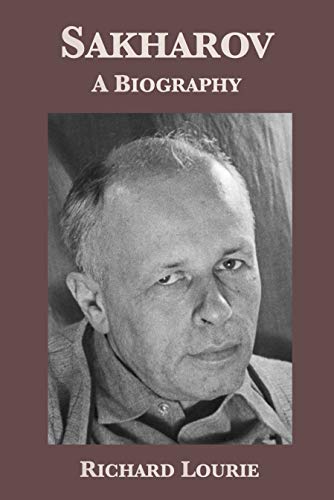
Ebook Info
- Published: 2018
- Number of pages: 366 pages
- Format: PDF
- File Size: 87.80 MB
- Authors: Richard Lourie
Description
Seemingly shy, Andrei Sakharov was in fact a man of three great passions. His passion for physics ultimately lead him to create the Soviet H-Bomb, making the USSR a super power. But he rejected all the position and prestige his inventions had brought him in the name of a greater passion — for justice. And yielding nothing to these two passions was his passion for human rights activist Elena Bonner, their love story one of the great romances of our time.This book tells the story of the man, his passions, and the time and place where they all played out.“As Richard Lourie’s new, subtle and revealing biography of Sakharov demonstrates… [Sakharov] ranks with Nelson Mandela as a person who helped guide his country to democracy, changing himself in the process. One of the strengths of Lourie’s biography is his description and analysis of how this transition occurred… a fascinating account of Sakharov… [Lourie’s] analysis of [Sakharov’s] complicated political journey seems authentic and immensely revealing.” — Loren Graham, The New York Times“A vivid portrait of [Sakharov,] this moral and intellectual giant… Lourie has written a highly intelligent and exceptionally readable book. He not only captures his protagonist admirably but exhibits a fine feel for the social and political backdrop as well as for the peculiar mixture of fearful servility and courageous generosity of the Russian people. Among other things, he vividly brings to life how the Communist regime constrained scientists, sometimes even arresting and murdering them, while those who survived persevered in their work to achieve remarkable results.” — Aleksa Djilas, Commentary Magazine“Lourie does full justice to a life that could not be more engrossing.” — Robert Legvold, Foreign Affairs“Richard Lourie is ideally placed to write the first full biography of this remarkable man. He was able to interview Sakharov and many of his colleagues. He has translated Sakharov’s memoirs, and often uses direct speech drawn from them to take us behind the scenes without giving rise to the usual suspicion of novelistic invention. This makes for an engagingly readable book… Lourie’s appraisal of Sakharov as a man is scrupulously balanced, with as much emphasis on his obstinacy as on his compassion… The book conveys both the elation of scientific work, the intense love between Sakharov and his second wife, and the bewildering nature of human courage.” — Elaine Feinstein, The Telegraph“A solid factual and interpretive study… Sakharov is an important account of one scientist’s courage and his quest for a humane world at peace.” — Herbert Mitgang, Chicago Tribune“The inventor of the Soviet H-bomb, [Sakharov] was in the forefront of the post-war breakthrough in thermonuclear physics that led to the creation of atomic energy. Yet he also stood, heroically at times, in the vanguard of the movement for human rights in the Soviet Union. Richard Lourie tells both these stories in this first full-length biography of the physicist and dissident. Lourie has benefited from the recent publication of the KGB files on Sakharov. He also knew the man himself, whose Memoirs he helped to smuggle out of Russia to the West (where they were published in Lourie’s translation a year after Sakharov’s death in 1989). Sakharov’s widow, Elena Bonner, has helped Lourie’s research, which adds a welcome new perspective on the last 20 years of his eventful life, when husband and wife were subjected to a bullying campaign of threats and slander by the KGB in a vain attempt to silence them.” — Orlando Figes, The Telegraph
User’s Reviews
Reviews from Amazon users which were colected at the time this book was published on the website:
⭐This is a fascinating biography of one of Russia’s best physicist, Andrei Sakharov, and his relation to the communist state of the USSR. Sakharov was a precocious youngster and went on to be instrumental in building Russia’s atomic bomb. He also became an opponent of the state but unlike the millions of people the state simply liquidated, his name was too well known to just get rid of. Instead, they bugged his whole life and subjected him to years of internal exile.Sakharov’s life was long and filled with seemingly limitless achievements and noteworthy events and his relationship with both his first wife and second wife (after first passed) were portrayed as something special. The true value of this book though is its portrayal of the horrendous conditions of communist totalitarian states and the truly evil people who rise to the top of those power structures. It is hard to fathom that communist or Bernie Sanders type leftism is coming back into fashion.Sakharov is often compared to Solzhenistyn and this book covers their relationship, which is somewhat interesting, but the two of them just seemed o travel on different wavelengths and never fit well together. Unfortunately neither of them defend liberty on the proper grounds, but both of them show enormous amounts of courage, standing up against 1984 style dictatorships, and their stories should be spread as much as possible. I highly recommend learning about the story of Sakharov and reading this book. And if you’re interested in the proper defense of liberty, it just so happens that it also comes from a contemporary Russian dissident- Ayn Rand.
⭐Nadezhda Mandelstam once wrote that “a person with inner freedom, memory, and fear is that reed, that twig that changes the direction of a rushing river.” Andrei Sakharov, scientist and father of the Soviet H-bomb, was such a twig, a twig that helped changed the course of Soviet and Russian history.How does a man evolve from being a relatively apolitical nuclear physicist in the 1940s to being the moral conscience of a nation striving for democracy by the time of his death in 1989? How does a man who was offered and provided all the material comforts available to the preeminent scientist in the USSR turn away from those temptations and choose, instead, to stand a lonely vigil outside kangaroo courts intent on hounding dissidents who dared to speak out against the Soviet regime?Lourie’s marvelous biography of Sakharov does a fine job of setting out both how and why Sakharov evolved from a hero of the USSR with direct telephone access to the Kremlin into a pariah who was hounded, slandered, and finally sent into internal exile in the closed city of Gorky. Yet, by the end of his life, Sakharov, this mere twig, managed to face down and indeed outlast those that set the political might of a nation against him.Lourie comes to Sakharov with an impressive background in Russian and Soviet history and literature. He has translated numerous works of fiction, including works by Vladimir Voinovich, and also translated Sakharov’s Memoirs. (The tragic story of the destruction of numerous drafts of Sakharov’s Memoirs by the KGB is set out in detail in Lourie’s biography.)Sakharov is set out in a straightforward, chronological fashion. It begins with Sakharov’s family background and his childhood and early adult years. Lourie moves relatively quickly through Sakharov’s birth in 1921 and his childhood and teen years. Sakharov , along with his families supported the Soviet regime. Dissent was not an issue for them. Sakharov always considered himself a loyal patriot devoted to the Soviet Union. Lourie sets out in detail Sakharov’s early interest in math and the sciences and his academic development. By the time World War II had started it was clear that Sakharov would have a career in the sciences.After the German invasion of Russia, Sakharov quickly found work in the area of munitions. It was here that Sakharov had his first run-ins with authority. Unlike many of his colleagues who was willing to brook interference from unknowing Commissars. Fortunately for Sakharov his suggestions and mechanical innovations were critical in aiding the Soviet war effort and he was allowed far greater flexibility in his approach to work and science than many of his peers.Lourie then traces the path that took Sakharov from improving the quality of tank shells and munitions to being the lead scientist in charge of the development of the Soviet atomic and H-bombs. Here Sakharov crossed paths with Stalin, Beria, and most of the other leaders of his time. It is clear that Sakharov would not have survived a failure. Sakharov was committed to the project and believed developing these weapons were in the best interests of Russia. The projects were successful and Sakharov became something of a national hero. It is here that Sakharov’s life began to change.He was provided almost unheard of access to the Soviet leadership. He had direct phone lines to the Kremlin. Gradually, Lourie shows Sakharov repeatedly refusing membership in the Communist Party. He also began taking up the causes of his fellow scientists who were treated unfairly by the apparatchiks that dominated all areas of life. He didn’t hesitate to pick up the phone and complain to KhrushchevAs Sakharov grew increasingly distanced from the Soviet regime, the regime grew increasingly intolerant of Sakharov’s actions. Sakharov’s dissidence evolved from one focusing on small issues to issues of internal democracy and global peace. It is clear that if Sakharov did not possess a vast array of nuclear secrets he would have been subject to the exile in the same manner as Alexandr Solzhenitsyn and Vladimir Voinovich. At the same time, Sakharov was awarded the Nobel Peace Price. The Soviet authorities were as put off by this award as the award of the Nobel Prize for Literature to Boris Pasternak. The authorities finally did exile, but to the closed city of Gorky. There he was harassed and harried on a daily basis.It should be pointed out that Sakharov became famous throughout the world for his dissident activities. However, Lourie’s examination of Sakharov focuses almost exclusively on Sakharov from an internal, domestic view point. I believe this was a wise choice as the West actually knew very little of what Sakharov actually was going through during those years.Lourie’s Sakharov is not an exercise in pure idolatry however. Lourie does not fail to note the lack of warmth, in fact the animosity, between Sakharov and his children from his first marriage (his first wife died after over 20 years of marriage) once he met and married Elena Bonner.Sakharov was, of course, a scientist and Lourie had to address certain scientific concepts and issues throughout the course of the book. His treatment was precise yet understandable to the lay reader.Lourie’s writing is precise and to the point. He lets Sakharov’s actions speak for themselves and does not engage in an excessive amount of self-indulgent psycho-analysis of Sakharov. Lourie treats his readers as adults and he allows the reader the opportunity to read the story of Sakharov’s life in a manner that allows us to ponder exactly how any man can become a twig that changes the course of history.This is a book worth reading.
⭐I read this book slowly. The author has gathered a lot of details and his interest in Russia is the main context in which the subject is considered. With the emphasis in this book on how extraordinary the Communist regime of the Soviet Union had been in ruthlessness even before it had the opportunity to acquire atomic weapons, I was afraid that its approach to what I was really interested in would be too tame and toothless for my taste. More than most nuclear scientists, Andrei Sakharov has been recognized as a great dissident. Many thought that this was some kind of folly. “In a joke of the time a dog explains glasnost: `The chain is longer, the food is still far away, but you can bark all you want.'” (p. 373). Jokes were a major feature of the situation. There is a paragraph early in the book, about a mannerism of a great Russian poet, who announced his appreciation for the best of his own work with the words, “`O Pushkin, you . . . !’ At moments of insight, rubbing his hands in delight, Sakharov would repeat those words aloud.” (p. 48) The big joke about Pushkin was most appropriate a hundred years after his death, after the official Pushkin Year of 1937, when a few people still had the nerve to say: “If Pushkin had lived in our times, he still would have died in ’37.” (p. 46). Sakharov grew up in tough times, but his sense of reality grew in proportion to the responsibilities which he assumed. When he was picked on in a personal manner, and he felt that the Soviet system reacted in a way that seemed inappropriate to him personally, he was capable of exhibiting his own toughness. When Tatiana, Bonner’s daughter, was expelled from Moscow University, he was capable of losing the restraint with which people are expected to submit to those who sit in positions of authority. Poor Ivan Petrovsky, rector of Moscow University. “Sakharov lost his temper and pounded the table twice with his fist. Later that day Petrovsky dropped dead from a heart attack, and in some quarters, including the Academy, Sakharov was considered complicit in Petrovsky’s death.” (p. 248). Joseph Shklovsky, author of FIVE BILLION VODKA BOTTLES TO THE MOON, considered himself a leader “because of his mastery of cursing, an art he had learned as a construction foreman.” (p. 59). Reporting on a month which Sakharov and Shklovsky spent on a train fleeing Moscow as students during World War II, Shklovsky reported, “One day he asked me a preposterous favor: `Do you have anything I can read on physics?’ . . . My first impulse was to send this mama’s boy and his ridiculous request straight to hell.” (p. 59). Years later, concerning Petrovsky, Shklovsky said, “I can’t forgive Andrei Sakharov for the sharp rebuke he delivered to the poor rector.” (p. 248).Since Sakharov was seeking convergence with the rest of the world more than anything else, it made sense for him to go see everyone “From Margaret Thatcher to Daniel Ellsberg” (p. 360) when he had the chance. He even “had half an hour alone with Edward Teller before a formal banquet honoring Teller on his birthday.” (p. 375) Later he convinced Solzhenitsyn’s wife to call Solzhenitsyn to a phone in Cavendish, Vermont so that “there should be nothing left unsaid between us.” (p. 376). With Elena, he met “both the head of the Italian Socialist Party and the pope. And, in an event that captures the flavor of that year of wonders, Sakharov and the pope discussed perestroika in the Vatican.” (p. 379).He finally met Gorbachev on January 15, 1988, (p. 366) and the two found themselves in an interesting political situation. After elections on March 26, 1989, Sakharov was to represent the Academy of Sciences in the First Congress of People’s Deputies on May 25. “Yeltsin won Sakharov’s admiration when he demanded live television coverage of the congress.” (p. 381). Gorbachev had a committee to draft a new constitution approved “when someone noticed all its members were communists.” (p. 384). Sakharov was added to the committee and became the major opponent of Article 6 of the constitution, which gave the Communist Party a monopoly on power. Open debate was new to those who had been involved in officially secret proceedings, and Sakharov found himself involved in arguments in which Gorbachev said, “I’m against running around like a chicken with its head cut off.” (p. 385). When the fight turned to Afghanistan, Sakharov had said things which rankled the usual superpower thinking on the Soviet side, and continued to insist, “The real issue is that the war in Afghanistan was itself a crime, an illegal adventure, and we don’t know who was responsible for it.” (p. 386). There were shouts in opposition to his views, but polls for the best deputy “showed Sakharov number one, Yeltsin two, and Gorbachev seventeenth.” (p. 386). When he died, a “crowd of fifty thousand” came to his funeral. (p. 401).
Keywords
Free Download Sakharov: A Biography in PDF format
Sakharov: A Biography PDF Free Download
Download Sakharov: A Biography 2018 PDF Free
Sakharov: A Biography 2018 PDF Free Download
Download Sakharov: A Biography PDF
Free Download Ebook Sakharov: A Biography