

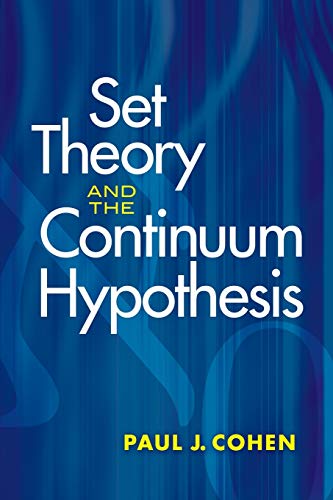
Ebook Info
- Published: 2008
- Number of pages: 190 pages
- Format: PDF
- File Size: 1.48 MB
- Authors: Paul J. Cohen
Description
This exploration of a notorious mathematical problem is the work of the man who discovered the solution. The independence of the continuum hypothesis is the focus of this study by Paul J. Cohen. It presents not only an accessible technical explanation of the author’s landmark proof but also a fine introduction to mathematical logic. An emeritus professor of mathematics at Stanford University, Dr. Cohen won two of the most prestigious awards in mathematics: in 1964, he was awarded the American Mathematical Society’s Bôcher Prize for analysis; and in 1966, he received the Fields Medal for Logic. In this volume, the distinguished mathematician offers an exposition of set theory and the continuum hypothesis that employs intuitive explanations as well as detailed proofs. The self-contained treatment includes background material in logic and axiomatic set theory as well as an account of Kurt Gödel’s proof of the consistency of the continuum hypothesis. An invaluable reference book for mathematicians and mathematical theorists, this text is suitable for graduate and postgraduate students and is rich with hints and ideas that will lead readers to further work in mathematical logic.
User’s Reviews
Editorial Reviews: About the Author A renowned mathematician, professor, and theorist, the late Paul J. Cohen won two of the most prestigious awards in mathematics: the American Mathematical Society’s Bôcher Prize in 1964, for analysis; and the Fields Medal, the “Nobel Prize” of mathematics, in 1966, for logic.
Reviews from Amazon users which were colected at the time this book was published on the website:
⭐As a work of science, “Set Theory and the Continuum Hypothesis” stands on a par with Darwin’s “On the Origin of Species”. First, like Darwin’s book, Cohen’s work is a profound contribution to its field; second it is also accessible to any educated and interested reader, although with some effort.This edition is a reproduction of the first edition. You might be shocked by the type-this is a plain, typewritten document with no illustrations (I find it charming)-but Paul Cohen’s crystal clear prose makes the book eminently readable.=WHAT YOU NEED=This is a graduate level book but you don’t need to be a graduate student in mathematics to understand it. You do need a laymen’s interest in mathematics; for instance you should enjoy reading Euclid, Ian Stewart, Douglas Hoftstadter, Martin Gardner. If you’ve enjoyed Douglas Hofstadter’s “Gödel, Escher, and Bach” then there is no reason you can’t understand this book.=WHAT IT DELIVERS=First, Cohen gives a barebones but complete introduction to formal logic and logical notation.Then he describes formal set theory, known as Zemerlo Frankel set theory, the foundation of all mathematics as it stands today.Having spent half the book on the necessary background, Cohen arrives to his main topic, the Continuum Hypothesis and whether it is true or false.=WHAT COHEN SAYS=ST&CH proves that a long standing problem in mathematics (the Continuum Hypothesis) has no solution. What does this mean?Most mathematicians believe in a scaled down version of Hilbert’s Programme. Hilbert hoped that all of mathematics followed from a small collection of definitions and axioms, much like all of geometry was once believed to follow from Euclid’s five axioms. Formal set theory, as defined by Zemerlo and Frankel, seemed to provide all the axioms needed for this task. However Kurt Gödel proved that the programme is impossible to realize: any formal system will have propositions that are possible to state but impossible to prove. In other words, no set of axioms can completely define all of mathematics.Paul Cohen proved that the Continuum Hypothesis is one such statement. But what is this hypothesis? It’s about cardinal numbers. A cardinal is a property of a set; specifically it says how many elements there are in a set. For example, the cardinal for the set of all positive odd integers smaller than ten is five because the set {1, 3, 5, 7, 9} has five elements in it.What about infinite sets? The simplest infinite set we know is the set of Natural Numbers, call it N, and N={1,2,3, …} . N has an infinite number of elements. What about if we add zero as an element and call the new set N*? Do we get a bigger set? In one way, N* is “bigger” than N because it has all the elements N has but it also has an extra element, “0”. But that’s not the right way to think about big or small when we talking about sets. We want to know if the cardinal of N* is bigger than the cardinal of N. It isn’t.It’s easy to see this. Let’s create a new set made up of all the possible ways of writing words with the letter “a” and call this set A. Well, obviously A={a, aa, aaa, aaaa, aaaa, ….}. Now it’s obvious that A does not contain N or N*, and vice versa. But can we say A is smaller than or bigger than or the same size as N or N*? Yes we can. Let’s start with the natural numbers N. We can say 1 is the first element of N, that 2 is the second element of N, that 3 is the third, and so on. Likewise, we can say a is the first element of A, aa is the second element of A, aaa, is the third, and so on.Now, bear with me here. We can also say that 0 is the first element of N*, 1 is the second element of N*, 2 is the third element of N*, and so on. So A, N, and N* seem to all have an infinite number of elements that can all be listed, or put in a one-to-one correspondence with each other. They are of the same size, they have the same cardinal, and we call that cardinal number Aleph Null (א is a Hebrew letter). We also say that sets with cardinal Aleph Null are countable, because we can count all their elements one after the other.The set of positive and negative whole numbers, Z, is also countable. We think of Z={…, -2, -1, 0, 1, 2, 3,…} but we can also write Z={0, 1,-1, 2, -2, 3, -3,…} and it’s now easy to see that Z is countable. Surprisingly, the set of all rational numbers (Q, the set of all fractions and whole numbers) is also countable. A rational number is a ratio of two whole numbers, a/b where b is never 0. We can certainly list all pairs of whole numbers in a set called P={(0,1), (1,1), (0,-1), (1,-1),(-1,1), (-1, -1), (0,2),(1,2),(2,2),(-1,2),…}. Since many of these pairs reduce to the same thing, for example (1,2) and (2,4) are both the same as 0.5, Q is a subset of P. So if P is countable, Q is countable.But what about other numbers? The set of real numbers, called R, is the set of all numbers that can be represented by a point on a line. All the rational numbers (Q) can be represented by a point on a line, but there are many numbers on the line that are not rational. The square root of two or Pi are two famous examples. Are all the numbers on the line countable? It turns out that they are NOT countable. No matter how you list them, you will always find a number that cannot fit anywhere in the list you made. The set R is not countable, so we say it is uncountable.It is in this sense that we say the set of Real Numbers is bigger than the set of Natural Numbers. We say that the cardinal of R is Aleph One. The Continuum Hypothesis states that there are no cardinals between Aleph Null and Aleph One; that there is no such thing as a set that is bigger than the Natural Numbers but smaller than the Real Numbers.We owe the above discoveries to a nineteenth century German mathematician named Georg Cantor. He first stated the Continuum Hypothesis and he spent years trying unsuccessfully to prove it. In the 1930s, Kurt Gödel proved that if you assumed that the Hypothesis was true, you did not contradict formal set theory.In 1964 Paul Cohen proved that if you assumed the Hypothesis was false, you did not contradict formal set theory either. And so he shows that in the context of set theory the Continuum Hypothesis is unprovable.What is now the way forward? Cohen thinks that one day we will feel the Hypothesis is obviously false. (He underlines the word “obviously”.) This means that set theory will have to be perfected, perhaps by adding a single simple axiom that is “obvious” and that results, as a consequence, in a proof that the Hypothesis is false. But with the same humility we find in Darwin, he leaves the problem for future generations to solve.Vincent Poirier, Montreal
⭐We used to think that if we could prove something existed with symbols, words, or diagrams, that it must exist. However, Cohen and Godel challenge this notion, in a similar way to Whitehead and Russel regarding the completeness of logic and math. By using logic, language, and symbolic logic, Cohen shows that our feeble attempts to prove the continuum exists will have to depend on scientific experiment and contact. This is similar to the problems encountered in modern cosmology. Without a star ship to allow us to boldly go, we cannot verify the existence of many of the images we see through our telescopes, and detectors. Observation from afar can only be supported by assumptions that allow us to educatedly guess whats our there, and how far away it is. But we really need to get out in space, find out how warped space is by gravity, and so on. . .This is a challenge to us all. We can no more prove the continuum exists than we can prove that god or the devil exists.
⭐Paul Cohen’s “Set Theory and the Continuum Hypothesis” is not only the best technical treatment of his solution to the most notorious unsolved problem in mathematics, it is the best introduction to mathematical logic (though Manin’s “A Course in Mathematical Logic” is also remarkably excellent and is the first book to read after this one).Although it is only 154 pages, it is remarkably wide-ranging, and has held up very well in the 37 years since it was first published. Cohen is a very good mathematical writer and his arrangement of the material is irreproachable. All the arguments are well-motivated, the number of details left to the reader is not too large, and everything is set in a clear philosophical context. The book is completely self-contained and is rich with hints and ideas that will lead the reader to further work in mathematical logic.It is one of my two favorite math books (the other being Conway’s “On Numbers and Games”). My copy is falling apart from extreme overuse.
⭐This has been one of my favorite books over the years. Copies were hard to get. There was one at a library near my former workplace, which, unintuitively enough, was an Army post; I am not sure how c = aleph_1 applies to Army logistics. I checked it out and read sections of this book. When I retired in 2005, I still had the book and renewed it by email. Eventually the Army wanted it back, so I mailed it back, and so I no longer had the book. I am glad to see, then, that Dover reprinted the book, and so once again I have it. It is a classic work. In it Cohen presents his proof that c = aleph_1 cannot be proved in normal (ZFC) set theory, by introducing a technique he calls “forcing”. He also explains many other parts of set theory as well.
⭐This explains one of the most important theorems in set theory. It is indispensable in advanced mathematics
⭐The mathematics content deserves a 6 star rating. It was a good surprise to find in this classic of Cohen such a fine exposition, clear and magnificently structured… The poor rating of 2 stars I’m giving it’s due to the appalling editing and formating: Amazon should actually be sued for selling a book on mathematics like this. Displayed formulas come in a small type and light gray almost impossible to read, since it doesn’t respond to the enlargement option (I had to use a magnifying lens) and the mistakes are too many, with formulas placed at wrong places, maths symbols transformed into strange combination of characters in the main text (as Pi_i in a displayed list of formulas, which became a few lines down &8;i as if the editing had been done by someone who doesn’t know any mathematics… Since the exposition is so good it was always possible to spot the errors and made for them, but it will not be the case in other maths books, where unsolvable confusion may be given to the reader…
⭐Too many typing errors causing difficulty reading, got confused by a smudge at the bottom of page 29; (let d=max{n,m}!) and for ages thought I had lost the ability to count and because of earlier typing errors spent hours finding contradictions with special cases. It is in fact a factorial sign and the lemma is only about existence to prove another Lemma.The typeset is difficult to read, Paul Cohen just casually uses words like Interpretation that have mathematical meaning and the typeset makes it too easy to miss important distinctions, so much so I downloaded a summer course in logic to find that a model includes an interpretation, but this uses Gothic letters and strange symbols so different I don’t want to get bogged down by it.The reason I bought the book is because I’ve written a theorem using naive set theory loosely following ZF or even ZFC that seems to contradict Paul Cohen’s Field’s medal winning work and thus must be wrong, but I can’t see what’s wrong with it and since nobody can be bothered to even read it thought I better find out about set forcing and find out for myself.Normally the works of genius such as a lecture by Alonzo Church are stimulating but this is a very hard read and made much harder than need be by the typeset.
⭐This is an excellent introduction to the notion of Forcing from, as it were, the horse’s mouth. Cohen is, however, something of an unreconstructed non-constructivist, and so does not seem to take the Intuitionist view all that seriously. Basically, he has no problem with completed infinities and so embraces the whole menagerie of large cardinals that ultimately flow from this standpoint. So if the whole idea of the Continuum as it stands gives you a bit of a philosophical itch in a place you can’t quite reach, this book won’t help you scratch it. It is, however, in it’s own way, fascinating.
⭐As for the content of this book, there is little to say. It is the original book by Cohen.However, I write this review just to warn that it is in a ‘typewriter’ font, which makes it very unpleasant on the eye and difficult to read.
⭐Texto com profundidade adequada, sem ser extremamente teórico mas não deixando de apresentar os aspectos importantes da teoria. boa leitura.As you can see from other reviews, Paul Cohen’s “Set Theory and the Continuum Hypothesis” is a masterpiece. Cohen was an American mathematician working in analysis, number theory and set theory. As a college student he was not particularly attracted to set theory because it seemed too vague and philosophical for his taste. Soon enough, however, he met Kurt Godel and decided to answer a very difficult question: is there a transfinite cardinal between aleph-naught and aleph-one? This book demonstrates how the answer to the problem was obtained by the genius of Paul Cohen. The book starts with the basics of set theory, then there is a discussion of ZF theorems, after which there is a chapter on the consistency of CH, finally followed by his infamous forcing concept. The language of the book is very clear, Cohen was no fan of the bombast so typical of most contemporary mathematical texts. The book is lucid and self-contained, but do not be deceived by the other reviewers. The text is graduate-level. If you are a newcomer to the field, you will not get far beyond page 1. I, for my part, have read 3 volumes of Russell’s “Principia”, Cantor’s, Godel’s and even Alain Badiou’s writings, so this stuff was pretty doable for me, and the book assumes mastery of Godel’s Incompleteness Theorem, ZF set theory and Cantor’s aleph notation. The book is of course FIVE STARS. P.S Even if you will not understand it at least you will make you math prof feel stupid!
Keywords
Free Download Set Theory and the Continuum Hypothesis (Dover Books on Mathematics) in PDF format
Set Theory and the Continuum Hypothesis (Dover Books on Mathematics) PDF Free Download
Download Set Theory and the Continuum Hypothesis (Dover Books on Mathematics) 2008 PDF Free
Set Theory and the Continuum Hypothesis (Dover Books on Mathematics) 2008 PDF Free Download
Download Set Theory and the Continuum Hypothesis (Dover Books on Mathematics) PDF
Free Download Ebook Set Theory and the Continuum Hypothesis (Dover Books on Mathematics)