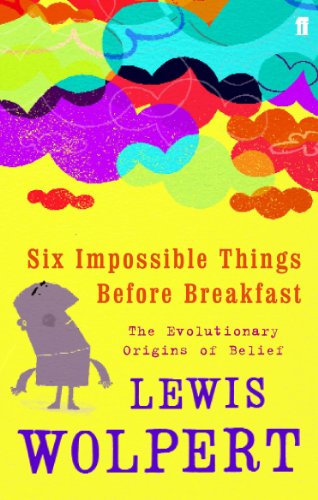
Ebook Info
- Published: 2011
- Number of pages: 260 pages
- Format: PDF
- File Size: 1.22 MB
- Authors: Lewis Wolpert
Description
Why does every society around the world have a religious tradition of some sort? Professor Lewis Wolpert investigates the nature of belief and its causes. He looks at belief’s psychological basis and its possible evolutionary origins in physical cause and effect. Wolpert explores the different types of belief – including that of animals, of children, of the religious, and of those suffering from psychiatric disorders. And he asks whether it is possible to live without belief at all, or whether it is a necessary component of a functioning society.
User’s Reviews
Reviews from Amazon users which were colected at the time this book was published on the website:
⭐A fascinating account about how fragile our believe system and therefore our reality is. It becomes clear how the fundamental need to make sense of our world through our believe system has left us open to the abuse of power throughout history. The role of tools is somewhat tenuous.
⭐In this book Lewis Wolpert tackles the nature of belief. An English biology professor explores belief’s psychological basis and its possible evolutionary origins in physical cause and effect.Motivated by his youngest son’s conversion to a fundamentalist Christian Church began an exploration of the scientific basis for people’s belief about causal beliefs.Wolpert argues all human belief stems an understanding of cause and effect. Deftly argued cogently written, he argues that although religious and mystical beliefs give comfort and meaning to life, science is the best way of understanding how the world works. Yet, he stops short of providing an explanation for the questions science cannot answer. To me, those answers are only found in religion.He states we have to both respect the beliefs of others and accept the responsibility to change to try to change them if they are improbable. I agree. In my mind, science reveals the beauty and complexity with which the world was created. Yet, its Big Bang theory – in which Wolpert professes belief – provides a fragmentary, incomplete answer.The freedom to reach and hold beliefs is vital to me and society. Yet it carries with it the responsibility to examine their origins and foundations. I disagree with Wolpert’s conclusions, but I was challenged, informed and entertained by reading his book.
⭐I bought this book because I was interested in the sub-title. It would seem to me there must be an evolutionary basis for belief, otherwise there would be no belief. Which I have noticed lately is a Darwinist tendency, to attribute everything that animals(or plants) do to evolutionary tendencies. Which is correct, in my opinion, but makes it hard to discuss with religious people as we disagree at the very basis of our discussion. I am continually astounded at how many people I know actually believe the world is 6000 years old in the face of overwhelming evidence that belief is incorrect. Which helps to explain Bush as president. But, I digress.What separates Science from Religion is that Science is based on data that can be tested to be proven true or false. Science constantly questions itself and encourages others to attempt to prove it wrong. Good science anyway. Religion does just the opposite-discourages questioning or testing and encourages acceptance of authority as proof. This book, while I tend to believe what it is saying, does not attempt to prove any of its assertions. Where are the end-notes quoting studies proving his points? This book reminds me of Religion as it expects us to believe statements made with no basis for the statements stated. Which, seems to me, to invalidate the argument and do more harm than good to the thesis.But I could be missing something.If the author made the assertions to encourage research and investigation, then I sort of get it. But I think research and investigation should come before the book, not after it.All that being said, it introduced to me some ideas I had not considered before and was worth the price of admission.
⭐This book is rather a chore to read. Part of the problem is that Wolpert is just not a very good writer. He has an unfortunate habit of stating the blindingly obvious (for ex., he informs us that “it is a serious evolutionary disadvantage to be ill”, and that “the moral and ethical beliefs that determine people’s actions in their social interactions are of great importance”). He all too often writes at a level more appropriate to a sixth grader (consider this gem describing the nature of science: “There are also complex instruments that are used to make all sorts of measurements.”). And Wolpert also is one of the worst overusers of “weasel word” qualifiers in his sentences that I have seen (“can be,” “sometimes”, “often”, etc.). But the deeper problem is that Wolpert does not seem to be a very clear thinker. The ideas drift around in this book almost aimlessly; one paragraph shifts to another with no apparent connection, and there is no clear thread of argument. Many of the assertions are so vague and open-ended as to be almost useless: e.g. “Religious concepts can be used by people when there is a need for them.” His basic thesis is itself quite remarkable: that religion and the paranormal (which he lumps together) are the result of a mechanistic “belief engine” which grows out of the unique human ability to make tools (yes, that’s correct: religion is an outgrowth of making stone axes & spears!). In contrast, science is “special,” a genuine search for truth based on real evidence and so is wholly “unnatural” (and of course, a product of free choice rather than deterministic genetic programming as religion is). As he himself admits, this is pure speculation in any case, and there is no evidence to support his claim. Nor does it seem very plausible. In his model of the mind, all humans have always been naturally irrational, deluded, and self-deceiving — at least until the invention of science in the 17th century, when the elite were able to become clear thinking rational truth-seekers. But is it really likely that evolution gave us a natural propensity to delusion and irrationality, which a tiny handful of us finally overcame only a few centuries ago? Moreover this violates the continuity thesis that Wolpert accepts: that nature does not create something out of nothing. Far more likely that science is continuous with common sense and ordinary rationality, in contrast to Wolpert’s extreme and implausible dichotomy between the scientist (like himself!) who is a paragon of rationality, versus the rest of the unwashed masses who are a bunch of deluded fools. Ironically, this book if anything undercuts that dichotomy. Wolpert himself is not very interested in deep thinking about science, and dismisses the entire field of philosophy of science in less than a page. The book is also full of misunderstandings and mistakes about religion. Mostly this book is just a rehash of familiar lists of the various bizarre things people have believed over the centuries, tied together with a dubious and barely-defended speculation about tool-making modules in the brain as the source of all religion and superstition.
⭐In this book, developmental biologist Lewis Wolpert investigates the origin of human belief, apparently in a quest to understand religiosity and science denialism. The central thesis of the book follows the central thesis that beliefs arose from the human ability to understand cause and effect, which evolved with the ability to make complex tools. The book first provides an overview of how cause-effect thinking in humans differs from other animals and how it develops in early childhood. Wolpert then discusses the link between cause-effect thinking and beliefs. The argument here is that belief is not irrational. It arises either from the tendency to maintain cognitive coherence or from a lack of better causal explanations.It has to be noted that the book is quite dense. It is very academic and does not adopt the more jovial tone that is more common in most current science books for general audiences. However, the effort to read it is well worth it. I gained many insights from reading it. The book is very well researched and provides an excellent overview of the key texts on the evolution of causal beliefs for anyone who wants to dive deeper into the topic.
⭐This book was a real disappointment.It seems a potentially fascinating subject, and I generally have a high tolerance for technically complex ideas. However it fails to be engaging, and while I can (slowly, but surely!) plough my way through books on quantum theory and epigenetics, this just bored me silly. I get the impression, from the “personalisation” of the subject matter and the fact that it’s not especially in depth, that this is intended as popular science, but it reads more like an academic paper. Basically, it falls between two stools, and is neither a light, engaging read for the dilletante, nor a rigorous, academic but potentially engrossing work.Premise wonderful: excecution poor.
⭐Have been asked to rate this but to tell the truth I didn’t even remember that I had it. I wonder if that means it didn’t grab me in the first chapter!
⭐I liked the first half of the book enormously, but my enthusiasm reduced a little as I read on. I ended up with some criticisms. On the whole, I think it is good, but it could have been a lot better.The title of the book is a direct quotation from Lewis Carroll:”Alice laughed: “There’s no use trying,” she said; “one can’t believe impossible things.””I daresay you haven’t had much practice,” said the Queen. “When I was younger, I always did it for half an hour a day. Why, sometimes I’ve believed as many as six impossible things before breakfast.”One of my minor disappointments was that Wolpert doesn’t draw enough attention to the perversity of this “six impossible things” comment. Carroll makes his White Queen proud of believing impossible things and that is a feature of many passionate believers. “Any fool,” says the fundamentalist “can believe things that are possible, but it takes hard work and talent to believe the impossible.”In discussing human beliefs Wolpert makes too little of the fact that many systems of belief seem to praise and honour adherents who are passionate in their belief of impossible things. This applies most of all to political and religious systems.The devotion to Big Brother expected of the citizens in 1984 is a marvellous example of this zealotry. We might assume that the man at the top is free of the delusion he requires of the junior ranks. And yet, in 1984, it seems possible that O’Brien really is a true believer at heart. The massive irony is that his job includes fabricating the lies that other citizens have to believe.And it does not happen only in fiction. The Catholic Church, the Stalinist state, the world of advertising, spin and PR are all examples of situations in which zealous belief is sometimes valued, apparently, at the expense of sanity.And another thing: earlier on the White Queen has said to Alice: “I wish I could manage to be glad! Only I never can remember the rule.” And maybe that is a key thing for belief – beliefs make us glad.(I am inordinately fond of Alice – perhaps Dodgson was too – and I feel many of the White Queen’s words, though quite mad, have enormous depths.)I wish Wolpert had put more effort into exploring the reasons for rationality being so vulnerable in human culture. Even more, I wanted to hear any ideas he had on reducing that vulnerability.However, that’s just a peeve. There was a lot I liked about the book. It brings together a lot of ideas, many based on research results and summarises them well. It describes the implications of a whole range of work, most of it recent. Many of the experiments are subtle and clever. The progress made in the twentieth century was huge on several fronts.It is an honest and open book. He explains his own position – atheist Jewish scientist – and freely admits that some of his idea may be prejudiced by his personal biases and beliefs. To that extent, he is humble.Many of the ideas he presents are ideas I can readily agree with. The general thrust of his thinking is, for me, both exciting and convincing.It is easy to read and assimilate, despite the fact that the ideas come from a huge range of sources and disciplines. Also, some of the ideas are intrinsically difficult and complicated, yet he explains them carefully and fluently.It is well worth reading, especially if your interests are wide. Perhaps it is a book for Alice in Wander Land, a book for those who wander, rather than just going where authority tells them. And not everyone who wanders is lost.
Keywords
Free Download Six Impossible Things Before Breakfast: The Evolutionary Origins of Belief in PDF format
Six Impossible Things Before Breakfast: The Evolutionary Origins of Belief PDF Free Download
Download Six Impossible Things Before Breakfast: The Evolutionary Origins of Belief 2011 PDF Free
Six Impossible Things Before Breakfast: The Evolutionary Origins of Belief 2011 PDF Free Download
Download Six Impossible Things Before Breakfast: The Evolutionary Origins of Belief PDF
Free Download Ebook Six Impossible Things Before Breakfast: The Evolutionary Origins of Belief