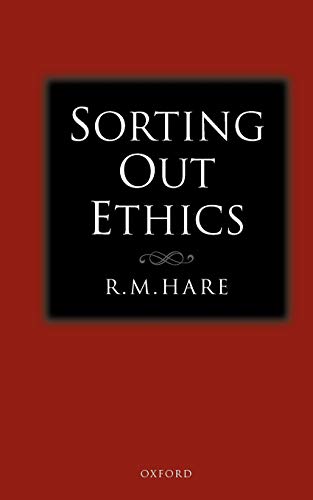
Ebook Info
- Published: 2000
- Number of pages: 208 pages
- Format: PDF
- File Size: 7.98 MB
- Authors: R. M. Hare
Description
…the book is extremely effective: written with customary clarity and vigour, and succinctly summarizing and cross-referencing the argument of the earlier works, it should replace them on reading lists as a student’s first exposure to Hare’s views.–Times Literary Supplement Sorting Out Ethics is a characteristically lucid and lively survey of rival ethical theories by one of the most influential moral philosophers of the century. It also constitutes a definitive summary of Hare’s own fundamental ethical position.
User’s Reviews
Editorial Reviews: Review “…the book is warmly to be recommended. Students, especially, will appreciate its central section, in which developments in moral philosophy during the present century are traced with exceptional clarity.”–International Philosophical Quarterly”…the book is extremely effective: written with customary clarity and vigour, and succinctly summarizing and cross-referencing the argument of the earlier works, it should replace them on reading lists as a student’s first exposure to Hare’s views.”–Times Literary Supplement”…the book is warmly to be recommended. Students, especially, will appreciate its central section, in which developments in moral philosophy during the present century are traced with exceptional clarity.”–International Philosophical Quarterly”…the book is extremely effective: written with customary clarity and vigour, and succinctly summarizing and cross-referencing the argument of the earlier works, it should replace them on reading lists as a student’s first exposure to Hare’s views.”–Times Literary Supplement About the Author R. M. Hare is Emeritus Professor of Moral Philosophy, University of Oxford, and Professor Emeritus, University of Florida, Gainesville
Reviews from Amazon users which were colected at the time this book was published on the website:
⭐This book has the appearance of an introduction to issues in contemporary meta-ethics, and I assumed it was something of this sort when I picked it up. I was wrong. It’s not that this book couldn’t be read as an introduction to meta-ethics; it could be so read. Still, introducing meta-ethics clearly isn’t what this book does best. Rather, it works best as an introduction to Hare’s own meta-ethical views. I don’t doubt that Hare himself considered this something of an introduction to meta-ethics more generally, but that’s because he held what are now fairly nonstandard views about the nature, methods, and aims of meta-ethics. So this work is a better introduction to Hare’s meta-ethics than it is to meta-ethics in general.That said, I can’t think of any book that better introduces Hare’s own meta-ethical views. I’ve previously read the sections on meta-ethics in both The Language of Morals and Freedom and Reason, and I think Hare’s arguments here are clearer, more compelling, and much more interesting. (I know I wish I’d read this before reading those other books, which honestly I found rather dull in places.) And since his views were pretty much unchanged throughout his career, you don’t have to worry about getting a different Hare in this book than you’d get by going to one of those other books.This books begins with two chapters that provide an introduction to Hare’s views about the nature and methods of ethical theory. In short, he claims that meta-ethics is the study of the moral language, and he tries to explain why study of moral language is of some value for substantive moral inquiry.This is followed by a set of lectures that forms the heart of the book. Hare begins these lectures by providing what he thinks is an exhaustive taxonomy of the main positions in meta-ethics, of the main possibilities for providing an account of the meaning of moral language. He then states his aim in the series of lectures: to argue that all the possibilities other than his own universal prescriptivism fail. In each chapter he takes up a possible position, describes its nature, and presents some reasons to think that it doesn’t provide us with an accurate account of moral language. In the end he hopes to show that his preferred view retains all the virtues of the other possible positions while avoiding their weaknesses.This section of the book is both a passable introduction to some parts of contemporary meta-ethics and a very good introduction to Hare’s own views. One strength of this as an introduction to Hare’s views is that it allows one to see just why Hare thinks that other possible theories fail. Another strength, and one not unconnected to the first, is that it makes clear what Hare thinks any adequate theory of moral language needs to look like. As he dismisses possible theories because of certain apparent shortcomings, it becomes clear just what problems Hare thinks a successful theory would need to avoid and what elements of our common-sense moral discourse and thought such a theory would need to preserve. Finally, this makes especiallyclear just how Hare thinks his own views should be distinguished from the views of others.In the final chapter, which consists of the essay “Could Kant Have Been a Utilitarian?”, Hare takes up some issues in normative ethics. In some ways, this serves as an introduction to Hare’s own position in normative ethics, a position that he thinks is both utilitarian and Kantian.I think I’ve listed some pretty significant virtues of this book, though I should also mention that Hare writes pretty good philosophical prose. And that, I think, is always a plus. Nevertheless, there are a couple, relatively minor, problems with this book. The first is that it doesn’t really cohere as much as it could; it’s clear that its distinct sections weren’t written with the intention that they be included in a single book. For instance, it seems that the last chapter is simply tacked on in order to provide some coverage of Hare’s views in normative ethics. The second problem is that Hare can be rather smug at times. He’s so convinced of the truth of his own position and of the obvious merits of his arguments for it that he often finds it necessary to impute willful bias or sheer blindness to those who disagree with him. Perhaps this is especially annoying to me because I rarely agree with Hare, but I must say that I find it distracting and unnecessary.Nevertheless, Hare is clearly an important figure in contemporary moral philosophy, and I suspect he will be for some time to come. And since I can’t think of a book that better introduces the most important elements of his own positions, I recommend this book to everyone interested in Hare or twentieth-century meta-ethics.
Keywords
Free Download Sorting Out Ethics in PDF format
Sorting Out Ethics PDF Free Download
Download Sorting Out Ethics 2000 PDF Free
Sorting Out Ethics 2000 PDF Free Download
Download Sorting Out Ethics PDF
Free Download Ebook Sorting Out Ethics