

Ebook Info
- Published: 1999
- Number of pages: 944 pages
- Format: PDF
- File Size: 179.65 MB
- Authors: William Theodore De Bary
Description
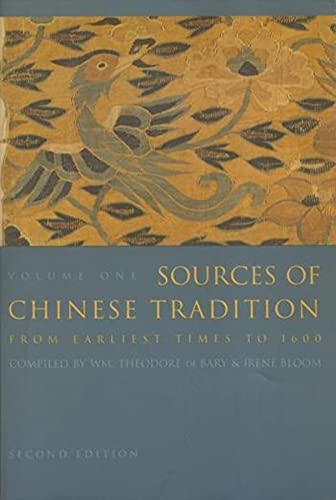
A collection of seminal primary readings on the social, intellectual, and religious traditions of China, Sources of Chinese Tradition, Volume 1 has been widely used and praised for almost forty years as an authoritative resource for scholars and students and as a thorough and engaging introduction for general readers. Here at last is a completely revised and expanded edition of this classic sourcebook, compiled by noted China scholars Wm. Theodore de Bary and Irene Bloom. Updated to reflect recent scholarly developments, with extensive material on popular thought and religion, social roles, and women’s education, this edition features new translations of more than half the works from the first edition, as well as many new selections. Arranged chronologically, this anthology is divided into four parts, beginning at the dawn of literate Chinese civilization with the Oracle-Bone inscriptions of the late Shang dynasty (1571–1045 B.C.E.) and continuing through the end of the Ming dynasty (C.E. 1644). Each chapter has an introduction that provides useful historical context and offers interpretive strategies for understanding the readings.The first part, The Chinese Tradition in Antiquity, considers the early development of Chinese civilization and includes selections from Confucius’s Analects, the texts of Mencius and Laozi, as well as other key texts from the Confucian, Daoist, and Legalist schools. Part 2, The Making of a Classical Culture, focuses on Han China with readings from the Classic of Changes (I Jing), the Classic of Filiality, major Han syntheses, and the great historians of the Han dynasty. The development of Buddhism, from the earliest translations from Sanskrit to the central texts of the Chan school (which became Zen in Japan), is the subject of the third section of the book. Titled Later Daoism and Mahayana Buddhism in China, this part also covers the teachings of Wang Bi, Daoist religion, and texts of the major schools of Buddhist doctrine and practice. The final part, The Confucian Revival and Neo-Confucianism, details the revival of Confucian thought in the Tang, Song, and Ming periods, with historical documents that link philosophical thought to political, social, and educational developments in late imperial China. With annotations, a detailed chronology, glossary, and a new introduction by the editors, Sources of Chinese Tradition will continue to be a standard resource, guidebook, and introduction to Chinese civilization well into the twenty-first century.
User’s Reviews
Editorial Reviews: Review “This masterful compilation is the most comprehensive sourcebook of chinese civilization ever published in a Western language.” — PLA, Appearing in University Press Books Selected for Public and Secondary School Libraries, “Journal of Chinese Religions” From the Back Cover This volume contains a chronological table of Chinese history beginning with 2852 B.C. up to A.D. 1849. In addition to presenting the major schools of classical philosophy, this volume discusses yin-yang theories of cosmology and geomancy and the rationale of monarchy and dynastic rule. About the Author Wm. Theodore de Bary (1919–2017) was John Mitchell Mason Professor Emeritus and provost emeritus of Columbia University. His many books include Waiting for the Dawn, Message of the Mind, and Learning for One’s Self, as well as Sources of Japanese Tradition and Sources of Korean Tradition, all published by Columbia University Press.Irene Bloom (1939–2010) was Wm. Theodore and Fanny de Bary and Class of 1941 Associate Professor of Asian Humanities at Columbia University and Anne Whitney Olin Professor Emerita in the Department of Asian and Middle Eastern Cultures at Barnard College. She edited and translated Knowledge Painfully Acquired: The K’un-chih chi of Lo Ch’in-shun and coedited, with Joshua A. Fogel, Meeting of Minds: Intellectual and Religious Interaction in East Asian Traditions of Thought. Read more
Reviews from Amazon users which were colected at the time this book was published on the website:
⭐Ok
⭐I wanted to love this — I mean, it has everything there to love it: history, primary documents, and analysis by leading scholars on the subjects.Unfortunately there were a few things that I found really disturbing. For example, the author spells “tao” as “dao” or he spells “Lao Tzu’s Tao Te Ching” as “Laozi’s Daodejing” – furthermore, although I’ve never read the analects or the Xunzi or the Mencius before, etc… These are just minor gripes — disturbing, however, knowing that if he spells these things differently he might spell everything else differently as well….Furthermore, I have read the Tao Te Ching before and thought that (a) the excerpts here were poorly selected and (b) the translations were mediocre. I would not be surprised if the same held true for the other selections in the rest of the book.Part of me wishes to say: Get this book and introduce yourself to these great traditions of thought!! It covers such a wide expanse of history and goes into surprising detail.But another part of me wants to say: get the best translations of the primary documents and study these traditions individually.I think, actually, the latter option would be far more rewarding. There’s nothing worse than reading a poor selection of a poor translation and then thinking to yourself: this is terrible — when really it is a work that, had you read a better selection and a better translation, you would have fallen in love with.
⭐Bought it for a college course and surprise (!) ended up reading it! It can be a bit dry of course, but its a pretty interesting read if you’re into that kind of stuff. If you have no interest in history well then obviously this book is not for you.Also it is HUGE. I definitely did not read the entire textbook. At whatever price you are paying for this book, the price per page is less than a penny. It weighs about 5 pounds and is fatter than a two cheeeseburgers stacked on top of each other.Still, decent read, heavy, and if you can get it for under 10 dollars you are probably getting a good deal.
⭐Good history of traditions.
⭐the book content is great and detailed, yet it is not as new as I expected, still, I am really satisfied with the price and the quality!
⭐This is on hundreds of pages in the book. No way could it have been “missed”. Pretty funny how the description actually says no notes, highlighting or mars. They flat out lied. I have had descriptions “forget” to mention something but this was pure and simple lying. I guess I really should pay more attention to the ratings.
⭐I am a native Chinese and I am a political science major student in a relatively prestigious school. I have been knowing Chinese history for years, with living in China and study Chinese history in my high school. HOWEVER, this book is truly amazing and revealed many things and insights about my own cultural roots. A must read!Highly recommended!
⭐Very engaging and enjoyable history book!
⭐This negative review is of the updated version of this once-beautiful book. It gets 2 stars, rather than 1, only because of the original book.I took the 1960 edition out of the university library to do research for an assignment and fell in love with it. It was spiritually aware and human and the language was beautiful. And I was so taken by it, I purchased a copy from Amazon – expecting the same content, with a new and perky cover – but it is not. It is twice as long and nothing whatever connects the original with the new. The chapters and the contents are all different.It has been ‘updated’ and made more ‘academic’ for our soulless times – and it has taken the heart and soul out of the book. I absolutely hate it.I am hoping, as the university copy is falling apart, that I can convince the library to swap them over – with them taking the sparkly new one and me the old one. I hope they agree because otherwise I have wasted good money on this awful book.IF, however, you are after newly-minted academic info on Chinese history – this book is probably a reasonable place to start.
⭐The problem with buying academic books new is the cost. Thankfully they can be bought second hand at a reasonable price. My copy came from Illinois, was in almost pristine condition and was delivered to me in the UK within two weeks. This is a splendid book for anyone interested in China and would be a useful read for any of our lawmakers who would profit from a little understanding of this huge and fascinating country. Many thanks.
⭐Wonderful work which gives the reader a large, diverse collection of translated sources ranging from Buddhist religious works and ancient fortune telling to Tang Dynasty era poetry to works on governance and philosophy in the Ming Dynasty. Although Chinese history and literature is of course incredibly vast, and no one work will come close to covering everything, Sources of Chinese Tradition succeeds into giving the reader a start in understanding some of the most significant works and people in Chinese Civilisation.
⭐good.
⭐Un testo utile per chi faccia storia della cultura cinese e voglia avere a disposizione un comodo repertorio di testi di vario genere. Non sempre la scelta dei brani o la selezione degli stralci e condivisibile. Non sempre si trova ciò di cui si ha bisogno. Ma essendo un’opera titanica, conviene averla a disposizione.
⭐
Keywords
Free Download Sources of Chinese Tradition, Vol. 1 2nd Edition in PDF format
Sources of Chinese Tradition, Vol. 1 2nd Edition PDF Free Download
Download Sources of Chinese Tradition, Vol. 1 2nd Edition 1999 PDF Free
Sources of Chinese Tradition, Vol. 1 2nd Edition 1999 PDF Free Download
Download Sources of Chinese Tradition, Vol. 1 2nd Edition PDF
Free Download Ebook Sources of Chinese Tradition, Vol. 1 2nd Edition