

Ebook Info
- Published: 2004
- Number of pages: 430 pages
- Format: PDF
- File Size: 1.35 MB
- Authors: Willi Goetschel
Description
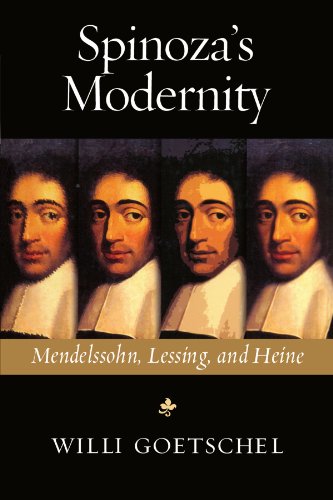
Spinoza’s Modernity is a major, original work of intellectual history that reassesses the philosophical project of Baruch Spinoza, uncovers his influence on later thinkers, and demonstrates how that crucial influence on Moses Mendelssohn, G. E. Lessing, and Heinrich Heine shaped the development of modern critical thought. Excommunicated by his Jewish community, Spinoza was a controversial figure in his lifetime and for centuries afterward. Willi Goetschel shows how Spinoza’s philosophy was a direct challenge to the theological and metaphysical assumptions of modern European thought. He locates the driving force of this challenge in Spinoza’s Jewishness, which is deeply inscribed in his philosophy and defines the radical nature of his modernity.
User’s Reviews
Editorial Reviews: Review “An extraordinary work with immense erudition and scholarship behind it. This has the potential to be a discipline-altering book.”—Warren Montag, author of “Bodies, Masses, Power: Spinoza and His Contemporaries””Willi Goetshel’s work on Spinoza is to be read for two reasons. One, it contributes to the growing literature on Spinoza, which recognizes his great importance both for the history of western ideas and current philosophical discussion. Two, it shows Spinoza’s significance for the whole Enlightenment project from its very beginnings. This book is masterful in its learning and its insights.”—David Novak, J. Richard and Dorothy Shiff Professor of Jewish Studies, University of Toronto”Willi Goetshel’s work on Spinoza is to be read for two reasons. One, it contributes to the growing literature on Spinoza, which recognizes his great importance both for the history of western ideas and current philosophical discussion. Two, it shows Spinoza’s significance for the whole Enlightenment project from its very beginnings. This book is masterful in its learning and its insights.”–David Novak, J. Richard and Dorothy Shiff Professor of Jewish Studies, University of Toronto About the Author Willi Goetschel is professor of German and philosophy at the University of Toronto. He is the author of Constituting Critique: Kants Writing as Critical.
Reviews from Amazon users which were colected at the time this book was published on the website:
⭐Spinoza and his impact on Enlightenment are getting renewed attention in philosophical and historical literature. The final volume of Johnathan Israel’s trilogy on Spinoza and the Enlightenment,
⭐together with Steven Nadler’s new study of Spinoza’s Theological-Political Treatise,
⭐, prompted me to continue with Spinoza and the Enlightenment by reading “Spinoza’s Modernity: Mendelssohn, Lessing, and Heine” (2004) which examines the reception of Spinoza in the works of these three important 18th Century German thinkers. The author, Willi Goetschel is professor of German and philosophy at the University of Toronto, and his book is part of a series, “Studies in German Jewish Cultural History and Literature.”This is a detailed, difficult book that considers three German writers whose works are not as familiar to American readers as they might be. Goetschel also offers new insights and direction in understanding Spinoza and what Goetschel sees as his uniquely modernist project. Beginning with the German writer Jacobi, Spinoza has tended to be read through his metaphysics and epistemology as a pantheist and a rationalistic fatalist. Jacobi was a severe critic of Spinoza and wanted philosophy to return to religious and Christian faith rather than reason. Goetschel begins differently with Spinoza. He emphasizes Spinoza’s philosophy of affects (emotions) found in the latter three books of the Ethics together with what Goetschel sees as the relations between emotion and reason for Spinoza. Goetschel also places great weight, as do Nadler and Israel, on Spinoza’s Theological Political Treatise and its discussion of the relationship between politics and religion. Spinoza’s unfinished Political Treatise receives much attention as well. Readers frequently underestimate Spinoza’s importance to political philosophy. The result of Goetschel’s reading is an interpretation of Spinoza that emphasizes its immanent character and its reworking of the distinction between universal and particular rather than a pantheistic reading of Spinoza. It is a materialistic philosophy with some modern interpretive twists. Spinoza begins neither with metaphysics nor epistemology and work down so to speak but rather thinks in a seamless web in which there is no outside privileged philosophical position.Goetschel, in company with some students of Spinoza, emphasizes the Jewish character of his thought as opposed to seeing him as a “rationalist” thinker following Descartes and a predecessor of Leibniz as he is frequently taught in courses on the history of philosophy. For Goetschel Spinoza’s Jewishness captures the nature of modernism and Spinoza’s role in developing modernity. The issue lies in the relationship between universalism and particularism. On the one hand, Spinoza taught a philosophy of reason and universalism stressing what was shared and accessible to everyone rather than claimed religious revelations which Spinoza rejected decisively as a source of knowledge and truth. But, Goetschel argues convincingly, Spinoza was a nominalist who approached reason and commonality only through particulars rather than as abstractions of a Platonic or other character. So, for Goetschel, Spinoza spoke for a culture which was universal and recognized the rights of all but which did not try to obliterate differences founded on imagination, tradition and diversity and difference. Spinoza spoke of the reason common to all men in founding a secularly based society while allowing for different imaginative expressions including Judaism and Christianity among others.In the first part of the book, Goetschel offers his account of Spinoza’s own writings which emphasizes the Spinoza’s conatus, or understanding of the nature of self-realization. He works through Spinoza’s understanding or religion and its difference from reason culminating in a discussion of Spinoza’s non-contractarian (which distinguishes it from Hobbes) political theory in the Political Treatise.In considering Spinoza’s reception in Germany, Goetschel focuses on religion, psychology, and interpretation rather than upon metaphysics. Goetschel also sees Spinoza as fundamental to the issue of Jewish emancipation in Enlightenment Germany. In the second part of his book, Goetschel discusses Spinoza’s influence on the thought of Moses Mendelssohn (1729 — 1786) who attempted the difficult task of combining philosophy with Jewish life. There are some valuable sections in this discussion, as Goetschel discusses Mendelssohn’s introduction to Rabbi Manasseh Ben Israel’s “Vindication of the Jews.” Rabbi Manasseh was one of Spinoza’s teachers prior to Spinoza’s excommunication from the Jewish community. But the focus of the discussion of Mendelssohn and almost of the book is on Mendelssohn’s book “Jerusalem, or on Religious Power and Judaism.” Here, Goetschel maintains, Mendelssohn elaborated on Spinoza’s Theological Political Treatise. He argued for what Goetschel describes as an “alternative universalism” in which the institutions of a society were secular but religious diversity and practice was encouraged in the spirit of self-realization and particularistic interpretation of tradition.Mendelssohn was a lifelong friend of Gotthold Lessing (1729 — 1781) who Jacobi, in a breach of confidence, revealed as a Spinozist in his outlook. Goetschel’s discussion focuses on what he perceives as an instrumental, pragmatist theory of truth that he finds in Lessing and that he argues derives from Spinoza. He links Lessing prospectively to the American pragmatists, Charles Peirce but also to William James as well. Goetschel offers a detailed reading of Lessing’s famous play “Nathan the Wise.” He sees this play as more than the plea for tolerance for which it is usually read. The play goes far beyond this, for Goetschel, in its epistemology and view of the value of religious diversity. Goetschel finds the play heavily indebted to Spinoza, as does Johnathan Israel in the book referred to in the first paragraph of this review.Goetschel’s treatment of Spinoza in Heinrich Heine (1797 –1856) seems to me comparatively short and rushed. Heine took issue with Hegel by challenging what became for a time a prevailing idealistic reading of Spinoza. Heine also placed Spinoza at the center of modern philosophy rather than on the periphery. Goetschel finds a Spinozistic influence regarding universals and particulars and Jewish interpretation in Heine’s late poetry, “Hebrew Melodies”.The style of this book is academic and turgid. The erudition in this book is deep and the footnotes are essential. The frequent passages from German texts are given by Goetschel in his own translation and in the original. A reading knowledge of German is valuable in understanding the book. I found the book more valuable for the interpretation Goetschel offers of Spinoza himself than in his readings of Mendelssohn, Lessing and Heine. This is not a book for casual reading. The book will appeal to readers with a serious interest and background in Spinoza and to readers with a broad knowledge of German literature and culture.Robin Friedman
⭐As expected no problems
Keywords
Free Download Spinoza’s Modernity: Mendelssohn, Lessing, and Heine in PDF format
Spinoza’s Modernity: Mendelssohn, Lessing, and Heine PDF Free Download
Download Spinoza’s Modernity: Mendelssohn, Lessing, and Heine 2004 PDF Free
Spinoza’s Modernity: Mendelssohn, Lessing, and Heine 2004 PDF Free Download
Download Spinoza’s Modernity: Mendelssohn, Lessing, and Heine PDF
Free Download Ebook Spinoza’s Modernity: Mendelssohn, Lessing, and Heine