

Ebook Info
- Published: 1996
- Number of pages: 308 pages
- Format: PDF
- File Size: 3.25 MB
- Authors: Lars T. Lih
Description
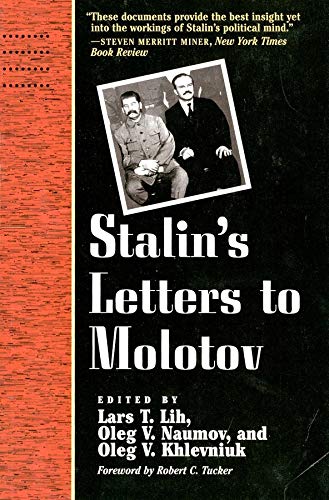
“It is thus important to a) fundamentally purge the Finance and Gosbank bureaucracy, despite the wails of dubious Communists like Briukhanov-Piatakov; b) definitely shoot two or three dozen wreckers from these apparaty, including several dozen common cashiers.”― J. Stalin, no earlier than 6 August 1930″Today I read the section on international affairs. It came out well. The confident, contemptuous tone with respect to the great powers, the belief in our own strength, the delicate but plain spitting in the pot of the swaggering great powers―very good. Let them eat it.”―J. Stalin, January 1933 Between 1925 and 1936, a dramatic period of transformation within the Soviet Union, Josef Stalin wrote frequently to his trusted friend and political colleague Viacheslav Molotov, Politburo member, chairman of the USSR Council of Commissars, and minister of foreign affairs. In these letters, Stalin mused on political events, argued with fellow Politburo members, and issued orders. The more than 85 letters collected in this volume constitute a unique historical record of Stalin’s thinking―both personal and political―and throw valuable light on the way he controlled the government, plotted the overthrow of his enemies, and imagined the future. This formerly top secret correspondence, once housed in Soviet archives, is now published for the first time.The letters reveal Stalin in many different and dramatic situations: fighting against party rivals like Trotsky and Bukharin, trying to maneuver in the rapids of the Chinese revolution, negotiating with the West, insisting on the completion of all-out collectivization, and ordering the execution of scapegoats for economic failures. And they provide important and fascinating information about the Soviet Union’s party-state leadership, about party politics, and about Stalin himself―as an administrator, as a Bolshevik, and as an individual.The book includes much supplementary material that places the letters in context. Russian editor Oleg V. Naumov and his associates have annotated the letters, introduced each chronological section, and added other archival documents that help explain the correspondence. American editor Lars T. Lih has provided a lengthy introduction identifying what is new in the letters and using them to draw a portrait of Stalin as leader. Lih points out how the letters help us grasp Stalin’s unique blend of cynicism and belief, manipulation and sincerity―a combination of qualities with catastrophic consequences for Soviet Russia and the world.
User’s Reviews
Editorial Reviews: About the Author Lars T. Lih is the author of Bread and Authority in Russia, 1914-1921. He is working on a study of bolshevism. Oleg V. Naumov is assistant director of the Russian Center for the Preservation and Study of Documents of Recent History in Moscow. Oleg V. Khlevniuk is editor of the journal Free Thought.
Reviews from Amazon users which were colected at the time this book was published on the website:
⭐great book for school paper got an A
⭐This is one of the first books I bought on Amazon and, although it took ages to arrive, it was well worth the wait. Unlike any of the other books I’ve read on the subject, this really gets inside the mind of Stalin and shows you his genius for politics, that has been imitated by the likes of Blair/ Brown*.Most books I’ve read on the subject focus on Stalin being an evil man and what he did in the purges. Although this does need to be considered, this book (to its credit) focuses on his running of the USSR, and covers 1925 – 1936, which is before the height of the purges and many of his more heinous acts#. It also covers the letters in a objective way, allowing the reader to make their judgements rather than the usual reminders that ‘he was an evil man’.Usefully, the book starts off by going through some of the issues confronting Stalin at the time of these letters, and allows the reader to understand the context of his actions.The book then goes through his letters year on year up till 1930, and the last chapter is a grouping of letters from 1931-1936. I found the most interesting of these to be the 1929, 1930 ones where Stalin is addressing issues arising from the five year plans.Winston Churchill once said that Stalin was full of ‘Good Sense’, and these letters let you see why; people who know anything about New Labour’s New Deal will see some similarities here (e.g. moving labour to the area of need, and cutting benefits for those who fail to find jobs).The other letters are also fascinating (1925 – 1928) and, again, give insight into the mind of Stalin. Molotov appeared to have a very close relationship with Stalin, and Stalin confides in him a great deal. As an example the period 1925-1926 sees a period when Stalin was ill which, if known to an untrusted aide, could have devastated his cause.Of course, there are downsides to this collection. Firstly, some of the letters get very technical and specific, and commentary isn’t provided for every letter. In addition, one feels the book would be more complete with letters covering the whole of Stalin’s reign, although whether Molotov disposed of these is not known.However, to summarise, this book is a fascinating and insightful read and well worth examining if you study the man himself as you will find things in this collection that you won’t get elsewhere. I was actually personally recommended this by a History teacher from years back and, suffice to say, it is one of the best recommendations I have ever received.**** – Apologies that I can’t think of an American equivilent, but Tony Blair and Gordon Brown were Labour (i.e. Socialist) Prime Ministers of Britain, who used many of Stalin’s better ideas (while not having to imitate his more evil actions). As an illustration, one opponent said of Brown (at the end of his honeymoon in office) that he had made “a remarkable transformation from Stalin to
⭐”.# – A commenter (‘Happy Camper’) has pointed out that, during the 1925-1936 period, there was the Holodomor (where 9-11 million died). The fact the Holodomor doesn’t feature at all in the letters (though the Ukraine does), shows the sociopathic nature of Stalin and how his scientific dissections of problems were only possible through his ignoring of human costs…
⭐Anyone with a serious interest in Stalin has to read Stalin’s letters to Molotov, and this book puts them all in one place. Academic reviewers are fairly harsh on the 61-page introduction by Lars Lih, but I found his analysis of Stalin’s actions through the lens of anti-bureaucratism to be compelling. But few people will by the book for the introduction; the letters are the main thing, and Lih and Russian editors do a great job of putting them in context.
⭐This very interesting book exists thanks to inadequate means of communication and also to Molotov himself.He gave the original letters to the authorities long after Stalin’s death.The letters are of great importance as they go beyond the formal language used in correspondences.The problems facing the new Soviet republic are mentioned in letters in everyday language.The book has to be read with other books related with the period as there are several broken links between letters.Could be read as a preliminary for studying the Soviet Union in 1930s.
⭐This is one of the first books I bought on Amazon and, although it took ages to arrive, it was well worth the wait. Unlike any of the other books I’ve read on the subject, this really gets inside the mind of Stalin and shows you his genius for politics, that has been imitated by the likes of Blair/ Brown.Most books I’ve read on the subject focus on Stalin being an evil man and what he did in the purges. Although this does need to be considered, this book (to its credit) focuses on his running of the USSR, and covers 1925 – 1936, which is before the height of the purges and many of his more heinous acts*. It also covers the letters in a objective way, allowing the reader to make their judgements rather than the usual reminders that ‘he was an evil man’.Usefully, the book starts off by going through some of the issues confronting Stalin at the time of these letters, and allows the reader to understand the context of his actions.The book then goes through his letters year on year up till 1930, and the last chapter is a grouping of letters from 1931-1936. I found the most interesting of these to be the 1929, 1930 ones where Stalin is addressing issues arising from the five year plans.Winston Churchill once said that Stalin was full of ‘Good Sense’, and these letters let you see why; people who know anything about New Labour’s New Deal will see some similarities here (e.g. moving labour to the area of need, and cutting benefits for those who fail to find jobs#).The other letters are also fascinating (1925 – 1928) and, again, give insight into the mind of Stalin. Molotov appeared to have a very close relationship with Stalin, and Stalin confides in him a great deal. As an example the period 1925-1926 sees a period when Stalin was ill which, if known to an untrusted aide, could have devastated his cause.Of course, there are downsides to this collection. Firstly, some of the letters get very technical and specific, and commentary isn’t provided for every letter. In addition, one feels the book would be more complete with letters covering the whole of Stalin’s reign, although whether Molotov disposed of these is not known.However, to summarise, this book is a fascinating and insightful read and well worth examining if you study the man himself as you will find things in this collection that you won’t get elsewhere. I was actually personally recommended this by a History teacher from years back and, suffice to say, it is one of the best recommendations I have ever received!**** – A commenter has pointed out that during the 1925-1936 period there was the Holodomor (where 9-11 million died). The fact the Holodomor doesn’t feature at all in the letters (though the Ukraine does), shows the sociopathic nature of Stalin and how his scientific dissections of problems were only possible through his ignoring of human costs…# – This is not intended as a smear, but more to point out to how some of his good-sense policies have been separated from his darker inclinations. It is not without reason that one opponent said of Gordon Brown (at the end of his honeymoon in office) that he had made “a remarkable transformation from Stalin to
⭐Mr Bean
⭐”.
Keywords
Free Download Stalin’s Letters to Molotov: 1925-1936 (Annals of Communism Series) in PDF format
Stalin’s Letters to Molotov: 1925-1936 (Annals of Communism Series) PDF Free Download
Download Stalin’s Letters to Molotov: 1925-1936 (Annals of Communism Series) 1996 PDF Free
Stalin’s Letters to Molotov: 1925-1936 (Annals of Communism Series) 1996 PDF Free Download
Download Stalin’s Letters to Molotov: 1925-1936 (Annals of Communism Series) PDF
Free Download Ebook Stalin’s Letters to Molotov: 1925-1936 (Annals of Communism Series)