Ebook Info
- Published: 2011
- Number of pages: 544 pages
- Format: PDF
- File Size: 39.51 MB
- Authors: Ya. B. Zel’dovich
Description
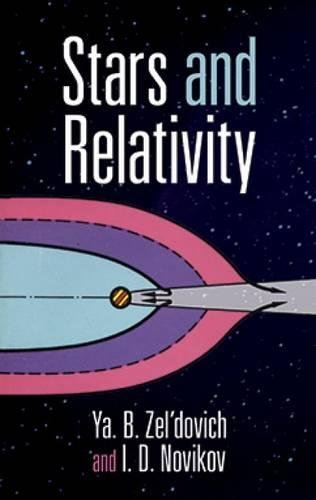
This edition reprints Volume 1 of an important two-volume Russian work which, at the time of its original publication, was the only comprehensive review in existence of the entire field of relativistic astrophysics. Subsequently revised and enlarged, both volumes remain today a valuable resource for physicists, astronomers, and others working in the field.The present volume is devoted to general relativity, properties of matter under astrophysical conditions, and stars and stellar systems. Individual topics include the theory of gravitation (including Einstein’s gravitational equations), the equation of state of matter (cold matter, properties of matter at high temperatures, etc.) and relativistic stages of evolution of cosmic objects (equilibrium and stability of stars, stellar evolution, star clusters, more).The authors of this book rank among the great astrophysicists of the century: their work is especially remarkable for its deep physical insights and clarity of presentation. Those features are here in abundance, ready to inform and inspire both practicing astrophysicists and aspiring students.
User’s Reviews
Editorial Reviews: About the Author Yakov B. Zel’dovich (1914–87) played an important role in the development of Soviet nuclear and thermonuclear weapons. He also made key contributions to the fields of adsorption and catalysis, shock waves, nuclear physics, particle physics, astrophysics, physical cosmology, and general relativity.Igor Dmitriyevich Novikov (1935–) is a Russian theoretical astrophysicist and cosmologist who formulated the Novikov self-consistency principle, an important contribution to the theory of time travel. He has worked at the Russian Space Research Institute, the Lebedev Physical Institute, Moscow State University, and the University of Copenhagen.
Reviews from Amazon users which were colected at the time this book was published on the website:
⭐I’m not reviewing the book – I’m reviewing the printed copy. Like most Dover books from a few years ago, the copy is decent but not outstanding. For the price, one can’t complain. The pages are on the thin side and text from the obverse is visible if a single page is viewed in a well lit room. The binding is standard for a paperback. Characters are usually crisp, but there is some very mild ghosting – enough to be visible if looked for, but not enough to be distracting during ordinary reading. All in all, a great buy for the price and thank you Dover for keeping books like this in print!
⭐As a non-science major I did find this book a little harder to read than some of the other mainstream authors – but I expected that. It was worth the effort. I confess I did skim over the harder to read parts! But it was an enjoyable read from an outstanding Russian scientist. Some of his works are very hard to get nowadays so I was very pleased to find this.
⭐met all of my expectations
⭐Kip Thorne–2017 Physics Nobel Laureate– was one of the Editors for this Volume (One, of Two). How can anyone pass it by ? Kip Thorne writes: “…the spirit of Zeldovich-Novikov research pervades these two volumes on relativistic astrophysics; as a result, these two volumes should be a ‘must’ on the reading lists of both practicing astrophysicists and aspiring students.” Given that Volume One “Stars and Relativity” is up-to-date as of 1969, one asks the reason to peruse the text as of 2017 ! Zeldovich writes: “….we feel strongly that the spirit of the time, 1969, is against thick books written by one or two authors…” ( Has anything changed, since, in that remark ? ). What, then, is in store for a reader approaching this volume today ?(1) Amusing historical sidelights: Glance at the index, you will not find the terminology “Black Holes” you will find “Frozen Stars.” Neutrinos, here, are still massless (page 89), Quarks are still frowned upon ( pages 193-194, “the idea of physical Quarks with fractional charges has been fading slowly…the evidence against fractional Quarks is strong…”).(2) Thus, accepting that certain things have been superseded, what do we learn of lasting value ? Chapter one provides for a beautiful exposition of Einstein’s gravitation, general relativity. (A nice footnote by the Editors occurs page 14; in fact, the footnotes provide a wealth of interesting detail.) We read: ” The metric components contain information not only about the flow of time and the geometry of the reference frame, but also about its accelerations and deformation.” (page 19, By the way, signature (1,-1,-1,-1) used ).(3) An interesting discussion of cosmological constant (pages 28-33). Reading: “We shall show how particle theory can give an order-of-magnitude estimate, which is nonzero, while maintaining relativistic invariance,” and ” …in curved spacetime the definition of the mass of the graviton is no longer clear.”(4) Qualitative discussion of gravitational radiation (pages 38-44). A reminder: “…Only relative accelerations are measurable.” (page 38). Kip Thorne authors sections 1.14 & 1.15: Gravitational Radiation Damping and Detection Of Gravitational Waves. ( see pages 51-61).(5) Chapter Two–Inescapability Of General Theory Of Relativity–should be required reading for all ! Let us read page 77: ” A popular, but untrue, assertion is that the gravitational interaction is due to an ‘exchange of gravitons.’ A note by Kip Thorne inserted (page 79) and appendix provides a nice derivation of ” how the potential of an aggregate of moving particles contained in a spherical vessel is calculated.”(6) Spherically Symmetric Gravitational Field, Chapter Three–again, required reading. Read: “The equations of General Theory Of Relativity are invariant under time reversal.” (page 113). A very detailed discussion of Kruskal Metric (pages 118-128). That discussion is continued in volume two. And, let us not ignore section 4.6, entitled “what happens to matter after it falls through the event horizon ? ” Wonderful !(7) An elaboration of the concept of “Pressure,” this awaits in chapter five. A review of degenerate electron gas awaits for Section 6.2, where reference is made to Landau-Lifshitz for further details. In fact, keep your volumes of Landau-Lifshitz handy throughout !(8) One waits until Part Three (page 233) for “the effects of the general theory of relativity to produce changes as compared with Newtonian Theory,” first stability, then rotating stars, white dwarfs, neutron stars, finally super-massive stars. All introduced, here, chapter ten. An appendix derives “the condition in Newtonian theory that the total energy of the star be an extremum is equivalent to the condition of hydrostatic equilibrium” (page 317) , another appendix derives virial theorem using variational methods (page 319 ). Beautiful !(9) Stellar Evolution: Instability and stability, again brought forth. Shock waves, and supernovae introduced. Collapse, again brought forth. Section 11.4 will detail corrections of general relativity in the theory of a rotating star (pages 393-397). Turbulence touched upon.(10) The book concludes with accretion, magneto-hydrodynamics, pulsars, superfluidity and superconductivity, Quasars (QSO’s). We read: “At the present time, there exists no theory of QSO’s that is either convincing or generally accepted.” (page 473 ). All discussed at a qualitative level. Thus, the concluding two chapters, roughly fifty pages, offers valuable insight into frontier topics of the day. I’ve offered a tour of the book, rapid-fire as it is. There is simply too much to thoroughly review of the contents of this Volume (and, the Second). As I’ve already stated, much is out-of-date (how could it be otherwise ? ), yet much remains of value. Hopefully, one will turn to this volume one (likewise, the second volume) in order to ascertain how scientists “think” about the problems of their day. Zeldovich and Novikov provide much food for thought, as they let you in on how they think about these issues.I highly recommend these monographs: not for any course, nor as textbook material cemented in stone,but for watching two scientists think and ponder about the universe, peering into the unknown.
⭐not writteen well al all
⭐Excellent classic on astrophysics and general relativity. It has strong theoretical foundations which have far reaching applications in the related area. It can serve as a text for exceptionally motivated graduate and PhD students in astrophysics and relativity and also for researchers and teachers involved in theoretical issues of astrophysics.
⭐Contains all that stuff I wanted to learn as a young student…answers to most questions.
Keywords
Free Download Stars and Relativity (Dover Books on Physics) in PDF format
Stars and Relativity (Dover Books on Physics) PDF Free Download
Download Stars and Relativity (Dover Books on Physics) 2011 PDF Free
Stars and Relativity (Dover Books on Physics) 2011 PDF Free Download
Download Stars and Relativity (Dover Books on Physics) PDF
Free Download Ebook Stars and Relativity (Dover Books on Physics)