Ebook Info
- Published: 2009
- Number of pages: 464 pages
- Format: PDF
- File Size: 10.08 MB
- Authors: Christopher Poelker
Description
If you’ve been charged with setting up storage area networks for your company, learning how SANs work and managing data storage problems might seem challenging. Storage Area Networks For Dummies, 2nd Edition comes to the rescue with just what you need to know. Whether you already a bit SAN savvy or you’re a complete novice, here’s the scoop on how SANs save money, how to implement new technologies like data de-duplication, iScsi, and Fibre Channel over Ethernet, how to develop SANs that will aid your company’s disaster recovery plan, and much more. For example, you can:Understand what SANs are, whether you need one, and what you need to build oneLearn to use loops, switches, and fabric, and design your SAN for peak performanceCreate a disaster recovery plan with the appropriate guidelines, remote site, and data copy techniquesDiscover how to connect or extend SANs and how compression can reduce costsCompare tape and disk backups and network vs. SAN backup to choose the solution you needFind out how data de-duplication makes sense for backup, replication, and retentionFollow great troubleshooting tips to help you find and fix a problemBenefit from a glossary of all those pesky acronymsFrom the basics for beginners to advanced features like snapshot copies, storage virtualization, and heading off problems before they happen, here’s what you need to do the job with confidence!
User’s Reviews
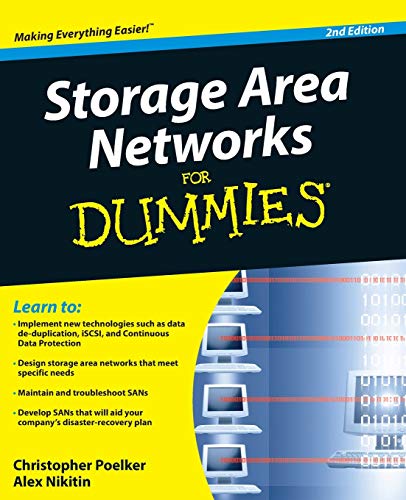
Editorial Reviews: From the Inside Flap Learn to:Implement new technologies such as data de-duplication, iSCSI, and Continuous Data ProtectionDesign storage area networks that meet specific needsMaintain and troubleshoot SANsDevelop SANs that will aid your company’s disaster-recovery planSo you need to set up a SAN? Here’s how to design, implement, and manage one!Whether you’re a complete novice or you already have a bit of knowledge about storage area networks, this book is almost guaranteed to make your job easier. From the basics for beginners to advanced features like snapshot copies, storage virtualization, and heading off problems before they happen, here’s what you need to do the job with confidence! Getting started — understand what SANs are, whether you need one, and what you need to build oneDesign basics — learn to use loops, switches, and the fabric layer, and design your SAN for peak performanceNo surprises — create a disaster-recovery plan with the appropriate guidelines and choose a remote site and data replication methodSANs united — see how to connect or extend SANs and how compression can reduce costsWait, back up — compare tape, disk, network, and SAN backup methods to choose the solution you needWhat if it breaks? — follow great troubleshooting tips to help you find and fix a problemDe-dupe, de-dupe — find out how data de-duplication makes sense for backup, replication, and retentionIt’s virtual — explore different types of virtualization and what they offerOpen the book and find:What RAID is and why it’s importantIssues to consider when planning your SANA translation of all those pesky acronymsWhat to do when your server gets the hiccupsHow to use CDP and CDRWhat you should beware of with storage virtualizationHardware- and software-based copy solutionsSAN best practices From the Back Cover Learn to:Implement new technologies such as data de-duplication, iSCSI, and Continuous Data ProtectionDesign storage area networks that meet specific needsMaintain and troubleshoot SANsDevelop SANs that will aid your company’s disaster-recovery planSo you need to set up a SAN? Here’s how to design, implement, and manage one!Whether you’re a complete novice or you already have a bit of knowledge about storage area networks, this book is almost guaranteed to make your job easier. From the basics for beginners to advanced features like snapshot copies, storage virtualization, and heading off problems before they happen, here’s what you need to do the job with confidence! Getting started — understand what SANs are, whether you need one, and what you need to build oneDesign basics — learn to use loops, switches, and the fabric layer, and design your SAN for peak performanceNo surprises — create a disaster-recovery plan with the appropriate guidelines and choose a remote site and data replication methodSANs united — see how to connect or extend SANs and how compression can reduce costsWait, back up — compare tape, disk, network, and SAN backup methods to choose the solution you needWhat if it breaks? — follow great troubleshooting tips to help you find and fix a problemDe-dupe, de-dupe — find out how data de-duplication makes sense for backup, replication, and retentionIt’s virtual — explore different types of virtualization and what they offerOpen the book and find:What RAID is and why it’s importantIssues to consider when planning your SANA translation of all those pesky acronymsWhat to do when your server gets the hiccupsHow to use CDP and CDRWhat you should beware of with storage virtualizationHardware- and software-based copy solutionsSAN best practices About the Author Christopher Poelker is Vice President of Enterprise Solutions for FalconStor Software, Inc. He spends most of his time with Fortune 1000 companies defining strategy for virtualization and business continuity solutions. Chris is also in great demand as a conference speaker. Alex Nikitin has been a storage architect and consultant for more than ten years. Read more
Reviews from Amazon users which were colected at the time this book was published on the website:
⭐If you know nothing about SAN this is a good start. But it is rather dated… I think they mention 4gbps FC being state of the art (our new switch is 32). It was useful for me to wrap my head around WWNs, zoning and fabric topology enough so I could get some hosts talking to a new storage solution and be confident I wasn’t going to break anything. But if you are looking for advanced topics, theory or anything other than purely practical and basic applications look elsewhere.
⭐I work for a company involved with manufacturing SAN-oriented equipment. This book is a great introduction to concepts and equipment commonly used in the SAN/fibre channel field. While storage and networking can easily become graduate/post-doc level areas most people involved are not of that level of expertise. Fortunately support-contracts are available so that the lay person and casual professional aren’t required to know everything. However, one must respect the equipment that they are working with and SAN for Dummies is a great way to learn the basics of this growing field of amazing feats like sending and storing at a rate of 20 Gb p/s and beyond.If you’re a casual professional or lay person, read this book so you don’t sound like an idiot when calling tech support.If you have a graduate degree in CompSci, read this book (and endure the generalizations/minor-ish inaccuracies) to assist your lessers in attaining SAN proficiency.P.S. This book is a beginning, not an end. If you read it hoping to sound like an expert in a weekend, those who know will see through your charade when the SAN hits the fan.
⭐This is a great book to start learn about SAN and NAS.It covers the basics and has a terrific chapter on why SAN is necessary for all enterprises.The value proposition of SAN, indeed, is very strong. No wonder practically all large IT enterprises have adopted SAN for their storage solution of choice.This book doesn’t cover any advanced materials. It doesn’t covers anything vendor specifc, such as EMC and NETAPP, technologies and solutions.This is a fine place to start but it will not make anyone a knowledgeable expert.Pros:1)Good overview of SAN.2)Terrific chapter on the value proposition of SAN to IT.3)Starts from ground up (What is RAID, Volume, LUN, etc).Cons:1)Doesn’t cover any major vendor specific technologies.2)Doesn’t cover major uses of SAN technology (such as database servers).3)Doesn’t deal with any technical issues beyond generalities. You will never find any command-line or technical troubleshooting steps.
⭐Considering the second edition was released in January 2009, it is appalling how little iSCSI is mentioned. According to the index iSCSI is referenced on fewer than 15 of the book’s 437 pages. Two SAN vendors have earned a living doing only iSCSI for over eight years and nearly all the rest offer both iSCSI and FC, so to treat this important SAN technology so lightly in 2008 when this book was going into its second edition was a fatal error to my mind. The author needs to rewrite this book quickly to address not only iSCSI, but also storage virtualization (11 pages), tiering of storage (0 pages), serial attached SCSI (SAS) (0 pages), solid-state drives (0 pages), SATA (2 pages), and thin provisioning (0 pages), to name a few. If you know you need Fiber Channel this book has some utility, but as an overiew of the state of the SAN world at press time or today, it is sadly lacking.
⭐I was assigned the task by my company to install a SAN without ever having seen one. This book was very valuable in preparing me to get the job done. It’s well organized with none of the usual excesses of the usual 800 page computer book.It makes for an excellent introductory book.
⭐Easy to read and understand.
⭐This has to be one of the best data storage books on the market today. While the vast bulk of it shares how to build, test, and troubleshoot a SAN, I used it for general data storage information. It hits on RAID, deduplication, virtualization, back-up, replication, CDP, etc. and many of the conceptual parts of the SAN.So many times I was reading, and I was like Ohhhhh, OK, THAT’s what that means!
⭐This is not a technical reference manual. It’s intended audience is primarily upper-level management types that won’t ever need to configure an initiator or target much less debate the merits or shortcomings of AoE, FC, or iSCSI.
⭐There are not many books regarding general topics on Storage Area Networks, and this one is most actual and comprehensive. It helps to order knowledge and information not only on storage networking but wider on storage and backup issues.Recommended for every IT personnel who is in touch with SAN/storage/backup technologies
⭐I bought this book for a colleague new to the team and new to the Storage environment. Looking at the content before handing it over, the subjects covered and the breadth and depth looked just about right for someone with a vague understanding of what a storage network is.He found the book extremely useful, easy to understand and helped explain some of the concepts he was learning on the job.Well worth the money!
⭐This book is very well written and just at the right level for someone new to working with SANs. Covers all the main areas of SAN design, management and maintenance extremely clearly and suggests a number of places to go for more detailed information. Don’t expect this to give you all the detailed technical information you need to be a SAN administrator, but then that isn’t the purpose of the book.
⭐Great book – makes SAN easy to understand by all
⭐Excellent condition
Keywords
Free Download Storage Area Networks For Dummies 2nd Edition in PDF format
Storage Area Networks For Dummies 2nd Edition PDF Free Download
Download Storage Area Networks For Dummies 2nd Edition 2009 PDF Free
Storage Area Networks For Dummies 2nd Edition 2009 PDF Free Download
Download Storage Area Networks For Dummies 2nd Edition PDF
Free Download Ebook Storage Area Networks For Dummies 2nd Edition