

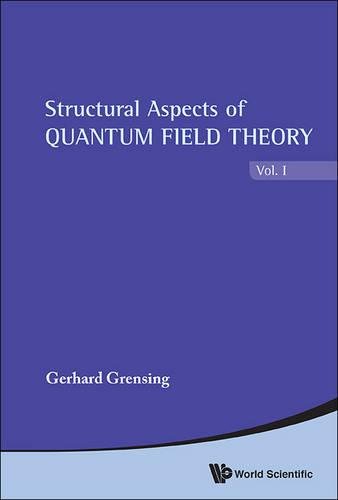
Ebook Info
- Published: 2013
- Number of pages: 1596 pages
- Format: PDF
- File Size: 6.83 MB
- Authors: Gerhard Grensing
Description
This book is devoted to the subject of quantum field theory. It is divided into two volumes. The first can serve as a textbook on the main techniques and results of quantum field theory, while the second treats more recent developments, in particular the subject of quantum groups and noncommutative geometry, and their interrelation. The first volume is directed at graduate students who want to learn the basic facts about quantum field theory. It begins with a gentle introduction to classical field theory, including the standard model of particle physics, general relativity, and also supergravity. The transition to quantized fields is performed with path integral techniques, by means of which the one-loop renormalization of a self-interacting scalar quantum field, of quantum electrodynamics, and the asymptotic freedom of quantum chromodynamics is treated. In the last part of the first volume, the application of path integral methods to systems of quantum statistical mechanics is covered. The book ends with a rather detailed investigation of the fractional quantum Hall effect, and gives a stringent derivation of Laughlin’s trial ground state wave function as an exact ground state. The second volume covers more advanced themes. In particular Connes’ noncommutative geometry is dealt with in some considerable detail; the presentation attempts to acquaint the physics community with the substantial achievements that have been reached by means of this approach towards the understanding of the elusive Higgs particle. The book also covers the subject of quantum groups and its application to the fractional quantum Hall effect, as it is for this paradigmatic physical system that noncommutative geometry and quantum groups can be brought together. Readership: Graduate students and professionals in theoretical and mathematical physics.
User’s Reviews
Editorial Reviews: Review “This self-contained, comprehensive first volume presents a fundamental and careful introduction to quantum field theory. It will be welcomed by students as well as researchers, since it gives an overview of the origin and development of the basic ideas of modern particle physics, quantum statistical mechanics and the mathematics behind. The book provides a rich collection of modern research topics and references to important recent published work.” –Zentralblatt MATH “The publication of this authoritative and comprehensively referenced two-volume set, written in somewhat condensed but eminently lucid style and explaining the principal underlying concepts and most important results of QFT, is particularly timely and useful. I am pleased to recommend most heartily this important reference source to students and physicists and to those concerned with the philosophy of science.” — George B. Kauffman, Professor Emeritus of Chemistry, California State University, Fresno “The book is primarily addressed to physicists. Nevertheless, as numerous examples are known in which exploration of the land where physics and mathematics overlap (and which quantum field theory definitely belongs to) resulted in important developments in mathematics, many mathematicians may also find this book interesting and even inspiring.” — MathSciNet From the Inside Flap This book is devoted to the subject of quantum field theory. It is divided into two volumes. The first can serve as a textbook on the main techniques and results of quantum field theory, while the second treats more recent developments, in particular the subject of quantum groups and noncommutative geometry, and their interrelation. The first volume is directed at graduate students who want to learn the basic facts about quantum field theory. It begins with a gentle introduction to classical field theory, including the standard model of particle physics, general relativity, and also supergravity. The transition to quantized fields is performed with path integral techniques, by means of which the one-loop renormalization of a self-interacting scalar quantum field, of quantum electrodynamics, and the asymptotic freedom of quantum chromodynamics is treated. In the last part of the first volume, the application of path integral methods to systems of quantum statistical mechanics is covered. The book ends with a rather detailed investigation of the fractional quantum Hall effect, and gives a stringent derivation of Laughlin’s trial ground state wave function as an exact ground state. The second volume covers more advanced themes. In particular Connes’ noncommutative geometry is dealt with in some considerable detail; the presentation attempts to acquaint the physics community with the substantial achievements that have been reached by means of this approach towards the understanding of the elusive Higgs particle. The book also covers the subject of quantum groups and its application to the fractional quantum Hall effect, as it is for this paradigmatic physical system that noncommutative geometry and quantum groups can be brought together.
Reviews from Amazon users which were colected at the time this book was published on the website:
⭐
Keywords
Free Download Structural Aspects of Quantum Field Theory and Noncommutative Geometry (In 2 Volumes) 1st Edition in PDF format
Structural Aspects of Quantum Field Theory and Noncommutative Geometry (In 2 Volumes) 1st Edition PDF Free Download
Download Structural Aspects of Quantum Field Theory and Noncommutative Geometry (In 2 Volumes) 1st Edition 2013 PDF Free
Structural Aspects of Quantum Field Theory and Noncommutative Geometry (In 2 Volumes) 1st Edition 2013 PDF Free Download
Download Structural Aspects of Quantum Field Theory and Noncommutative Geometry (In 2 Volumes) 1st Edition PDF
Free Download Ebook Structural Aspects of Quantum Field Theory and Noncommutative Geometry (In 2 Volumes) 1st Edition