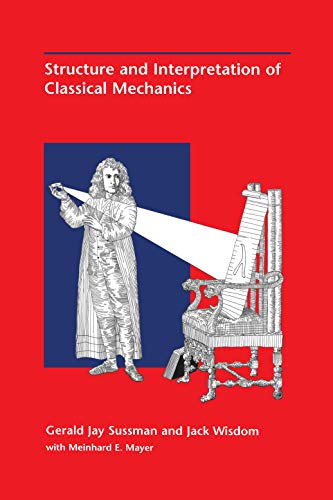
Ebook Info
- Published: 2001
- Number of pages: 526 pages
- Format: PDF
- File Size: 10.43 MB
- Authors: Gerald Jay Sussman
Description
This textbook takes an innovative approach to the teaching of classical mechanics, emphasizing the development of general but practical intellectual tools to support the analysis of nonlinear Hamiltonian systems. The development is organized around a progressively more sophisticated analysis of particular natural systems and weaves examples throughout the presentation. Explorations of phenomena such as transitions to chaos, nonlinear resonances, and resonance overlaps to help the student to develop appropriate analytic tools for understanding. Computational algorithms communicate methods used in the analysis of dynamical phenomena. Expressing the methods of mechanics in a computer language forces them to be unambiguous and computationally effective. Once formalized as a procedure, a mathematical idea also becomes a tool that can be used directly to compute results.The student actively explores the motion of systems through computer simulation and experiment. This active exploration is extended to the mathematics. The requirement that the computer be able to interpret any expression provides strict and immediate feedback as to whether an expression is correctly formulated. The interaction with the computer uncovers and corrects many deficiencies in understanding.
User’s Reviews
Editorial Reviews: About the Author Gerald Jay Sussman is Panasonic Professor of Electrical Engineering at MIT.Jack Wisdom is Professor of Planetary Science at MIT.
Reviews from Amazon users which were colected at the time this book was published on the website:
⭐Would give zero stars, but it is not possible. To use the book, you need specific version of Scheme language with specific library. These are available only for Linux or MacOS. Since I don’t own Linux or Mac machine and don’t plan to own one, I stopped reading the book on page 3 and never resumed. Unfortunately, I discovered this after 30 days return period. By the way, link to this software, listed in the book is wrong. There should be a big warning on the cover that software is available only for Linus and MacOS, to avoid situations like mine. Selling book with software that runs on 10% of computers, without visible warning should be considered a fraud. Oh, yes, you can google and find variuos ad-hoc procedures to run this on Windows, but none of these worked for me.
⭐Among the horrors of modern education is the production of vast quantities of poorly written, error ridden science text books. This is in spite of the fact that many if not most of the great scientists of the 20th century have been excellent writers and lecturers. Einstein and Feynman are important examples: brilliant in their discoveries, they were equally brilliant in their abilities to describe and explain some of the most difficult concepts of science. We should be asking why these people can write about their work with such perfection while the “professionally produced” text books in our high schools and colleges are so mediocre.The MIT Press stands among those publishers producing the very best work. Sussman’s and Wisdom’s text, “The Structure and Interpretation of Classical Mechanics”, provides a wonderful example. Here is a book providing further proof that (a) great science necessarily includes excellent writing and communications, (b) brilliant scientists tend to be the best writers in their fields, and (c) a text book on a difficult subject can be remarkably enjoyable as well as informative when well conceived and well written.The very first chapter, “Lagrangian Mechanics”, is worth the price of admission. It has all the attributes which make the entire book a gem: it is concise, efficient, clear, compact, full, and rewarding. Every sentence contains important ideas and information, yet each sentence is clear and direct. These are attributes usually associated with poetry, and one could argue that this text book approaches that level of literature. In the first three pages of the chapter, the authors present as complete a discussion as I’ve read on the relationship of mathematics to natural phenomena, the basic project of classical mechanics, and the “remarkable discovery that the same mathematical tools used to describe the motions of the planets can be used to describe the motion of the juggling pin.” Furthermore, the chapter introduces and describes the concepts of configuration paths, variational formulation (and why that has some advantages over the classical Newtonian formulation), generalized coordinates, and the relationship of these formulations to a computer program in Scheme.By the end of the chapter, students will be immersed in the subject out of interest, and will fully appreciate the themes and likely outcomes of the book. Classical mechanics will essentially “come to life” through a well structured use of computers to achieve a very deep understanding of classical systems.Jump next to the book’s Appendices, which present an introduction to the computer programming language of Scheme and a full explanation of the authors’ adaptation of functional mathematical notation. Scheme is wonderfully crafted language for exploring, describing, and demonstrating science and mathematics. The mergence of Scheme, functional notation, and classical mechanics in a single text while retaining almost luminescent clarity ranks among great educational achievements!This is almost too incredible to say, but the truth is that an entire semester could be dedicated to the first chapter and the two appendices, and everyone involved — teacher and students — would be entirely satisfied. But in this text, and in a course based on this text, these sections would serve as appetizers, and we would all want more. Fortunately, there is plenty more.The authors write that they prefer using functional notation to traditional mathematical notation because, “In functional notation mathematical expressions are unambiguous and self-contained.” This statement is, in fact, the best description of the entire book.I believe that the book could be used effectively in high school, if there was some capacity for integrated curriculum planning. Students could be learning Scheme — an excellent language to learn if programming is a major interest or even hobby — and physics and math. Not least importantly, students would also learn the importance of good writing.Some will argue that the book is more a college text, although I think we tend to underestimate the powerful minds and interests of younger learners. In either case, this book belongs in those places promoting good science and quality education, and, if you simply enjoy learning and reading, it has a place on your home bookshelf.
⭐I’ve had this book on my shelf for several years waiting for the chance to read it and in the past few weeks I’ve finally found the time to dig into it. It’s phenomenal. First a few notes:* yes, the notation is slightly different. In this case I think it is better and worth a little time to learn it. It is worth familiarizing yourself with a variety of notations anyway.* Scheme is ever present, but not required. Nor is it currently difficult to get running on mac or linux. By the time you are an upper level undergrad (in any physics department I have witness or can imagine) you are expected to have a working knowledge of getting access to a linux terminal. If you do not have that, this is an opportunity to get it. Scheme is a really neat language, easy to learn and well suited to symbolic manipulation. Also, with numpy/scipy toolkit, you can easily build most of the numerical integration tools they use throughout.All that aside, the book is excellent. The typical mechanics course/book spends most of it’s time on Lagrangian mechanics and lots of pen and paper work. Here, Lagrangian mechanics is covered quickly (but completely) and most attention centers on the insights we can gain about motion from Hamiltonian Mechanics and phase space structure. It contains clear explanations of topics obfuscated elsewhere: the action principle in Hamiltonian mechanics, and the Legendre Transform (I love the area interpretation!). I wish I had learned classical mechanics from this book, but am happy I came to it eventually.
⭐This is an awful book. It merely rewrites the classical mechanics notation to include all parametrizations explicitly. (For example, how to include the time parameter in the terms of the Lagrangian, so we can compute the action and do variational calculus.) But we already know this. You can easily pick it up when you read Goldstein or Arnold. I don’t see the point of the new clumsy notation. It provides no new insight, no new physics, and zero advantages when doing computations. In fact, it just makes everything cumbersome. In his book, Arnold acknowledges that classical mechanics requires parametrization but never explicitly indicates it in its notation, but chooses to avoid it in keeping with centuries of notation and understanding of how it works. Why change it for the worse when the new notation provides zero additional benefits except a nerd’s satisfaction that he/she is able to decipher it? The book also provides no new examples of classical mechanics beyond what is found in standard textbooks. Thus, I cannot recommend this book unless you want to waste your time.
⭐
Keywords
Free Download Structure and Interpretation of Classical Mechanics in PDF format
Structure and Interpretation of Classical Mechanics PDF Free Download
Download Structure and Interpretation of Classical Mechanics 2001 PDF Free
Structure and Interpretation of Classical Mechanics 2001 PDF Free Download
Download Structure and Interpretation of Classical Mechanics PDF
Free Download Ebook Structure and Interpretation of Classical Mechanics