Ebook Info
- Published: 2012
- Number of pages: 482 pages
- Format: PDF
- File Size: 99.03 MB
- Authors: Michael B. Green
Description
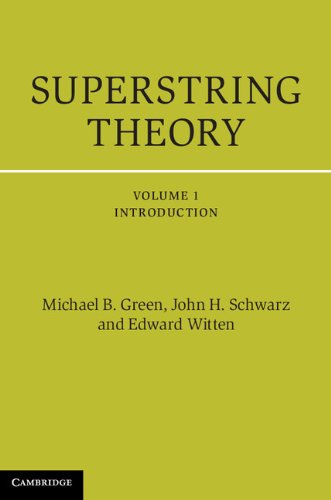
Twenty-five years ago, Michael Green, John Schwarz, and Edward Witten wrote two volumes on string theory. Published during a period of rapid progress in this subject, these volumes were highly influential for a generation of students and researchers. Despite the immense progress that has been made in the field since then, the systematic exposition of the foundations of superstring theory presented in these volumes is just as relevant today as when first published. A self-contained introduction to superstrings, Volume 1 begins with an elementary treatment of the bosonic string, before describing the incorporation of additional degrees of freedom: fermionic degrees of freedom leading to supersymmetry and internal quantum numbers leading to gauge interactions. A detailed discussion of the evaluation of tree-approximation scattering amplitudes is also given. Featuring a new preface setting the work in context in light of recent advances, this book is invaluable for graduate students and researchers in general relativity and elementary particle theory.
User’s Reviews
Reviews from Amazon users which were colected at the time this book was published on the website:
⭐I have just finished reading and studying Volume 1 of Green, Schwarz and Witten, it is extremely well written the first four chapters I understood them straight away, the first one gives you an historical introduction into the subject as how strings were used in the early seventies for modeling the strong nuclear force and the Veneziano Amplitude. Details are give as how the different conformal mappings of the string worldsheet can be mapped to the whole plane or half plane (depending wether you have a closed or open string) and how the different values of the points (0,1,infinity) contribute due to the conformal symmetry that the theory has. It is important at this stage to point out that the book by Kiritsis (“String Theory in a Nutshell”) does not give you any hint of why the infinite value of the variable does not contribute. But GSW explains it beautiful. The only problem is when you have a Tachyon in which case you have a divergence in the amplitude of scattering on top of dealing with a particle which is nonsensical since it has imaginary mass. The second chapter introduces the Bosonic String, both the open and closed case and the various conditions for the boundaries and vibrational modes propagating on them. Here it is shown that the Bosonic String has a tachyon and that the theory only makes sense in the critical dimension D=26. Also the light-cone gauge and old covariant methods of quantization are presented. Chapter three gives the more new method of BRST quantization, it explains how you construct the BRST charge and that the physical states are anhilated by it. Here are given the action of the ghosts that are brought with the BRST and how they again imply D=26. Chapter four is about the superstring applying supersymmetry to the world-sheet coordinates, the usual SUSY transformations are given for the bosonic coordinates and for the new fermionic ones who happen to be Spinors in the worldsheet. A word of caution the SUSY transformations only close on-shell but then using the superspace technique an auxiliary field is introduced who fixes everything and has no dynamics. Chapter five is about applying Supersymmetry to the spacetime and the problem here is that the book begins to get more involved in the formalism. For example the Superstring now has equations of motion so complicated they can only be resolved in light-cone gauge again the BRST is applied and now as a result we have more ghosts but this time bosonic associated to the fermionic coordinates. With SUSY the tachyon is shown to disappear and the critical dimension is now D=10 for Lorentz invariance and conformal invariance and susy. Chapter 6 deals with the way to incorporate internal gauge degrees of freedom like giving quantum numbers to the two ends of the open string or separating the Fermionic spinors into one which live in one representation and other group in another thus creating the Heterotic String with SO(32) or E8xE8 gauge symmetry. Finally chapter seven is a lot of crap (excuse me) for how you can build the tree amplitudes of scattering for the different strings. AH! and by the way Type I refers to having Supersymmetry with N=1 and 32 supersymmetric charges and Type II (A and B) for SUSY with N=2 and 64 supercharges. Type II A also has left and right chiral fermions while Type II B has only one type of chirality. The amplitudes are presented first for the bosonic open and closed string and then for the Ramond Neveu Schwarz model of the superstring (the approach of chapter 4) and finally the explicit superstring in the spacetime, both superstrings have critical dimension D=10. Here are constructed the various vertex operators that are needed for inserting legs to the string diagrams, the ones for the Bosonic case are more or less self evident but you need to have more care for the Vertex operators of the Fermionic states in the superstring specially in the last case that refers to the strings of chapter 5, some of the last things I just skipped because it gets really awful for a first reading. I am now prepared to delve into the Second Volume specially because on the mathematical side I am already acquainted with most of the differential geometry and algebraic topology which are reviewed in chapters 12 and 15!! (although no algebraic geometry on my wallet!) All in all a great read and the only book that has permitted me to go through the theory of Superstrings in depth although I had already read the half of the undergraduate introductory text of Zwiebach and another one called “String theory demystified” both of them dealing only with the Bosonic string, so this going of Green Schwarz and Witten has been my first attempt to go through the SUPERSTRINGS, so my recommendation, go first with Zwiebach, then MacMahon (demystified) and then with this volume and it will be I hope as it has been to me SUCH A GREAT ADVENTURE!, can wait to read the second volume, these guys (Green, Schwarz, Witten) really know their subject and they do it well, A MUST for any physicist thinking on going as me to go IN Superstrings Theory which by the way is the only theory that has predicted GRAVITY at the quantum level and in a consistent though surprising way, A MUST!!………….
⭐This is a great book, and the costumer service is very good.
⭐Very good condition
⭐Anyone interested in learning string theory could perhaps start with the current formulation involving D-branes and M theories. This is certainly possible and will lead one to the frontiers of research. However, it would not perhaps give one an appreciation of string theory that would be obtained by persuing a study that explains how it arose in the study of the strong interaction . This book, written by three giants in string theory, will give the reader such a study, and was the first book to appear on the subject. The book is a monograph, and not a textbook, since no exercises appear, but it could still serve as a reference and “required reading” for courses in string theory. The learning of string theory can be a formidable undertaking for those who lack the mathematical background. Indeed, a proper understanding of string theory, not just a forma one, will require a solid understanding of algebraic and differential geometry, algebraic topology, and complex manifolds. There are many books on these subjects, but I do not know of one what will give the student of string theory an in-depth understanding of the relevant mathematics. These two volumes include two rather lengthy chapters on mathematics, one on differential geometry and the other on algebraic geometry. The mastery of these two chapter will give readers a formal understanding of the mathematics, and will allow them to perform calculations in string theory efficiently, but do not give the insight needed for extending its frontiers. There have been a few books published on string theory since these two volumes appeared, but they too fail in this regard (and some even admit to doing so). To gain the necessary insight into the mathematics will entail a very time-consuming search of the early literature and many face-to-face conversations with mathematicians. The “oral tradition” in mathematics is real and one must embed onself in it if a real, in-depth understanding of mathematics is sought. The physics of string theory though is brought out with incredible skill by the authors, and the historical motivation given in the introduction is the finest in the literature. Now legendary, the origin of string theories in the dual models of the strong interaction is discussed in detail. The Veneziano model, as discussed in this part, has recently become important in purely mathematical contexts, as has most every other construction in string theory. The mathematical results that have arisen from string theory involves some of the most fascinating constructions in all of mathematics, and mathematicians interested in these will themselves be interested in perusing these volumes, but will of course find the approach mathematically non-rigorous. Some of the other discussions that stand out in the book include: 1. The global aspects of the string world sheet and the origin of the moduli space, along with its connection to Teichmuller space. 2. The world-sheet supersymmetry and the origin of the integers 10 and 26 as being a critical dimension. In this discussion, the authors give valuable insight on a number of matters, one in particular being why the introduction of an anticommuting field mapping bosons to bosons and fermions to fermions does not violate the spin-statistics theorem. 3. The light-cone gauge quantization for superstrings. The authors show that the manifestly covariant formalism is equivalent to the light-cone formalism and is ghost-free in dimension 10. The light-cone gauge is used to quantize a covariant world-sheet action with space-time supersymmetry, with this being Lorentz invariant in dimension 10. This allows, as the authors explain in lucid detail, the unification of bosonic and fermionic strings in a single Fock space. 4. Current algebra on the string world sheet and its origin in the need for distributing charge throughout the string, rather than just at the ends. The origin of heterotic string theory is explained in this context.
⭐El material físico del libro de pasta dura es bueno. El contenido excelente. Como exposición para introducir al lector en la teoría de súper-cuerdas es de lo mejor.No brainer. Like MTW or “The Large Scale Structure of Spacetime”, this is another jewel which beauty and value goes beyond the content. You need up to chapter 16 included of Peskin and or alike to be able to even go through the first chapter though.
Keywords
Free Download Superstring Theory: Volume 1, Introduction: 25th Anniversary Edition (Cambridge Monographs on Mathematical Physics) 1st Edition in PDF format
Superstring Theory: Volume 1, Introduction: 25th Anniversary Edition (Cambridge Monographs on Mathematical Physics) 1st Edition PDF Free Download
Download Superstring Theory: Volume 1, Introduction: 25th Anniversary Edition (Cambridge Monographs on Mathematical Physics) 1st Edition 2012 PDF Free
Superstring Theory: Volume 1, Introduction: 25th Anniversary Edition (Cambridge Monographs on Mathematical Physics) 1st Edition 2012 PDF Free Download
Download Superstring Theory: Volume 1, Introduction: 25th Anniversary Edition (Cambridge Monographs on Mathematical Physics) 1st Edition PDF
Free Download Ebook Superstring Theory: Volume 1, Introduction: 25th Anniversary Edition (Cambridge Monographs on Mathematical Physics) 1st Edition