

Ebook Info
- Published: 2011
- Number of pages: 224 pages
- Format: PDF
- File Size: 1.08 MB
- Authors: Craig Raine
Description
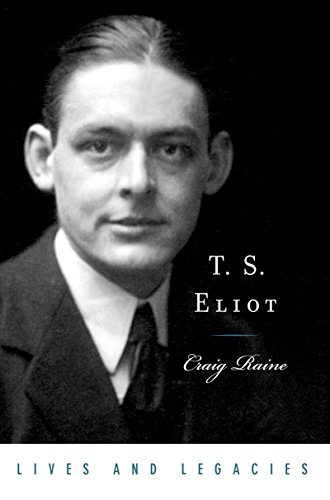
The winner of the Nobel Prize for Literature, the twentieth century’s most famous poet and its most influential literary arbiter, T.S. Eliot has long been thought to be an obscure and difficult poet–forbiddingly learned, maddeningly enigmatic.Now, in this brilliant exploration of T.S. Eliot’s work, prize-winning poet Craig Raine reveals that, on the contrary, Eliot’s poetry (and drama and criticism) can be seen as a unified and coherent body of work. Indeed, despite its manifest originality, its radical experimentation, and its dazzling formal variety, his verse yields meaning just as surely as other more conventional poetry. Raine argues that an implicit controlling theme–the buried life, or the failure of feeling–unfolds in surprisingly varied ways throughout Eliot’s work. But alongside Eliot’s desire “to live with all intensity” was also a distrust of “violent emotion for its own sake.” Raine illuminates this paradoxical Eliot–an exacting anti-romantic realist, skeptical of the emotions, yet incessantly troubled by the fear of emotional failure–through close readings of such poems as “The Love Song of J Alfred Prufrock,” “Gerontion,” The Hollow Men, Ash Wednesday, and many others. The heart of the book contains extended analyses of Eliot’s two master works–The Waste Land and Four Quartets. Raine also examines Eliot’s criticism–including his coinage of such key literary terms as the objective correlative, dissociation of sensibility, the auditory imagination–and he concludes with a convincing refutation of charges that Eliot was an anti-Semite.Here then is a volume absolutely indispensable for all admirers of T.S. Eliot and, in fact, for everyone who loves modern literature.
User’s Reviews
Reviews from Amazon users which were colected at the time this book was published on the website:
⭐For an installment in an Oxford University Press series called “Lives and Legacies”, T. S. ELIOT contains surprisingly little about Eliot’s life and it discusses his legacy even less. What it is is an intelligent and scholarly, yet readable, overview of Eliot’s writings, principally his poetry. If, like me, you already are a fan of Eliot’s poetry, I recommend the book. If you are not a fan, I doubt this book will turn you into one or otherwise do much for you.To me, reading the book was most notable for encouraging the reader to look at Eliot’s poetry as a body of work, as one extended poem. Over the years I have read many of Eliot’s poems multiple times, but – in part, no doubt, because they are so complex and fecund – I have tended to think of the poems, or even discrete parts or stanzas, in isolation. Raine attempts to present Eliot’s work as “one significant, consistent and developing personality.” Towards that end, he identifies and explicates two overarching themes in particular: the failure to live fully (either as illustrated in the poems or ruefully recognized by many of the voices of the poems), and “classicism”, an aesthetic stance that is skeptical of theatrical, exaggerated emotion (i.e., anti-Romantic). Raine also registered a point with me in describing Eliot’s poetry as “impersonal”, in the sense that in order to appreciate it a reader need know little or nothing about the biographical background of its author (unlike, for example, Sylvia Plath).Raine makes his way through Eliot’s oeuvre more or less chronologically, though his rather brief discussion of “Prufrock” is postponed until the middle of the book. He devotes one chapter each to “The Waste Land” and “Four Quartets”, and then individual chapters to Eliot’s dramas and to his literary criticism. For me, the first two chapters were the most rewarding, in part because they include insightful discussion of several of the lesser known (and, thus, less written about) poems – for example, “Animula”, “Gerontion”, and “Marina”.Raine’s book is NOT a “reader’s guide”. He does not attempt, thankfully, to explicate each and every line of each and every poem. He confines himself to the thematic points he wishes to make, and he avoids the drudgery and stuffiness of an Oxford don (though he long taught there). Nonetheless, in discussing sources, models, and influences, he obviously draws on impressive Eliot scholarship. By and large, his writing is spare and taut, somewhat poetic and much less verbose than the typical texts of poetry criticism/exposition. (Still, there are quite a few 50-cent words, such as “oneiric” and “euphistically”.)At the end of this relatively brief book there is a lengthy (30-page) Appendix in which Raine discusses the charge, delivered by many critics, that T.S. Eliot was anti-Semitic. Here the tone of the book changes and Raine engages in rather prosaic academic polemics. I don’t follow all of Raine’s arguments in defense of Eliot, but then neither do I follow many of the accusers’ arguments. For the general reader, it perhaps suffices to report that in Raine Eliot has an intelligent and reasoned defender, and before anyone (based on reading Anthony Julius, George Steiner, Louis Menand, etc.) mentally pigeonholes Eliot as an anti-Semite, in fairness they should read Raine’s Appendix.I bought the so-called “hardcover” edition. It is rather cheap and tacky, surprisingly so for a publication by such an august publishing house. The cover is some sort of pressed cardboard (I don’t know the precise term) with a glossy finish on which the cover photo and text are directly emblazoned – i.e., there is no dust jacket. The edges of the pages are almost coterminous with the edges of the cover, and the paper itself is ordinary. The book is “bound” – more accurately, glued – indifferently, so that the first few pages of my copy have been given permanent waves in close to the gathering. These rather mediocre production features probably influence my four-star assessment.
⭐I just became interested in biographies. And I really like his poems. However, the book comes across as literary snobishness at certain points.
⭐delivered on time and in good shape! I would recommend the product and carrier to everyone I know. yes, yes.
⭐While giving interesting insight into the poetry etc.,it is essential, I feel to have read the poetry described before hand,otherwise you are at a loss through ignorance of the work.Nonetheless a well researched and interesting book showing the intelligence and wildly read mind of Eliot.
⭐Prior to reading this book, I’d had little exposure to Eliot’s works and was unaware that his poetry carried such depth and spiritual meaning. However, Craig Raine’s analysis provides insight essential for comprehension of Eliot’s enigmatic poetry. While the author certainly admires his subject, he does not shy away from addressing certain errors in Eliot’s critical assessments. Furthermore, Raine adroitly dispenses with the (largely paranoid) allegations of anti-semitism, but leaves the door open for further evidence. Highly recommended.
⭐I did not find it interesting. It was not clear and too biased
⭐Total satisfaction in every way. Thank you.
Keywords
Free Download T. S. Eliot (Lives and Legacies Series) 1st Edition in PDF format
T. S. Eliot (Lives and Legacies Series) 1st Edition PDF Free Download
Download T. S. Eliot (Lives and Legacies Series) 1st Edition 2011 PDF Free
T. S. Eliot (Lives and Legacies Series) 1st Edition 2011 PDF Free Download
Download T. S. Eliot (Lives and Legacies Series) 1st Edition PDF
Free Download Ebook T. S. Eliot (Lives and Legacies Series) 1st Edition