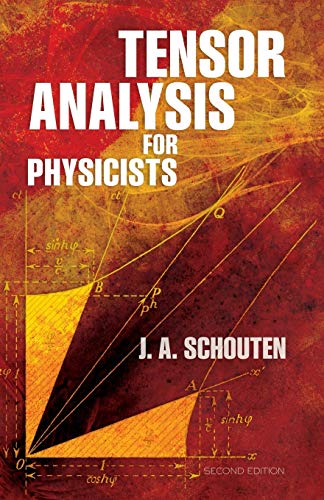
Ebook Info
- Published: 2011
- Number of pages: 320 pages
- Format: PDF
- File Size: 22.83 MB
- Authors: J. A. Schouten
Description
This brilliant study by a famed mathematical scholar and former professor of mathematics at the University of Amsterdam integrates a concise exposition of the mathematical basis of tensor analysis with admirably chosen physical examples of the theory.The first five chapters incisively set out the mathematical theory underlying the use of tensors. The tensor algebra in EN and RN is developed in Chapters I and II. Chapter II introduces a sub-group of the affine group, then deals with the identification of quantities in EN. The tensor analysis in XN is developed in Chapter IV. In chapters VI through IX, Professor Schouten presents applications of the theory that are both intrinsically interesting and good examples of the use and advantages of the calculus. Chapter VI, intimately connected with Chapter III, shows that the dimensions of physical quantities depend upon the choice of the underlying group, and that tensor calculus is the best instrument for dealing with the properties of anisotropic media. In Chapter VII, modern tensor calculus is applied to some old and some modern problems of elasticity and piezo-electricity. Chapter VIII presents examples concerning anholonomic systems and the homogeneous treatment of the equations of Lagrange and Hamilton. Chapter IX deals first with relativistic kinematics and dynamics, then offers an exposition of modern treatment of relativistic hydrodynamics. Chapter X introduces Dirac’s matrix calculus. Two especially valuable features of the book are the exercises at the end of each chapter, and a summary of the mathematical theory contained in the first five chapters — ideal for readers whose primary interest is in physics rather than mathematics.
User’s Reviews
Editorial Reviews: About the Author Dutch mathematician Jan Arnoldous Schouten (1883–1971) was an important contributor to the development of tensor calculus and one of the founders of Amsterdam’s Mathematisch Centrum.
Reviews from Amazon users which were colected at the time this book was published on the website:
⭐An advanced and excellent text book on the subject.
⭐The book, though thorough, did not meet my expectations for the application-based approach that I expected from a book aimed at Physicists instead of pure Mathematicians. Also, the type style/font employed made it difficult to read in many places.
⭐In recent times it has become fashionable to derogate the classical tensor analysis cultivated by such pioneers as Levi-Civita, Schouten and Eisenhart. Modern critics refer to such works as a “sea of indices”, the reading of which is likened to “chasing shadows”. It is true that this style of tensor analysis does not uphold the standards of rigor set forth by the Bourbaki school of presentation, but, in light of the fact that the language has changed so drastically since the writing of this book, it would be fair to treat the classical theory as a separate subject, of interest in its own right.This book offers a valuable, yet not entirely self-contained, introduction to classical tensor analysis. As a beginner, I found the text to be too terse and was forced to consult other sources, such as Levi-Civita’s “Absolute Differential Calculus” and Eisenhart’s “Riemannian Geometry”. Once I had gained some familiarity with the basic notions, Schouten’s book became the preferred reference. The author develops an extremely precise notation which he calls the “kernel-index method” and systematically applies it as a problem solving tool throughout the book. Looking back, it is difficult to say how I ever got along without it.Unfortunately, the book’s terseness is due in part to the fact that the first five chapters are basically abridged excerpts from the author’s lengthier 1954 treatise, “Ricci-Calculus”. In nearly every respect, the aforementioned title is more complete than the present book. In the interest of saving space for the physical applications in the second half of the text, the author omitted important details, such as an adequate definition of manifold and the role of the vector field which generates the infinitesimal transformations used in discussing Lie derivatives.For classical tensor analysis, Schouten’s “Ricci-Calculus” (1954) and “Pfaff’s Problem and its Generalizations” (1949, but still in print) are both excellent. For the modern theory, I have found Noll: Finite Dimensional Spaces; Choquet-Bruhat et al: Analysis, Manifolds and Physics, Part I and II; Spivak: A Comprehensive Introduction to Differential Geometry, Volume 1; Loomis: Advanced Calculus; and Helgason: Differential Geometry, Lie Groups and Symmetric Spaces all to be exceptionally well written.
⭐This is tensor analysis for physicists, written from the point of view of a mathematician. Not of much use for a physicist.
⭐Very good book of the subject.
⭐Very good book on the subject of Tensor Analysis.
Keywords
Free Download Tensor Analysis for Physicists, Second Edition (Dover Books on Physics) in PDF format
Tensor Analysis for Physicists, Second Edition (Dover Books on Physics) PDF Free Download
Download Tensor Analysis for Physicists, Second Edition (Dover Books on Physics) 2011 PDF Free
Tensor Analysis for Physicists, Second Edition (Dover Books on Physics) 2011 PDF Free Download
Download Tensor Analysis for Physicists, Second Edition (Dover Books on Physics) PDF
Free Download Ebook Tensor Analysis for Physicists, Second Edition (Dover Books on Physics)