Ebook Info
- Published: 2018
- Number of pages: 448 pages
- Format: PDF
- File Size: 19.10 MB
- Authors: C. T. J. Dodson
Description
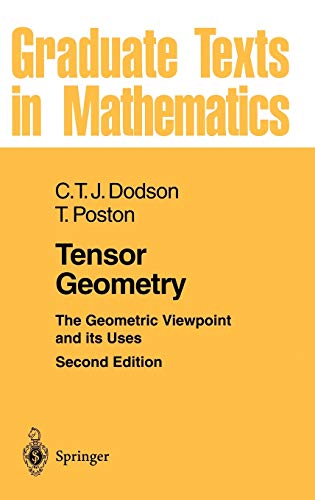
This treatment of differential geometry and the mathematics required for general relativity makes the subject accessible, for the first time, to anyone familiar with elementary calculus in one variable and with some knowledge of vector algebra. The emphasis throughout is on the geometry of the mathematics, which is greatly enhanced by the many illustrations presenting figures of three and more dimensions as closely as the book form will allow.
User’s Reviews
Reviews from Amazon users which were colected at the time this book was published on the website:
⭐A comprehencive treatment of an important topic. A step-by-step approach to advanced material, with (almost) no prerequisites. This handbook constitutes a very usufull way to understant many fundamental subjects of both mathematics and physics. A note of minor inportance can be made, concerning the appearance of this excellent book (perhaps the introduction of more graphs and a more confortable fonds).
⭐As most of the reviewers commented, the book uses physical intuition to motivate the ideas in almost all chapters. I personally like that; readers who are inclined more to formalism might find it uneconomical but grounded intuition should always be welcomed. There are some omitted topics like Cartan’s work. On top of that, figures are only numbered without any sort of description and some minor typos, especially in the curvature chapter.Apart from the above minor points. I highly recommend it for a reader who is geometrically inclined and mature enough to work through some of the fundamental abstractions. It will all be worth it.
⭐The authors of this excellent text include a memorable passage in the Introduction that perfectly captures the purpose and primary strength of the book:”The title of this book is misleading. Any possible title would mislead somebody. ‘Tensor Analysis’ suggests to a mathematician an ungeometric, manipulative debauch of indices, with tensors ill-defined as ‘quantities that transform according to’ unspeakable formulae. ‘Differential Geometry’ would leave many a physicist unaware that the book is about matters with which he is very much concerned. We hope that ‘Tensor Geometry’ will at least lure both groups to look more closely.”Dodson and Poston’s text is a welcome entry in that all-too-small class of books that attempt to bridge the conceptual gulf that separates mathematicians from physicists when they write about differential geometry and general relativity. Modern mathematical treatments of both Riemannian and Lorentzian geometry are typically written primarily in concise and conceptually rich coordinate-free notation; physicists, in sharp contrast, tend to write almost exclusively in a notation that stresses the use of local coordinate systems and index manipulation. A person who is educated in one of these traditions must apply himself with diligence to become proficient in the other; however, this “bilingual” proficiency is surely necessary for the serious students of general relativity, who must study literature written in both styles.Dodson and Poston’s book provides an accessible introduction to the mathematics of general relativity, and it should be particularly useful to both mathematicians and physicists as they develop their abilities to read and write in both coordinate-free and index-based notations. The book is written at a level that should make it accessible to anyone who has studied multi-variable calculus and linear algebra. It is not a complete introduction to either modern differential geometry or general relativity, nor do the authors claim that it is. After all, Spivak devoted five volumes to Riemannian geometry alone and still failed to provide an exhaustive introduction; the subject is enormous in scope.Mathematicians who find this book helpful in their studies of general relativity might consider looking into the following books, each of which is written in the same mathematical style: (1) Gravitational Curvature by Theodore Frankel (offers a beautiful derivation of the Raychaudhuri Equation); (2) Manifolds, Tensor Analysis and Applications by Abraham, Marsden and Ratiu (Chapters 6, 7 and 8 offer an exceptionally lucid introduction to differential forms, integration on manifolds, the Hodge star operator, the codifferential, and applications of these materials to physics); (3) The Geometry of Kerr Black Holes by Barrett O’Neill (if you want to UNDERSTAND the use of the Weyl curvature tensor in defining the Petrov Type of a spacetime, then read Chapter 5 of this wonderful book); (4) Semi-Riemannian Geometry with Applications to Relativity by Barrett O’Neill (makes an excellent companion text to Dodson and Poston as a mathematically rigorous introduction to GR); (5) General Relativity for Mathematicians by Rainer Sachs and Hung-Hsi Wu (a masterpiece, difficult to find today but worth the effort). For a more far-ranging treatment of geometry with applications beyond GR, Theodore Frankel’s The Geometry of Physics is also highly recommended.After one has used Dodson and Poston and some of these other references as a sort of “Rosetta Stone,” then one can become reasonably proficient in deciphering both coordinate-free and coordinate-based literature and translating one into the other. It is sad that the educational process is necessarily so inefficient, but we must be grateful for books like Dodson and Poston’s that help us in the endeavor.
⭐This is one of those books that is very pleasing to the eye of a mathematical physicist, but lacks a facility of mechanical derivation and simplicity of formalism involved to present the essence of the theory, which here really is general Relativity. A more appropriate title would have involved relativity, perhaps Relativity for Mathematical Physicists. or Relativity for Mathematicians, as it is very clear from the beginning the text is going to be tied in with it. At the end of the book, he gives an exposition of the theory, however the formalism involved seems to be unnecessary and not very motivated as to how much it deviates from standard presentations involving tensor calculus and Levi-Civita. It seems he avoids the traditional tensor calculus in favor of the mathematician’s modern formulation of differential geometry to appease that audience. But as a mathematician myself, I do not favor unnecessary abstraction unless it is necessary and simplifies the theory. In this case, it adds extra weight and time to the book. I would prefer to read a the relevant portions of Kreyszig, and then develop the theory of GR. Even Novikov and Dubrovin in Modern Geometry, though less discussion on the physical side of things, mathematically are much more efficient in presenting all kinds of mathematics useful not just to GR, but even inclusive of Yang-Mills and Jacobi Variational theory. I think there is valuable insight in this book, however if you are looking for efficiency in a text, I do not suggest this one.
⭐This book is excellent, but I can’t understand that this second edition contains so many “typographical” errors! So, the novice reader will have to consult reference material to make sure he doesn’t overlook something, which somehow defeats the purpose of the book.
⭐I agree with previous reviewers, and only wish to add a few comments: 1. This book assumes very little on the part of the reader, which makes it ideal for beginners, as long as they’re mature readers. 2. Like many books out there, everything in this book is real and finite dimensional, which is a bit disappointing. 3. It’s not as advanced as the writers or reviewers would like to think. For instance, no differential forms, no killing vectors, and although there’s a chapter on lie groups it treats only their geometrical aspects and not the algebraic ones. 4. However, it contains two (extensive) chapters on SR and GR which are pure gold, I say! Everything is done from the geometrical point of view, and only AFTER all of the math has been introduced, so the discussion is mature and elegant. In short, this is a good book to read for the geometrical intuition but don’t count on it to explain everything about differential geometry. Enjoy!
Keywords
Free Download Tensor Geometry: The Geometric Viewpoint and its Uses (Graduate Texts in Mathematics, 130) 2nd Edition in PDF format
Tensor Geometry: The Geometric Viewpoint and its Uses (Graduate Texts in Mathematics, 130) 2nd Edition PDF Free Download
Download Tensor Geometry: The Geometric Viewpoint and its Uses (Graduate Texts in Mathematics, 130) 2nd Edition 2018 PDF Free
Tensor Geometry: The Geometric Viewpoint and its Uses (Graduate Texts in Mathematics, 130) 2nd Edition 2018 PDF Free Download
Download Tensor Geometry: The Geometric Viewpoint and its Uses (Graduate Texts in Mathematics, 130) 2nd Edition PDF
Free Download Ebook Tensor Geometry: The Geometric Viewpoint and its Uses (Graduate Texts in Mathematics, 130) 2nd Edition