

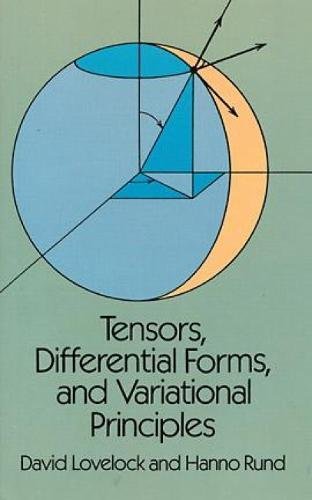
Ebook Info
- Published: 1989
- Number of pages: 400 pages
- Format: PDF
- File Size: 5.31 MB
- Authors: David Lovelock
Description
The aim of this book is to present a self-contained, reasonably modern account of tensor analysis and the calculus of exterior differential forms, adapted to the needs of physicists, engineers, and applied mathematicians. In the later, increasingly sophisticated chapters, the interaction between the concept of invariance and the calculus of variations is examined. This interaction is of profound importance to all physical field theories.Beginning with simple physical examples, the theory of tensors and forms is developed by a process of successive abstractions. This enables the reader to infer generalized principles from concrete situations — departing from the traditional approach to tensors and forms in terms of purely differential-geometric concepts.The treatment of the calculus of variations of single and multiple integrals is based ab initio on Carathéodory’s method of equivalent integrals. Subsequent material explores the effects of invariance postulates on variational principles, focusing ultimately on relativistic field theories. Other discussions include:• integral invariants• simple and direct derivations of Noether’s theorems• Riemannian spaces with indefinite metricsThe emphasis in this book is on analytical techniques, with abundant problems, ranging from routine manipulative exercises to technically difficult problems encountered by those using tensor techniques in research activities. A special effort has been made to collect many useful results of a technical nature, not generally discussed in the standard literature. The Appendix, newly revised and enlarged for the Dover edition, presents a reformulation of the principal concepts of the main text within the terminology of current global differential geometry, thus bridging the gap between classical tensor analysis and the fundamentals of more recent global theories.
User’s Reviews
Reviews from Amazon users which were colected at the time this book was published on the website:
⭐The authors make a very strong, and successful, attempt to motivate the key tensor calculus concepts, in particular Christoffel symbols, the Riemann curvature tensor and scalar densities.The first 238 pages of ”
⭐”, by David Lovelock and Hanno Rund, are metric-free. This book is very heavily into tensor subscripts and superscripts. If you don’t like “coordinates”, you won’t like this book. Here’s a round-up of the chapters.Chapter 1 (17 pages) has some interesting examples which demonstrate how tensors arise naturally, namely the (symmetric) stress tensor in elasticity, the (antisymmetric) inertia tensor for rigid bodies, and cross-product vectors (which arise in electromagnetism). Also discussed are vector components and the properties of determinants.Chapter 2 (36 pages) presents “affine tensor algebra in Euclidean geometry”, which means basic tensor algebra in flat Euclidean spaces, including non-linear coordinate transformations. There’s a very interesting explanation of how a metric tensor and Christoffel symbols naturally arise in flat space when parallel vector fields are subjected to non-linear transformations.Chapter 3 (47 pages) introduces manifolds (using an atlas of charts), including tensor algebra on manifolds and the derivatives of tensor fields, where once again the Christoffel symbol is introduced to make the derivatives tensorial, thereby motivating Christoffel symbols. Then there’s more on absolute differentials (i.e. covariant derivatives) of tensor fields, the effects of multiple covariant differentiation (which motivates the definition of Riemannian curvature), parallelism on manifolds, and properties of the Riemannian curvature tensor.Chapter 4 (29 pages) has some miscellaneous tensor calculus topics, namely scalar densities (with transformation-invariant integrals), normal coordinates, and the Lie derivative.Chapter 5 (51 pages) is about differential forms, including exterior products, the exterior derivative, Poincaré’s lemma, systems of total differential equations, the Stokes theorem, and curvature forms.Chapter 6 (58 pages) is concerned with “invariant problems in the calculus of variations”.Chapter 7 (59 pages) introduces Riemannian geometry. This includes Finsler spaces and Riemannian and pseudo-Riemannian spaces. Topics include geodesics, Riemannian curvature tensor properties in the presence of a metric, and a divergence theorem for Riemannian manifolds.Chapter 8 (33 pages) is titled “invariant variational principles and physical field theories”. This includes Lagrangians, vector field theory, metric field theory, and Einstein’s equations.The authors have made great efforts to explain and motivate everything.
⭐As long as you have strong differential calculus, then this book is as clear as can be (note: differential calculus should be strong before attempting to learn this anyway).It’s well written in general context. Everything is motivated and follows logically. I think the book is perfect so far.It presents the “mathematics of GR” in a very procedural manner. In a sense that it is always clear what we are trying to define, why we are doing so, and how to do it. Start by defining then requiring “orthogonal transformations” for all coordinate transformations. Define scalers, vectors, co-vectors, etc. by how they respond under these transformations. Build calculus and whatever else from these definitions. Everything else follows accordingly.Again, it’s an excellent text written with clarity. Definitely a must if looking at GR and tensor analysis for the first time (or 2nd time. Or maybe even 3rd).
⭐I found the complaint of 2015 about the math equations not changeable and the same problem still exists today. In addition, the font size of notes is not changeable either. It seems amazon doesn’t think it’s important.This is an addition to my previous comment. The author could have used matrix algebra to simply many derivations. The book could be much shorter and easier to read, in my opinion.One of my pet peeves is that this book certainly lacks structure. It could go on for several tens of pages non-stop, like old fashion Fotran code. There are no boldface titles such as definition, axiom, lemma, theorem, corollary … Readers have to figure them out in the context.
⭐I have both the Kindle and Paperback editions. The paperback is poorly inked, words and math symbols are hard to read, derivations are difficult to follow because of this defect. The Kindle edition has a different problem: most of the math formulas (numbered equations and sequences) are set as images, and they do not scale with the rest of the text. If you want to read the math, you have to go out of you way to enlarge a very small area, then the surrounding words are off-screen. Also, references or links to distant locations are not automatically processed. I am using the Kindle app on a new Samsung S-10.
⭐I really like the Dover series for this topic in general, but in comparison to others this one was more difficult to get into. It may very well be me, but I found it quite difficult to absorb and comprehend the material and also relate it to practical uses – although this wasn’t really the case with the others, for example
⭐The materials seems quite comprehensive, mind you.
⭐One of the best books on tensor analysis I have read. I have been trying to study tensors on my own for a couple of years and most references are very difficult to follow. I found this book extremely clear for a beginner with a fair background on calculus.
⭐Book as advertised and arrived within estimated time.
⭐This is a well composed dissertation on differential forms. Everything from tensors entities defined in Euclidean space having affine (linear) connections to non-Euclidean space having nonlinear connections. The authors initially provide simple notions for motivation w.r.t. differential forms (basically Cartesian tensors) and gradually develop into more general representations. I especially appreciate the appendix which presents the most abstract notions (purely mathematical) of differential forms.
⭐Book arrived on time in expected condition, and is a goof combination of two of the three main areas of advanced calculus – the other being function spaces/lebesgue integration
⭐Delivered quickly. Meets all my expectations
⭐Es un gran libro, pero difícil de leer si no tienes background. Realmente he disfrutado este libro, aunque no lo he leído todo. No es muy formal, ya que no es un libro orientado para matemáticos (o eso parece), sin embargo tiene muchas referencias.Los ejercicios son bastante difíciles, así que son muy buen entrenamiento.Compre este libro para estudiar tensores, que para mí resultaban misteriosos y un tanto desconocidos. El primer capítulo da una introducción de como resulta necesario ampliar el concepto de los vectores para analizar correctamente situaciones físicas, y cómo estás entidades aparecen naturalmente al estudiar temas como la dinámica de cuerpos rígidos, tensor de inercia. Aún no termino el segundo capítulo sin embargo introduce los nuevos conceptos gradualmente, y como el autor lo dice, solo cuando es necesario. Sin duda lo recomiendo aampliamente. El envió llego antes de lo esperado y en muy buenas condicionesPara estudantes de relatividade com pegada matemática, trata-se de um texto clássico e que exige empenho.
⭐
Keywords
Free Download Tensors, Differential Forms, and Variational Principles (Dover Books on Mathematics) in PDF format
Tensors, Differential Forms, and Variational Principles (Dover Books on Mathematics) PDF Free Download
Download Tensors, Differential Forms, and Variational Principles (Dover Books on Mathematics) 1989 PDF Free
Tensors, Differential Forms, and Variational Principles (Dover Books on Mathematics) 1989 PDF Free Download
Download Tensors, Differential Forms, and Variational Principles (Dover Books on Mathematics) PDF
Free Download Ebook Tensors, Differential Forms, and Variational Principles (Dover Books on Mathematics)