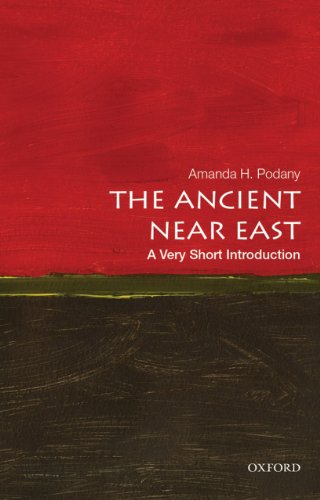
Ebook Info
- Published: 2013
- Number of pages: 168 pages
- Format: PDF
- File Size: 3.20 MB
- Authors: Amanda H. Podany
Description
The ancient Near East is known as the “cradle of civilization”–and for good reason. Mesopotamia, Syria, and Anatolia were home to an extraordinarily rich and successful culture. Indeed, it was a time and place of earth-shaking changes for humankind: the beginnings of writing and law, kingship and bureaucracy, diplomacy and state-sponsored warfare, mathematics and literature.This Very Short Introduction offers a fascinating account of this momentous time in human history. The three thousand years covered here–from around 3500 BCE, with the founding of the first Mesopotamian cities, to the conquest of the Near East by the Persian king Cyrus the Great in 539 BCE-represent a period of incredible innovation, from the invention of the wheel and the plow, to early achievements in astronomy, law, and diplomacy. As historian Amanda Podany explores this era, she overturns the popular image of the ancient world as a primitive, violent place. We discover that women had many rights and freedoms: they could own property, run businesses, and represent themselves in court. Diplomats traveled between the capital cities of major powers ensuring peace and friendship between the kings. Scribes and scholars studied the stars and could predict eclipses and the movements of the planets.Every chapter introduces the reader to a particular moment in ancient Near Eastern history, illuminating such aspects as trade, religion, diplomacy, law, warfare, kingship, and agriculture. Each discussion focuses on evidence provided in two or three cuneiform texts from that time. These documents, the cities in which they were found, the people and gods named in them, the events they recount or reflect, all provide vivid testimony of the era in which they were written.About the Series:Oxford’s Very Short Introductions series offers concise and original introductions to a wide range of subjects–from Islam to Sociology, Politics to Classics, Literary Theory to History, and Archaeology to the Bible. Not simply a textbook of definitions, each volume in this series provides trenchant and provocative–yet always balanced and complete–discussions of the central issues in a given discipline or field. Every Very Short Introduction gives a readable evolution of the subject in question, demonstrating how the subject has developed and how it has influenced society. Eventually, the series will encompass every major academic discipline, offering all students an accessible and abundant reference library. Whatever the area of study that one deems important or appealing, whatever the topic that fascinates the general reader, the Very Short Introductions series has a handy and affordable guide that will likely prove indispensable.
User’s Reviews
Reviews from Amazon users which were colected at the time this book was published on the website:
⭐It’s a very easy read for those how are staring to be interested in history
⭐I continue to sing the praises of the “A Very Short Introduction” series. This is the sixth work of theirs that I have read. Most have been on scientific subjects, such as magnetism; one was on literature, and this one provides a summary of a historical period. In fact, the first one. Professor Amanda Podany, who toils in the California university system, has provided a convenient, fairly dense summary of the first three millennium of the Western history, from 3600 to 539 BCE. Her account focuses on the area often referred to as “the fertile crescent,” which is primarily the area of modern day Iraq and Syria. Peripheral areas, mainly Anatolia and Egypt, and to a lesser degree, Iran (Persia) are also included.I need my maps! And Podany provides two very good ones. I noted the criticism of the maps in other reviews… which are now a year or so old. That criticism may have been valid at the time; and if it was, the issue is now fixed, which is one of the beauties of the Kindle publishing process. Each of the two maps can be expanded many fold, thereby ensuring the readability of all the script.Podany commences by stating: “For thousands of years before the first cities were constructed, people lived and prospered in Mesopotamia.” The first real city she identifies is Uruk, with about 25,000 people, and a perimeter city wall ten kilometers long, which was built around 3100 BCE. There were distinct social and economic advantages to city life, as many of us know, which overcame the downside: noises, smells, and diseases. The city was on the Euphrates River, in southern modern-day Iraq. Their god was “Inanna,” and their writing, on clay tablets, is called “proto-cuneiform.” Most of these tablets served prosaic economic purposes, such as tabulating the number of sheep delivered to the temple.From these beginnings, societal structure evolved in terms of complexity, the population numbers grew, and the centers of power shifted up and down the Euphrates and Tigris River valley. The concept of hereditary kingship developed around 2900. Two city states developed substantial rivalries: Umma and Lagash. Trade in basic commodities became more common, and extended as far as India and Afghanistan. A fellow Amazon reviewer recently introduced me to Akkad, and its language, which his son briefly study. Their leader, Sargon, established the world’s first real empire, which stretched from the Mediterranean to the Persian (Arabian) Gulf. After that empire’s collapse, the city of Ur, in the far south of present-day Iraq, became the dominant power. Over 120,000 clay tablets have been discovered from Ur. Podany describes the substantial long-term trade arrangements between Kanesh, in central Turkey, and Assur, in northern Mesopotamia, which were 1,200 km. apart (It was six week journey by mule caravan).In the old Babylonian Empire, Hammurabi became famous for the rule of law he created (and that empire would become infamous due to its Biblical notoriety of enslaving the Jews.) In the second half of the second millennium (1595-1155) both Egypt and the Hittite Empire (of central Turkey) were brought into the world system via the cuneiform writing system. Much of this grand system was devastated around 1200 by “the Sea People” of which little is known as to their origins. A new Assyrian empire arose, with its capital at Nineveh. The author’s account ends with the ascendency in the region of Persian power, led by Cyrus, in 559 BCE.How do we know all this? Podany describes some of the work of archeologists, and how today’s knowledge has been hampered by inexperienced excavators, looters, and, of course, wars. It was a good read, and will serve as a convenient reference for the future. She provides an ample list of references for further reading. Overall, another 5-star read.
⭐This is a solid introduction and survey of the current state of archeological and historical knowledge concerning Near Eastern/Middle Eastern history and culture from prehistory to just short of the beginning of classical history. The books starts with the early development of Sumerian city states – when the term for king was not being used – and the early start of writing – when writing was essentially a “memory aid” – through successive eras of the 700 year “Uruk period” (circa 3600 BC to 2900 BC), the early dynastic period, the Akkadian Empire (2334 BC – 2194 BC), the Third Dynasty of Ur, the early Babylonian period, the early Assyrian period – when Assyria was treated like a bumptious upstart by the Hittite king – the Late Bronze Age – including its collapse – the neo-Assyrian Empire (973 BS – 612) – when the bumptious upstart became the sole remaining player of the Game of Kings – and the neo-Babylonian Empire (612 BC – 539 BC) – which was in turn brought law by the Medes.Along the way, the author shares insight into cultural and technological developments including the development of writing and the institutions of kingship and empire. Language moves from eastern Sumerian to central Sumerian (Akkadian) to western Sumerian. (Amorite) as new people emerged and/or the locus of power shifted. The author touches on the literature of Sumeria, including Gilgamesh, the flood story of Utnapishtim, and Enlil’s “Tablet of Destiny.” I want to share the last because it is interesting and was touched on in Mark S. Smith’s ”
⭐://Order was maintained in the universe because the king of the gods possessed an object called the “Tablet of Destinies” on which were inscribed the me (pronounced “may”). These me were never written down on any earthly tablet, as far as we know, for human edification. But they encompassed all that kept chaos at bay. Humans were not significant enough, in the Mesopotamian view, to have any major role in cosmic events. It was neither here nor there to the gods what humans actually believed about them. They simply were. And just as the gods needed a king, so too did the humans. This was part of the cosmic order.Podany, Amanda H. (2013-10-21). The Ancient Near East: A Very Short Introduction (Very Short Introductions) (Kindle Locations 521-526). Oxford University Press, USA. Kindle Edition.Insofar as that was the case, one can see the “anti-pagan polemic” in the Old Testament’s claim that humans were created in the image and likeness of God (albeit the Sumerians believed that men were created in the same shape as their gods, albeit that was a fact without significance.)Clearly, the author’s interest is directed to Mesopotamia. Egypt gets some mentions, such as its involvement in the cooperative era of the Late Bronze Age, when Egypt was willing to use cuneiform and clay tablets to communicate with her international allies. But the area outside of Mesopotamia is largely off-camera.There is some overlap here with Eric Cline’s
⭐, for those with an interest in the mystery of the collapse of Late Bronze Age civilization.The writing is clear and direct. I listened to this book mostly as an audiobook (as part of Kindle’s “whispersync” program.) I found the writing and the subject to be sufficiently interesting to keep my attention as I was driving. Although the book tends to fall on the academic side, the “very short” format keeps the work focused and direct. I think that someone with an interest in “ancient” history would find this to be a worthy addition to their library.
⭐Well written and interesting. Sometimes histories are categorized as either “top down,” which focus on leaders, battles, and diplomacy, or as “bottom up,” which focus on how the general population experienced day to day life. Because Prof. Podany especially emphasizes written documents, which were very much elite products when almost all the population was illiterate, this book leans heavily toward the top-down side. I’d have enjoyed knowing more about how family relations, housing, diet, agricultural methods, art and other aspects of everyday life changed over the 3,000 years covered in this book, and archeology has been consistently telling us more about these topics even during these current years of strife in much of the region. But Prof. Podany nonetheless does a fine job in covering changes in power, diplomacy, law and language — commendable in such a short book.
⭐Ancient Mesopotamia’s history was quite neglected in my early schooling. Egypt, Greece and Rome got the lion’s share of time and attention. Dr. Podany repairs the rift, and does so in charming fashion. Her portrayal is more nuanced than just describing kings, territories and wars. I also like her usage of Before the Common Era (BCE) rather than the religious-based “BC” very much.
⭐I enjoy reading the Oxford Very Short Introduction books. This specific title provided insights about some of the earliest civilizations. As the title suggests, it is an introduction. So, I am left with questions….back to the books for me….A good start..enough to get you more curious….
⭐I finished Babylon in the same series before gaining more interest in the Mesopotamia civilisation and buying this. It provides a clear timeline and after reading the book I am able to tell the chronology of the empires that rose and fell between 3000 BC and 539 BC on the lands of Mesopotamia and Anatolia, from the beginning of city-states in 3000 BC to the foundation of the Akkadian Empire, the first empire in human history ever in 2300 BC, and from the complicated ‘brotherhood’ between Babylon, Assyria, Hittites , Egypt and many more kingdoms during the 2nd millennium BC to the abrupt end of the ancient civilisation by the siege of Babylon by Cyrus the Great in 539 BC.It also describes cultures, religions and social compositions of people living 5000 years ago. For example, it mentions the relationship of Assyria merchants and the Hittites kingdom as trading partners from the archeological evidences that there were exotic materials and gems imported from other areas.It is very useful and I am able to link the knowledge I learned from this book to the artifacts in British Museum in my recent visit. It strengthens my memory and deepens my understanding on the basis of the content of the book. I would highly recommend it as a starting material on the topic if you can accept an academic style of writing.
⭐fine
⭐I’m very happy with the item. It totally fulfilled my expectations.
⭐most interesting
⭐This book presents a sober introduction to kingdoms and empires that flourished in the cradle of civilization. A “very short”, concise but not superficial overview of the “cuneiform cultures”.
Keywords
Free Download The Ancient Near East: A Very Short Introduction (Very Short Introductions) 1st Edition in PDF format
The Ancient Near East: A Very Short Introduction (Very Short Introductions) 1st Edition PDF Free Download
Download The Ancient Near East: A Very Short Introduction (Very Short Introductions) 1st Edition 2013 PDF Free
The Ancient Near East: A Very Short Introduction (Very Short Introductions) 1st Edition 2013 PDF Free Download
Download The Ancient Near East: A Very Short Introduction (Very Short Introductions) 1st Edition PDF
Free Download Ebook The Ancient Near East: A Very Short Introduction (Very Short Introductions) 1st Edition