Ebook Info
- Published: 2018
- Number of pages: 320 pages
- Format: PDF
- File Size: 6.77 MB
- Authors: Eugenia Cheng
Description
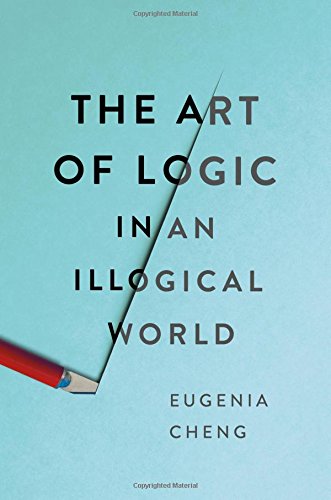
How both logical and emotional reasoning can help us live better in our post-truth world In a world where fake news stories change election outcomes, has rationality become futile? In The Art of Logic in an Illogical World, Eugenia Cheng throws a lifeline to readers drowning in the illogic of contemporary life. Cheng is a mathematician, so she knows how to make an airtight argument. But even for her, logic sometimes falls prey to emotion, which is why she still fears flying and eats more cookies than she should. If a mathematician can’t be logical, what are we to do? In this book, Cheng reveals the inner workings and limitations of logic, and explains why alogic — for example, emotion — is vital to how we think and communicate. Cheng shows us how to use logic and alogic together to navigate a world awash in bigotry, mansplaining, and manipulative memes. Insightful, useful, and funny, this essential book is for anyone who wants to think more clearly.
User’s Reviews
Editorial Reviews: Review “It’s a shame that not everyone can read this book, but Cheng claims it is incumbent on those of us who can to use compassion and logic to argue productively with those who can’t. In this way, advanced mathematics could make a meaningful contribution to creating a better society as well as happier conversations and relationships. There is a sense in which this book is proof it can.”―Guardian “Following in the tradition of George Boole, Lewis Carroll and John Venn, who provided algebraic or diagrammatic aids to logical calculation, Eugenia Cheng enhances her reputation as a popular mathematics writer with this perceptive analysis of logic and its limitations.”―Times Higher Education “Cheng’s book covers the basics of logic, argumentation, and emotion through humor and an excellent use of illustrations like ice cream, sexism, and Gödel’s Incompleteness Theorem.”―MAA Reviews”Entertaining… a very welcome primer in logical thinking.”―Kirkus Reviews”Cheng’s suggestion to combine the persuasive powers of logic with emotional appeal to find common ground is original and pragmatic, particularly in these divisive times.”―Publishers Weekly”With humor, grace, and a natural gift for making explanations seem fun, Eugenia Cheng has done it again. This is a book to savor, to consult, and to buy for all your friends. You’ll think more clearly after reading this book, something that is unfortunately in short supply these days. I am buying several copies to send to heads of state.”―Daniel J. Levitin, Ph.D., New York Times bestselling author of This Is Your Brain on Music and The Organized Mind”This book is empowering! Eugenia Cheng makes logic alive and relevant with prose that is accessible, clear and engaging. In this masterpiece, you will learn how the power of logic can clarify some of the most pressing issues that confront us, as individuals and a society.”―Stephon Alexander, author of The Jazz of Physics and professor of physics, Brown University About the Author Eugenia Cheng is Scientist in Residence at the School of the Art Institute of Chicago and an Honorary Visiting Fellow at City, University of London. She has authored numerous titles, including How to Bake Pi, Beyond Infinity, and x + y. Cheng lives in Chicago, Illinois.
Reviews from Amazon users which were colected at the time this book was published on the website:
⭐Math: a subject that is often misunderstood. Seen by many as a nuisance in school: full of rote memorization of methods and theory. Divorced from the real world. Only caring about the answer, not how the answer was derived. But what if this view, a very common and tradition view, was wrong? Or at the very least shallow? In her book, The Art of Logic in an Illogical World, mathematician Eugenia Cheng explores the concept of mathematical logic. From the principles that underlie mathematical logic to its application and limitations with real-world issues, the author seeks to show that mathematical logic can provide much needed elucidation on complicated issues that plague humanity. And for the most part, she succeeds.One of the most impressive aspects of this book is how it is written. The biggest obstacle when it comes to popular science books is that they must maintain a balance between entertaining and informing the reader. Lean too far towards informing, and one risks boring the reader and not imparting any information. Lean too far towards entertainment and one risks not only not imparting any information, but imparting poor information which may set the reader even further back. This book manages a deft balance between the two extremes, managing a tone that while is semi-formal is also nonetheless conversational. Any mathematical term or concept is thoroughly explained in simple English. And the author when applicable uses her own experiences with using logic to explore her beliefs. All these aspects together create a work that never speaks down to the audience or tries to condescend. Rather, it feels like a work that understands its audience and tries to engage with the audience on a mutual level of understanding.Another thing to appreciate about the book is the fact that it explores the limitations of logic and not just paradoxes, though those are discussed in the book. Rather, the book explores the role of emotions and intuition in shaping one’s logic. She notes that even if one tries to dissuade themselves of a belief they know is harmful through logic or information, without engaging one’s emotional reasoning, it can be difficult to change. Segueing into conversations over difficult issues, she notes that while it can be gratifying to try to overwhelm an opponent through facts and information it does little to actually promote understanding. That to truly convince someone of one’s position, you have to not only engage their logic with your own, but their emotional reasoning with your own emotional reasoning. Or in other words, to have some compassionate empathy for the person you are debating. Without that component, she argues that even if you manage to convince them of the logical aspects of your goal or position, there will always be a shred of doubt due to not engaging the emotional aspect of the reasoning. I feel that this is an important concept for the book to explore due to the fact that it does feel like a lot of conversations, as they take place both in person and online, tend towards posturing oneself as being the most rational of the debaters. Trying to score brownie points in a game that has no winners or losers, or end. Thus to find a way to circumvent that aspect of conversations is a noble endeavor.In short, I truly adore this book. I feel that it has a lot of useful applications for those interested in math or want nothing to do with math.
⭐I’m a layperson with a natural tendency towards logical analysis, yet my lack of formal training made it difficult to identify certain logical fallacies until after the fact. I needed a book that broke down logical thinking and pitfalls which I could apply in the real world.This book is full of practical insights and is equally entertaining. Cheng pokes fun at her weight loss anxiety and love of ice cream throughout to keep light the subject matter of contrapositives vs converse, category theory, and the equally essential aspect of emotions and logic in public debates on racism and sexism.You will come away feeling glad you read this book.
⭐I just purchased Eugenie Cheng’s book and just started reading it. I find the comments who didn’t like the interesting in that the main complaint they have is about her political views as if being Logical is like being an emotionless machine. The comments actually are the reason why we need the tools of logic to learn how to think and form good arguments.Case in point: You can’t agree with the statement “All Lives Matter” and not agree with the statement “Black Lives Matter” because when you say “ALL” , that includes everyone along with the Lives of Black people. So if you don’t support the statement “Black Lives Matter”, then you don’t actually believe All Lives Matter. It’s an illogical and contradictory statement.
⭐This book was interesting and had its moments, but overall felt like a bit of a slog to read. It’s clear that this writer is a mathematician since their prose is often very dry and uses very little figurative language or other devices to make it interesting. Also, the author tends to get caught up trying to preempt counterarguments to her points, making some sections very twisty, dense and not fun to read. I agree with other reviewers that the author relies a little too heavily into current sociopolitical issues. I imagine in her mind disagreements with racism and sexism are untenable positions so those were easy examples for her to use. To a point it does work, but sometimes it feels as though Cheung is strawmanning her opponents. Perhaps her points would have been better illustrated by using an apolitical example before moving on to a political one.All in all, the writing style wasn’t my favorite, but there were things I learned about logic from this book and I think the concluding thought about intelligent argumentation is a nice one that we should all strive to follow.
⭐This is an excellent work and insight into the meaning of logical and constructive dialogue, but be aware that this is NOT a course in informal logic.I had hoped that a slightly greater emphasis would have been placed on the technical aspects of informal argumentation, and a bit less on the analysis of some social dynamics, but, all told, there are hidden gems here that are sure to cleanse one’s mental windshield with some very effective windshield wipers.And that is most logical.
⭐I wish that the author had said from the outset « We should not pit ourselves in futile battles against other humans with whom we are trying to coexist on this earth. Are we ? The author explain how we can use logic and emotions to cooperate. Are we playing a zero-sum game to win instead ? Do we argue to find the truth or to win the argument ? If you don’t buy cooperation, don’t buy this book. If you believe we can and should coexist, the book shows a clear path to do it. Hope to meet you there…
Keywords
Free Download The Art of Logic in an Illogical World in PDF format
The Art of Logic in an Illogical World PDF Free Download
Download The Art of Logic in an Illogical World 2018 PDF Free
The Art of Logic in an Illogical World 2018 PDF Free Download
Download The Art of Logic in an Illogical World PDF
Free Download Ebook The Art of Logic in an Illogical World