

Ebook Info
- Published: 2005
- Number of pages: 178 pages
- Format: PDF
- File Size: 10.84 MB
- Authors: Stephen I. Brown
Description
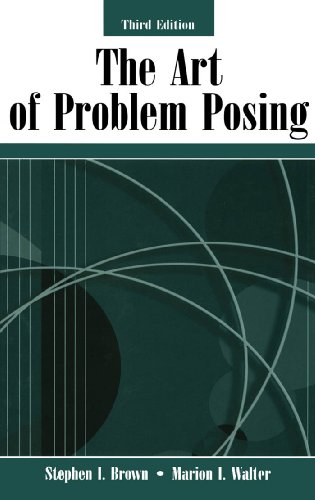
The new edition of this classic book describes and provides a myriad of examples of the relationships between problem posing and problem solving, and explores the educational potential of integrating these two activities in classrooms at all levels. The Art of Problem Posing, Third Edition encourages readers to shift their thinking about problem posing (such as where problems come from, what to do with them, and the like) from the “other” to themselves and offers a broader conception of what can be done with problems. Special features include: an exploration of the logical relationship between problem posing and problem solving; sketches, drawings, and diagrams that illustrate the schemes proposed; and a special section on writing in mathematics.In the updated third edition, the authors specifically:*address the role of problem posing in the NCTM Standards;*elaborate on the concept of student as author and critic;*include discussion of computer applications to illustrate the potential of technology to enhance problem posing in the classroom;*expand the section on diversity/multiculturalism; and*broaden discussion of writing as a classroom enterprise.This book offers present and future teachers at the middle school, secondary school, and higher education levels ideas to enrich their teaching and suggestions for how to incorporate problem posing into a standard mathematics curriculum.
User’s Reviews
Reviews from Amazon users which were colected at the time this book was published on the website:
⭐The Art of Problem Posing is a great book. The authors provide a step by step method for learning about, and solving problems in, mathematics. The method is as follows:Level O:Choose a starting point ie a problem or a concept in mathLevel 1:Define the attributes of a problem or conceptLevel 2:Ask what if not for each concept.Level 3:Ask Questions about the results of 0 – 2.Level 4:Analyze (solve) the problemThe authors use fairly accessible math in the process of explaining their techniques, including the Pythagorean Theorem and a few other concepts that most people will know.I want to emphasize that this book is not just about problem posing; it also offers a technique for problem solving. The authors note that the two cannot really be completely separated.
⭐Written at an elementary level, but the insights are fantastic. I don’t know if the mathematically astute think analogously to the manner taught in this book, but it seems there would be something here for everyone — excluding maybe professionals. Also, the book is so short that it can be read (and re-read if need be) speedily until the strategies are second nature. I was as excited reading this as I was Polya’s series — but the two cover different aspects of mathematical investigation. I’m glad this book was written and that I found it!
⭐It’s a classic book for teachers in their first steps attempting to incorporate problem posing into their teaching repertoire techniques. If it is intended for academic purposes you should be aware that recent research has not been a part of the writer’s focus.
⭐
⭐
Keywords
Free Download The Art of Problem Posing 3rd Edition in PDF format
The Art of Problem Posing 3rd Edition PDF Free Download
Download The Art of Problem Posing 3rd Edition 2005 PDF Free
The Art of Problem Posing 3rd Edition 2005 PDF Free Download
Download The Art of Problem Posing 3rd Edition PDF
Free Download Ebook The Art of Problem Posing 3rd Edition