

Ebook Info
- Published: 2008
- Number of pages: 528 pages
- Format: PDF
- File Size: 1.51 MB
- Authors: Stanley Hauerwas
Description
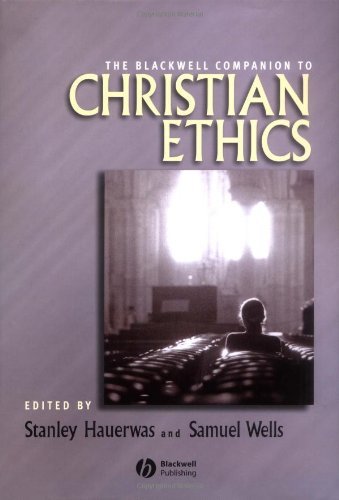
The Blackwell Companion to Christian Ethics presents a comprehensive and systematic exposition of Christian ethics, seen through the lens of Christian worship. An innovative exposition of Christian ethics, seen through the lens of Christian worshipChallenges conventional approaches to the subjectRestores a sense of the integral connection between Christian ethics and theologyStanley Hauerwas is one of the most influential figures in Christian ethics around the worldEmbraces contributors from the Roman Catholic, Anglican, Methodist, Presbyterian, Mennonite and Pentecostal traditionsDesigned to be accessible to introductory studentsWill have a major impact on the discipline of Christian ethics
User’s Reviews
Reviews from Amazon users which were colected at the time this book was published on the website:
⭐The Blackwell Companion to Christian Ethics, edited by Stanley Hauerwas and Samuel Wells is one of the several ways in which one can approach the subject (and one I had not thought of until I encountered this book as a text in a class on Christian ethics). This should not be surprising, because the authors plainly declare that “We hope that, years form now, this book will be seen as a milestone for Christians….we are convinced that this book represents a new turn not only for Christian ethics, but also for the way Christians learn to live in that time often identified as “late modernity”.So this presents itself as a new approach, and I am not in a position to challenge that claim. One thing which is “old” is the fact that it uses “ethics” in a way different from those in Philosophy departments who write about morality. For them, Ethics is not the prescription of behavior. That is “morality”. “Ethics” is the study of what questions does morality ask, and how does it justify its answers. For the Christian, that role is taken by theology. For the Christian, “Ethics” is virtually synonymous with the answer to the question “what is moral behavior?”What we have said so far means that this book would NOT be an acceptable text on the history of Christian ethics. For that, go to J. Philip Wogaman’s “Christian Ethics”. I might also point out that, with Hauerwas, at least, the theology behind this book is what is known as “narrative” or “post-liberal” theology, which is embedded in how a community understands its beliefs. And, since the ultimate act of Christian worship is the celebration of the Eucharist, it is around this and other themes of worship that the study of “what we ought to do” is based.I concur with the authors that I am surprised at this connection. The link with preaching, homiletics, and hermeneutics would seem make far more sense. But I also concur with the authors that it makes no sense that liturgy, ritual, creeds, and sacraments should not be kept in a separate, less important pigeon-hole. This separation can be traced back to Kant, who enshrined the split between doctrine and behavior, between the transcendental and the practical, which seemed to sunder morality from theology. The remaining three causes for the separation are elaborations on that one, except that the second is important in connecting Hauerwas’ brand of theological thinking with pre-Kantian theology, especially as laid out by Jonathan Edwards. This aspect is the separation of action from beauty. This is the most artificial, as both morality and art come under the rubric of value. That means there are far greater similarities between judging a painting or a wine or a novel as good and judging behavior, than there is between all sorts of value judgments and matters of fact. Of course, if you are mistaken about the facts of the matter, that will unquestionably influence your value judgments.One of the simplest ways to explain the connection between worship and secular behavior is to compare worship, taken as a whole, the liturgical year, as a great play which offers us models by which we may guide our daily life. To take a simplistic example, by watching Shakespeare’s ” A Midsummer Night’s Dream”, one may come away with a greater tolerance for the directions (and absurdities) the gales of romantic love may propel those so driven. Close attention to the creeds, the prayers of intercession, and even the hymns may strike a chord you can carry with you throughout the week. Does it not seem odd that it is so important to have the church officiate over once per lifetime birth, death and (in principle) marriage, once a year Christmas and Easter, and once a month (for many churches) Eucharist, and we leave that all behind when we walk out of those heavy wooden doors. Hauerwas’ narrative theology is based on the fact that life is cut from a single bold of fabric, and we should behave in that manner.The authors claim that Christian ethics is a recent invention, arising out of Kant’s watershed work on the nature of moral philosophy. This is only partly true. What Kant did was to separate for good the difference between secular and theological ethics. But that split began at least as early as John Locke’s works on moral thinking, and it was in full swing when Jonathan Edwards wrote the last major treatise which synthesized secular and theological virtue. But formal Christian moral thinking is at least as old as Clement of Alexandria’s (150 – 215) second of three major works, the Paedagogus, an ancient guide to teaching morality to children / new Christians. Other major milestones are Augustine’s writings, Aquinas’ theory of Christian virtues, and Erasmus’ (1466 – 1536) “Handbook of a Christian Soldier” (1503).What is new is the style of Christian thinking which evolved around the turn of the last century, with Ernst Troeltsch’s “The Social Teaching of the Christian Churches” (1912), Richard Niebuhr’s “Christ and Culture” (1951), and John Howard Yoder’s “The Social Teaching of Christ” (1959). The way I interpret what Hauerwas is saying is that what is new is that the church went down the path laid out by Kant, which separated the practical from the emotional experience of the noumenal (value). I take the authors to mean that they wish to mend that rip in the fabric of Christian life. A tall task, but totally in keeping with Jesus’ teaching that what we do should authentically reflect our intentions and ritual statements.The book is an anthology of 36 pieces, written by people from every color of the denominational spectrum, from Catholics to Mennonites, including, somewhere in the middle, no less than Rowan Williams, the Archbishop of Canterbury. What surprises me is that there seems to be little representation of the notion of Discipleship. The emphasis is on both liturgical and public policy issues such as Baptism, Marriage, Communion, Euthanasia, Stewardship, Justice, Ecology, and the aesthetics of worship. That last subject I suspect is robust enough to be treated separately, but am glad to see it represented.The bottom line is that the editors have a particular agenda. If the book were to be used in a Christian Ethics course, it could not be the only text. You may not even want it at all, if your primary intention is social and practical issues. The level of narrative tends to be relatively abstract. If you are reading for your own information, you may prefer to start with Niebuhr and Yoder.
⭐Great text however… the binding is really bad. It fell apart as soon as I started reading it. It is really distracting while trying to read.
⭐intensive text to open minds
⭐Quick service. great book.
⭐exactly what I was looking for
⭐I was glad to recieve the book in the excellent condition and in the prescribed time frame.
⭐There simply is no other book like this on the market. In terms of Christian ethics, the editors require us to see that our worship, the manner in which we are liturgically formed, produces the kind of people we are. They begin with a few chapters explaining how Christian ethics came into being, and how they are determined by our worship practices. What follows are creative/provocative essays that span a wide range of issues including: gender, war, abortion, money, marriage, euthanasia, sex, arts, politics, and the environment. What renders this such an incredible book is how the authors explore what the eucharist, baptism, hymn-singing, footwashing, passing the peace, prayer, and other Christian practices have to do with the aforementioned issues. If you are interested in Christian ethics, and you want to read an accessible book from reputable sources, then you can do no better than this book.
⭐This book enables you to consider alternative views of ethocal approaches and decision making than those commonly used in UK medical ethics discussions (Beauchampt & Chldress, Seedhouse etc.). It is useful in both theological and ethical discussions to promote discussion. My only problem with buying this in the Kindle version is the difficulty getting to alternative chapters, rather than plodding my way through every page. As a mere student I can’t afford to update my model, so I will have to stick to the traditional approach, page by page!
⭐Excellent for continuing reference
⭐A good academic read
⭐An excellent read covering topics I detail
Keywords
Free Download The Blackwell Companion to Christian Ethics (Wiley Blackwell Companions to Religion Book 15) 1st Edition in PDF format
The Blackwell Companion to Christian Ethics (Wiley Blackwell Companions to Religion Book 15) 1st Edition PDF Free Download
Download The Blackwell Companion to Christian Ethics (Wiley Blackwell Companions to Religion Book 15) 1st Edition 2008 PDF Free
The Blackwell Companion to Christian Ethics (Wiley Blackwell Companions to Religion Book 15) 1st Edition 2008 PDF Free Download
Download The Blackwell Companion to Christian Ethics (Wiley Blackwell Companions to Religion Book 15) 1st Edition PDF
Free Download Ebook The Blackwell Companion to Christian Ethics (Wiley Blackwell Companions to Religion Book 15) 1st Edition