

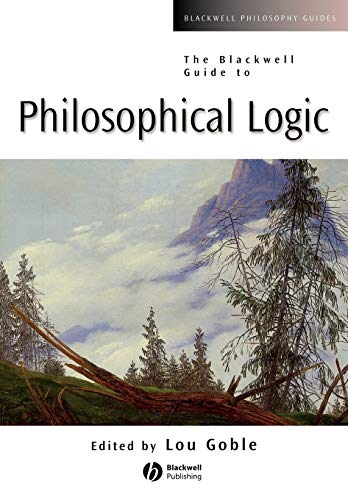
Ebook Info
- Published: 2001
- Number of pages: 528 pages
- Format: PDF
- File Size: 18.44 MB
- Authors: Lou Goble
Description
This volume presents a definitive introduction to twenty core areas of philosophical logic including classical logic, modal logic, alternative logics and close examinations of key logical concepts.
User’s Reviews
Editorial Reviews: Review “Suppose your friend – or your student, or yourself – knows a little logic and a little philosophy. If you wish that person to gain an early appreciation of philosophical logic, then this book is a perfect gift – or assignment, or purchase. Written by outstanding philosophical logicians, its clear and authoritative chapters guide the reader directly into the heart of each topic. There are enough details to create genuine understanding, but not so many as to intimidate. The term ‘guide’ is exactly the right word for this splendid book.” Nuel Belnap, University of Pittsburgh “This is an excellent collection of articles covering the main areas of philosophical logic, written by front-line, internationally known researchers in the field. It should be available in every serious library.” Dov Gabbay, King’s College, London “This volume on philosophical logic is a welcome and manageable resource. The editor is to be congratulated both on his choice of material and on his choice of collaborators. The result is a well-balanced mix of authoritative overviews of classical mathematical logic and up-to-date accounts of topics in linguistics and computer science.” Krister Segerberg, Uppsala University “These twenty chapters cover the areas of logic of greatest interest to philosophers, and also to computer scientists, linguists, and cognitive scientists. They are written by world-class authorities in their fields and give comprehensive and definitive introductions to their subjects.” Ernie Lepore, Rutgers University “For those interested in the philosophy of logic an excellent place to turn would be The Blackwell Guide to Philosophical Logic edited by Lou Goble. The book consists of 20 specially written essays by distinguished figures in the field, each with an editor’s introduction.” Times higher Education Supplement “The intended readership is philosophers and logicians, but there is much that will be of interest to computer scientists, cognative scientists and theoretical linguists. The Book is accessible to non-experts and experts will find much substance in the essays.” Studia Logica Book Description The Blackwell Guide to Philosophical Logic is a cutting edge volume that introduces 20 core ideas of philosophical logic, including classical logic, modal logic, alternative logics, & close examinations of key logical concepts. From the Inside Flap This volume presents a definitive introduction to twenty core areas of philosophical logic including classical logic, modal logic, alternative logics and close examinations of key logical concepts. The chapters, written especially for this volume by internationally distinguished logicians, philosophers, computer scientists and linguists, provide comprehensive studies of the concepts, motivations, methods, formal systems, major results and applications of their subject areas. The Blackwell Guide to Philosophical Logic engages both general readers and experienced logicians and provides a solid foundation for further study. From the Back Cover This volume presents a definitive introduction to twenty core areas of philosophical logic including classical logic, modal logic, alternative logics and close examinations of key logical concepts. The chapters, written especially for this volume by internationally distinguished logicians, philosophers, computer scientists and linguists, provide comprehensive studies of the concepts, motivations, methods, formal systems, major results and applications of their subject areas. The Blackwell Guide to Philosophical Logic engages both general readers and experienced logicians and provides a solid foundation for further study. About the Author LOU GOBLE is Professor of Philosophy at Willamette University. He has published numerous articles in philosophical logic in various anthologies and journals such as Journal of Philosophical Logic, Logique et Analyse, Notre Dame Journal of Formal Logic, and other more general philosophy journals. Read more
Reviews from Amazon users which were colected at the time this book was published on the website:
⭐When one first learns of logic as a special discipline, one is told it is something like “training in the art of correct reasoning”; the importance and appeal of logic, even its conceivability, seems to rest on there being only one right way to reason. For a little less than a century, logicians and philosophers went questing for the One True Logic, where translation of philosophical problems into its regimented syntax would make all clear. However, by the middle of the 20th century it was all over: the limitations of first-order logic forced formal thinkers to develop a plurality of logics, different formalizations of reasoning for different purposes. This almost sounds like crazy science fiction, but it’s quite real and the *Blackwell Guide to Philosophical Logic* is an excellent starting-point for thinking about “non-classical logic”: why we need it and what we can do with it.Strictly spoken, philosophical logic is separated from “mathematical” logic not by its methods but by its intent: analytic philosophers are keen to develop rigorous theories of things like truth and knowledge, but many of the features of the common-sense concepts philosophy works with cannot be perspicuously rendered in “plain old” first-order logic. For example, the definition of the conditional (“if p then q”) in ordinary mathematical logic is very straightforward: a conditional is true if its antecedent is never true when its consequent is false. This definition permits of an easy symbolization using truth-tables, but makes room for some very strange “paradoxes of implication”: “If the moon is made of cheese, then New York is in Germany” is a true statement under the “material” or “Megarian” interpretation of the conditional — the moon isn’t ever made of cheese, so any consequent, even a false one, will make the statement true.Philosophical logicians working with “relevance” logic reject the material conditional, and have devised systems of reasoning with additional principles necessary to enforce a meaningful connection between premise and conclusion. However, as often happens in philosophical logic the semantics of relevance logic, its interpretation in terms of mathematical structures, is considerably more complicated than that of classical logic: relevance logicians had to wait 20 years for a workable semantics for propositional relevance logic to be developed by researchers in Australia (some would say they’re still waiting for a usable semantics for quantified relevance logic). Learning about meaningful non-classical logics is a heady experience, and relevance logic is only one small part of philosophical logic as it is practiced today: understanding phenomena in metaphysics, ethics, linguistics and even math itself requires resources first-order logic just doesn’t have.The score of introductory articles included here on modal, temporal, relevance, and other logics — as well as a few background articles on basic logical principles to warm up — are written by top minds in the field: learning about logical semantics for natural language from Alice ter Meulen or the “new theories of truth” (for languages that contain their own truth predicate) from Anil Gupta is as good as it’s going to get. There is much exposition but relatively little proof: the book will be accessible to anyone with some understanding of philosophy and logic; in fact, the book might conceivably have some “gift value” for young researchers who want friends and family to get a little of what it is they “do”. However, people who are really going to need these logics for work in philosophy, computer science etc. will have to look elsewhere quite soon; if you are a young grad student on the make, you might take a quick look at this and move on to Graham Priest’s more “technical’ *Introduction to Non-Classical Logic*.A useful compendium of fascinating theories.
⭐There is a brief and probably terse-for-most introduction to classical first-order logic by Hodges. It spans 23 pages, so it’s expected. However, if you have some formal training, e.g. from an introductory course on predicate logic, many of the articles in the book won’t be too tough. Some of them seem surprisingly advanced (e.g. the ones on intuitionist logic, many-valued logics, and relevant logics, respectively), either because the authors are being thorough or unnecessarily complicated. It is apparent when they are guilty of one rather than the other (or both for that matter). E.g., the intuitionist article is just thorough, and the introduction of combinators in the relevant logics chapter doesn’t fit for this sort of introduction to the subject (though the rest of it is quite good).Otherwise, most of the chapters are accessible and very good introductions to various areas of philosophical logic with the added bonus of containing decent bibliographies and “Suggested further readings” at the end of each. A quick look at the introduction reveals that the list of contributors are currently at the forefront of their respective fields. It is one of the better anthologies on philosophical logic available, especially for the price.
⭐Better quality than expected.
⭐Good survey of various interesting topics. Highlight is certainly a superb and enthralling chapter on incompleteness by Raymond Smullyan. He has some great and thought-provoking puzzles, and some very minimal descriptions of incompleteness, first and second.For some of the other chapters, I would have preferred a clearer discussion of the exact deep theorems. Thus, the epistemic and modal discussions seemed a bit definition-heavy.Maybe it’s me, but I find the reverse subset symbol for implication less clear than the double arrow one. Not sure why they use the former.Would have preferred more on probability, although there is one chapter. Notably missing is a discussion of fuzzy logic. Maybe quantum logic would have been helpful too.Valuable reference.
⭐This book is NOT an introduction to philosophical logic. If you have not had ample exposure to formal logic or mathematical reasoning this book will likely be out of your reach (I would recommend that you start with Gensler’s “Introduction to Logic”, take a couple courses in Calculus and then tackle this book). For those with the requisite background this work offers a direct, concise rendering of the various subfields of formal philosophical logic including propositional logic, predicate calculus, Godel’s Theorem, Fuzzy Logic, Modal Logic, Deontic Logic and much more. The text stresses rigour, so its paragraphs are dense with definitions and symbols. There are no excercises and, as such, this book is best used as a reference. This book is highly recommended for anyone with a solid background in formal logic who is looking for a broad collection of essays to explain the philosophical implications of various systems of formal logic.
⭐Great overview of several types of logic, and not only for the philosopher – coming from the computational/mathematical side of things, this quickly filled my “find out about X” stack with several new directions to explore. Yes, first-order classical logic is not everything (hey, teachers in high school didn’t even ALLUDE to that…). Sadly for me computers can be easily swamped trying to prove statements in anything more expressive than fragments of FOL with equality. Well, logic programming is still a very fruitful field full of practical solutions of high relevance.This brings me to the fact that the text is from 2001, practically from before the Internet, so maybe an update is required. There seems to have been considerable work on various logics and their interpretations since then – and even before, work that is now “bubbling up”. In particular, a chapter with a link to computation and complexity theory would be welcome. Girard’s linear logic is interesting to discuss. I would hazard that the chapter on “Probability, Logic, and Probability Logic” needs updating with the work by (among others) Judea Pearl and his discussion of Causality.P.S. This book goes well with the excellent “Computability: Turing, Gödel, Church and Beyond” by MIT Press. And with the Stanford Encyclopedia of Philosophy on the ‘net.
Keywords
Free Download The Blackwell Guide to Philosophical Logic 1st Edition in PDF format
The Blackwell Guide to Philosophical Logic 1st Edition PDF Free Download
Download The Blackwell Guide to Philosophical Logic 1st Edition 2001 PDF Free
The Blackwell Guide to Philosophical Logic 1st Edition 2001 PDF Free Download
Download The Blackwell Guide to Philosophical Logic 1st Edition PDF
Free Download Ebook The Blackwell Guide to Philosophical Logic 1st Edition