Ebook Info
- Published: 2017
- Number of pages: 569 pages
- Format: Epub
- File Size: 3.80 MB
- Authors: S. A. Chakraborty
Description
Step into The City of Brass, the spellbinding debut from S. A. Chakraborty perfect for fans of The Golem and the Jinni, The Grace of Kings, and Uprooted, in which the future of a magical Middle Eastern kingdom rests in the hands of a clever and defiant young con artist with miraculous healing gifts.
On the streets of eighteenth-century Cairo, Nahri is a con woman of unsurpassed skill. She makes her living swindling Ottoman nobles, hoping to one day earn enough to change her fortunes. But when Nahri accidentally summons Dara, an equally sly, darkly mysterious djinn warrior, during one of her cons, she learns that even the cleverest of schemes can have deadly consequences.
Forced to flee Cairo, Dara and Nahri journey together across hot, windswept sands teeming with creatures of fire and rivers where the mythical marid sleep, past ruins of once-magnificent human metropolises and mountains where the circling birds of prey are more than what they seem, to Daevabad, the legendary city of brass.
It’s a city steeped in magic and fire, where blood can be as dangerous as any spell; a city where old resentments run deep and the royal court rules with a tenuous grip; a city to which Nahri is irrevocably bound—and where her very presence threatens to ignite a war that has been simmering for centuries.
*Finalist for the World Fantasy Award: Best Novel
*Nominated for the Locus Award: Best First Novel
*Finalist for the British Fantasy Award: Best Newcomer
Featuring a stepback and extra content including a bonus scene and an excerpt from The Kingdom of Copper.
User’s Reviews
Review “The City of Brass is the best adult fantasy I’ve read since The Name of the Wind. It’s stunning and complex and consuming and fantastic. You must read it.” — Sabaa Tahir, #1 New York Times bestselling author of An Ember in the Ashes“An opulent masterpiece. Chakraborty’s debut is desire-soaked, intrigue-laced, and rife with so-delicious-you’ll-sink-your-teeth-into-it worldbuilding and equally mesmerizing characters. A must-read.” — Roshani Chokshi, New York Times bestselling author of The Star-Touched Queen“[The City of Brass] reads like an invitation for readers from Baghdad to Fairbanks to meet across impossibly divergent worlds through the shared language and images of the fantastical.” — New York Times Book Review“Chakraborty writes a winning heroine in Nahri — flawed but smart and engaging. And her portrayal of the cultural conflicts in the magical city of Daevabad and of Ali’s inner turmoil is compelling and complex, serving as a strong counterpoint to the thrilling action.” — Washington Post”I loved the protagonist, there was a nice cast of supporting characters, and the plot had some twists and turns that I did not see coming… Her style is vivid and colourful and very readable. The best thing, though, was the setting. Instead of drawing on the European Dark Ages and Middle Ages, Chakraborty evoked the flavours of the Middle East and ARABIAN KNIGHTS and the legends of the djinns. I enjoyed the novel hugely, and I just ordered the second and third books in the trilogy so I may continue the adventure.” — George R.R. Martin“Chakraborty’s debut dazzles…The City of Brass takes readers on an emotional roller-coaster, leaving them with an open ending that will have them desperate for the follow-up. Majestic and magical.” — Shelf Awareness (starred review)“Against [a] syncretic yet nonderivative and totally credible backdrop, Chakraborty has constructed a compelling yarn…culminating in a cataclysmic showdown that few readers will anticipate….Best of all, the narrative feels rounded and complete yet poised to deliver still more. Highly impressive and exceptionally promising.” — Kirkus Reviews (starred review)“This lyrical historical fantasy debut brings to vivid life the ancient mythological traditions of an Islamic world…Chakraborty’s grasp of Middle Eastern history, folklore, and culture inspires a swiftly moving plot, richly drawn characters, and a beautifully constructed world that will entrance fantasy aficionados.” — Library Journal (starred review)“The City of Brass is more than a promising debut — it beguiles all the way…Chakraborty’s research and imagination are equally strong, and she deftly sets up a rich world — and ample suspense — for the rest of this trilogy.” — Vulture (The Ten Best Fantasy Books of 2017)“It’s hard to describe just how gorgeous and intricate this fantasy novel is.” — SYFY Wire –This text refers to the paperback edition. Amazon.com Review An Amazon Best Book of November 2017: George R. R. Martin’s Game of Thrones meets Naomi Novik’s Uprooted in this marvelous debut fantasy about a young con artist from 18th century Cairo who learns that her mysterious parentage—and her ability to work small magics—might be connected to the nearly forgotten legends of the djinn, Suleiman the Magnificent, and the mysterious brass city of Daevabad. When Nahri accidentally summons Dara, a djinn warrior with a long and bloody past, she plunges both of them into the brewing animosity among the ancient djinn tribes united only by their disdain for their half-human offspring, who have few rights in the djinn stronghold of Daevabad. But not all djinn think the half-humans should be persecuted. Alizayd, the djinn king’s second son, works in the shadows to right wrongs even as surging tensions birth battles in the streets. Deep and gorgeous world building plus the political plot corkscrews caused me to happily ruminate on this book and its characters weeks after I finished it. I have a few quibbles—Nahri doesn’t have as much to do in the second half as in the first—but Chakraborty’s heck of a finale was both a surprise and felt completely right…and left me quivering with anticipation for the second book in the trilogy. —Adrian Liang, The Amazon Book Review –This text refers to an alternate kindle_edition edition. From the Inside Flap Nahri has never believed in magic. Certainly, she has power; on the streets of eighteenth-century Cairo, she’s a con woman of unsurpassed talent. But she knows better than anyone that the trades she uses to get by–palm readings, zars, and a mysterious gift for healing–are all tricks, both the means to the delightful end of swindling Ottoman nobles and a reliable way to survive. But when Nahri accidentally summons Dara, an equally sly, darkly mysterious djinn warrior, to her side during one of her cons, she’s forced to reconsider her beliefs. For Dara tells Nahri an extraordinary tale: across hot, windswept sands teeming with creatures of fire and rivers where the mythical marid sleep, past ruins of once-magnificent human metropolises and mountains where the circling birds of prey are more than what they seem, lies Daevabad, the legendary city of brass–a city to which Nahri is irrevocably bound.In Daevabad, within gilded brass walls laced with enchantments and behind the six gates of the six djinn tribes, old resentments run deep. And when Nahri decides to enter this world, her arrival threatens to ignite a war that has been simmering for centuries. Spurning Dara’s warning of the treachery surrounding her, she embarks on a hesitant friendship with Alizayd, an idealistic prince who dreams of revolutionizing his father’s corrupt regime. All too soon, Nahri learns that true power is fierce and brutal. That magic cannot shield her from the dangerous web of court politics. That even the cleverest of schemes can have deadly consequences. After all, there is a reason they say to be careful what you wish for . . .–Booklist –This text refers to an alternate kindle_edition edition. From School Library Journal Nahri, a common Cairo thief who can sense sickness in others and sometimes heal them, is thrust into a magical world when she accidentally summons a powerful djinn. The handsome Dara insists that he escort Nahri to the magical hidden Daevabad, the City of Brass, where Nahri will be protected by Prince Ali’s family, who have the power of Suleiman’s seal. Never sure whom to trust, Nahri must rely on her street smarts to survive the dangers of the beguiling city and the duplicitous natures of those who surround her. Chakraborty’s compelling debut immerses readers in Middle Eastern folklore and an opulent desert setting while providing a rip-roaring adventure that will please even those who don’t read fantasy. Though Nahri is in her early 20s, young adults will recognize themselves in her. The other narrator, Prince Ali, is an 18-year-old second son who doubts the current class structure of his kingdom. Chakraborty’s meticulous research about Middle Eastern lore is evident, but readers won’t be bogged down by excessive details. VERDICT A must-purchase fantasy for all libraries serving young adults.—Sarah Hill, Lake Land College, Mattoon, IL –This text refers to an alternate kindle_edition edition.
Reviews from Amazon users, collected at the time the book is getting published on UniedVRG. It can be related to shiping or paper quality instead of the book content:
⭐ For fans of mythology, fantasy, and historical fiction, this is a great read. It took me awhile to get into it fully because I’m not a big fan of action packed road trips (which made up a fair sized portion of the beginning of the book), but once the story got to where it was going and the two pov characters met, I became hooked. However, unlike in the summery amazon gives for this novel, the Suleiman mentioned is not Sultan Suleiman I “the Magnificent” of the Ottoman Empire, but the prophet Suleiman, also known as Solomon. As disappointed as I was to figure this out, and no matter how little it related to “A Song of Ice and Fire”/”Game of Thrones,” also unlike their description, it was a very enjoyable read and I found I couldn’t put it down once I was about a third of the way through. Chakraborty makes the world she writes about come alive with a well fleshed out fictional history of the civilization and characters she created, and the political intrigues running through the book make each chapter ending a true cliffhanger.
⭐ What a fantastic debut novel. I expect this will be on many awards lists next year. I will certainly nominate it.Two things really leap out at me. First, the world-building is superb. The author is very good at showing, not telling, and there is a lot of mystery hinted as there is a great deal the characters themselves do not know about how the world works. It seems marids are as mysterious to djinn as djinn initially are to the reader. I am really looking forward to learning more in the next book. The Arabian Nights sort of setting is relatively uncommon in fantasy literature, and it’s nice to see more writing in that area (a tip of the hat here to Saladin Ahmed’s Throne of the Crescent Moon).Second, the characters are fascinating and sympathetic. This is particularly noteworthy as many of the characters are at odds with one another, yet I sympathized with each of them, even when they were in direct conflict! These are complicated, deeply human (in the emotional sense – they are nominally a variety of fantasy races) characters with strengths and weaknesses. They make mistakes, and their current states reflect that, but in each case you can understand why they did what they did. There is one scene where two of the main characters are doing their level best to kill one another. I loved both characters, and couldn’t really say that either was in the wrong. That’s a difficult task for a novelist to pull off, and a great achievement for a debut novel.
⭐ I was really intrigued by the concept of this book, but ultimately underwhelmed. It felt long, but like not much happened. Most of the time it felt like characters were just explaining things to each other for the whole book – meanwhile, not much was going on in terms of plot. There was a 50 or so page section at the end that got more interesting, but then nothing was resolved and instead the ending felt like more set up for the second book in this trilogy. I didn’t end up caring much about any of the characters and I didn’t think the author was very good at setting the scene and describing what was going on in a way that I could visualise. Overall, disappointing and I won’t be reading the second part of this trilogy.
⭐ I wanted to love this book. I love fantasy as a genre and was excited for one based on middle eastern culture. Unfortunately, this book lacks a plot whatsoever.The trope of a young woman with powers and background she doesn’t understand, surrounded by powerful people (mostly men) who refuse to tell her everything she should know because they “know better” than her, is infuriating. It makes my blood boil.How much more interesting would this story have been if the protagonist was given all pertinent information and we got to watch her – a girl who raises herself on the streets – navigate this rife and dangerous political landscape?That brings me to my next point – there is no plot. There is a beginning. And the book ends somewhere in the middle. That’s it. We didn’t see the female lead overcome anything, we didn’t see the male lead overcome anything. In fact, they are worse off than they started. I understand this is a trilogy but each book should be able to stand alone as a story and this is unfinished- an absolute atrocity considering its length. Given the reviews for the second book, I understand it ends in a major cliffhanger. Another sign of poor execution by a novice author.Don’t even get me started on Dara. The “romance” felt tacked on and cheap. In fact, if that had been left out, the last few chapters would have felt more authentic to his character. But we are supposed to sympathize with him and I just didn’t. Ali was boring and I skimmed most of his chapters but I see that as a better romantic match (and friendship).I plan to wait for the third book to drop and base my decision to continue this series on the reviews for the whole trilogy. But I am disappointed that a premise with such promise was so poorly executed.
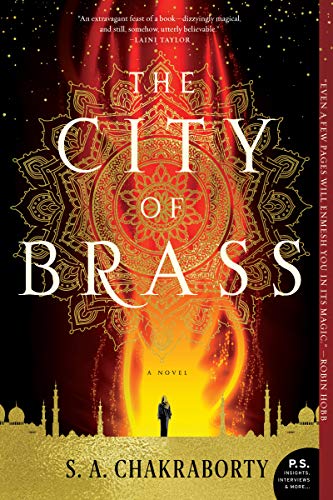
⭐ The City of Brass was a book I recognized from the cover but hadn’t heard many people talking about it. And then all of a sudden in the past month I was seeing it everywhere and it was getting rave reviews. So I decided it was time to request it from the library. And I’m happy I did!The main characters are all written so well. I felt like Ii easily knew them and I couldn’t help but love Nahri, Dara, and even Ali by the end. Nahri is such a badass character. When we first meet her she’s living in Cairo, Egypt stealing and conning people to survive. We learn she has this magical healing power but she doesn’t know where it came from or even where she comes from. I think her motives and her character arc are realistic and I easily rooted for her the entire way through the story. I do not typically have fictional literary crushes, but Dara is definitely an exception. I enjoyed his individual plot when it came to his past and his own character arc but also him and Nahri had amazing chemistry. They stole the show every time they had a scene together. I liked their friendship and I really loved their romance. I would have loved to see more. The one main character I wasn’t a huge fan of at first was Ali. He kind of drove me insane but by the end of the story he did warm up to me a bit more. I am not sure how I completely feel about him but he doesn’t annoy me as much anymore either.I love that on the cover and in the story it is shown/described that Nahri wears a head wrap (and even there’s a part where she wears one that covers everything but her eyes) because there isn’t many fantasy or even contemporary stories, at least in YA where that kind of representation is front and center in the story. I am so happy for any readers who will see themselves on the cover or even in Nahri herself. She’s an amazing character to relate to because of her strength and determination. Representation matters and I think this is a great example of that.The plot was an incredibly rich and it was thick with these beautiful Middle Eastern settings. I have not read a lot of fantasy (or really, any genre) set in the Middle East so this whole atmosphere is very new to me. The added on Middle Eastern mythology, food, clothing, and culture made the reading experience come alive way more than a lot of fantasy novels I’ve read, especially the first in a series. I loved learning about this world and it’s one of the best fantasy worlds I’ve read in a very long time. However, the pacing for this book did have me feeling a bit nervous I was entering in a reading slump territory. It took me longer than it typically would for me to really get hooked into the story and I found myself having to put my phone across the room so I wouldn’t let myself get distracted at every new chapter. It wasn’t until about 250 pages into the story where I actually felt hooked and needed to keep reading. I think taking your time reading the story may be the best way to read it because there are so many important details in the different djinn tribes and it could have been confusing if I tried speeding through the story.The writing, like I mentioned earlier, is so well done with the setting and fantastical world Nahri is thrown into. I also love a lot of the dialogue, especially between Nahri and Dara because of their playful banter and how comfortable they are with each other. Although I enjoyed a lot of the dialogue and I loved the world, I also felt a bit of a disconnect emotionally when it came to the characters. It was weird, because on one hand I liked them a lot and I thought they were well written, but there was something detaching myself from being emotionally invested as much as I normally would have been. I think it may be because I was so focused on the political intrigue, the different tribes of djinn, and even the history of the djinn and the characters. As I was reading I noticed the kindle e-book edition was only two dollars so I snagged it immediately. So I plan on re-reading it before the release of the second one and I am hoping now that I have read it once I can be more emotionally invested in the next read.Unfortunately, that plus the pacing is why I gave it four stars instead of the five I would have given it if I didn’t have those issues.I highly recommend this book. I think it is a beautiful fantasy story and I am definitely reading the second book the moment it comes out because I need to know what is going to happen next. If you’re a fan of the fantasy genre, worlds rich with culture and mythology, an amazing cast of characters, and some terrifying villains, I recommend picking up The City of Brass.
⭐ Let’s get to the heart of the question: should you read this book.YES! Hands down YES!”Tell me why nena, but don’t tell me what HAPPENS.”OK *Sucks in deep breath.*- brooding warriors who SLAY- magic cities with potions, betrayals, curses, revolts, and death- flying carpets- demonic monsters that you would dive into their murderous waters to learn more about- royal intrigue- world building that touches on known and imagined religions, languages, cities, customs, magics, and wars- non westernized settings and inspiration from non westernized legends/stories- characters that draw you in and then stick in your mind even after you put the book down, like Nahri the thief with magic up her sleeve.”He was an easy mark. Nahri smiled behind her veil, watching the two men bicker as they approached her stall.”Pacing is a little slow in the beginning (compared to rest of book), but it established what Cairo life is like, and what our MC Nahri is like. Unless you’re just not interested in seeing Cairo during this old old time, it could be considered slow, but I’d disagree. I was sucked in the minute Nahri picked a gullible mark to swindle, until the final pages. Once her adventure really gets under swing with a “lunatic fire creature” we call Dara (name said with a melancholy sigh and with a small hint of longing), the POV does switch to Ali. The switch jarred me a bit, but eventually people start getting chopped up, and things picked back up.Even in the middle of the action, the author digs into the heart of her main characters (Dara aside, because SECRETS). I feel like I could tell you why I would be friends with Ali, why I want to be a thief like Nahri, and I can even tell you why I sympathize with the “usurper” king sitting on the throne (who never gets a POV but the author is so talented you feel like you did). But why should I take all the fun from you when you read a be a part of the adventure and the characters yourself?
⭐ I have been looking forward to this book since it was first announced, and I wasn’t disappointed. THE CITY OF BRASS has some of the best fantasy world building I’ve ever read, along with compelling characters, an intriguing mystery, a dash of swoon-worthy romance, and roots in cultures that don’t normally take center stage in fantasy. I mean, seriously, when was the last time you read a fantasy set in Egypt in the 19th century? On top of all this, the characters in THE CITY OF BRASS are some of the most complex and nuanced I’ve ever read. The book was constantly challenging my evaluations of specific characters, and keeping me guessing. If you are a fan of either adult or young adult fantasy (this one is adult, but I think has strong crossover appeal), I highly recommend THE CITY OF BRASS!!!
⭐ One of my favorite reads of 2017!The world building is incredibly rich – in both setting and the politics of the world of djinn and daevas.Nahri is a clever con artist, with strange healing powers, who soon realizes she may not be completely human. She sets out on a journey with Dara, a daeva (don’t call him a djinn) with a grumpy personality and a dark past. Alizayd is the prince of Daevabad – a righteous boy who wants to do well, but doesn’t always succeed in court politics.As the main characters intersect, the web of court politics begins to tighten. Everyone has an agenda, and, impressively, I found myself sympathizing with most of them. I was truly conflicted as to who I wanted to triumph – most of the characters had a point. These secondary characters sparkle. There are interesting sibling dynamics, scheming rulers, romantic entanglements, and revolutionaries.The writing is also great – Chakraborty excels at writing impactful lines to end scenes and chapters.This novel is so intricate, so compelling, and with such a complex world, it’s astonishing. It would be a triumph for any writer, but even more so a triumph for a debut author. I cannot wait for the next installment.
⭐ I’ll start this off by saying that I think the more positive reviews definitely have some good points, but based on my own perception of the story and its characters, I felt like there were factors that were a little frustrating/difficult to connect with. I’m going to sandwich my review, so here goes:Positive:The setting is very different from the typical fantasies I read, which are more western in origin. As much as I love elves and dwarves and whatnot, it’s really wonderful and refreshing to read a fantasy novel that tosses you into a completely new and unfamiliar setting, which Chakraborty described very well. One thing I really appreciated about the book was how much effort is put into describing the setting. Chakraborty’s descriptions of cities and landscape are so vivid that I wanted to make sure I reread them just to make sure I was picturing the setting right.Negative:I found the main character Nahri very difficult to like/sympathize with. She often forms an opinion on something just from hearing about it once, and then goes on to argue about it with someone who has far more context on the subject than her, which I found to be intensely frustrating. She ignores anything other characters have to say if it contradicts how she wants to perceive something, even if that information has been heavily implied to her leading up to that moment. It feels like she’s constantly arguing or making irrational, unjustified decisions, and I can’t think of any moments in the book that balance that out by emphasizing the charming parts of her character. It felt like the only reason I had to sympathize with her was that she was the main character and the story was being told from her perspective.The romance seemed to come out of nowhere. It solidified in one specific moment, but Nahri and Dara didn’t really seem to bond much in their interactions leading up to it. In fact, I’m pretty confident they were constantly getting into serious arguments. Later on in the book their relationship develops a little more naturally, but in the beginning the romance between them feels forced.Positive:I really like how the book establishes early on that there really isn’t a right or wrong side, and that what is considered right is determined by perspective. The narration from two different perspectives does an excellent job of illustrating it, as both character are exposed to a opposing views. Each side is responsible for its own atrocities, but also has its own motivations/excuses for committing them. This adds a lot of ambiguity to the conflict presented in the novel, and Chakraborty does an excellent job of keeping both sides in a constant balance.While the first half of the book felt very long to me, the second half went by much, much faster. When I started reading the book I was pretty sure I wouldn’t be interested in reading the rest of the trilogy, but I judged too quickly. I didn’t like Nahri(as you can probably tell), but I can see her character starting to develop and am interested to see how she’ll change in next book. And while the main character isn’t my favorite, I see a lot of potential in the supporting cast of characters and would love to see more from them in the future. This definitely isn’t my favorite fantasy novel, but I think I’ll give the second book a shot
⭐ Book 1 gets 4/5 stars, great world building, excellent characters, interesting plot, very immersive. A breath of fresh air. Read it in a day. Book 2, more of the same, read it in a day.Book three lost me. The writing is still polished, but so very repetitive. Every single character that bumps into another character gets a full recap of the plot to date, without much furthering of of additional plot information. Even relatively minor characters. Every single action is accompanied by an internal dialogue of what we already know, or has at least been heavily foreshadowed. I want to learn how it all turns out, and I actually love long books, but wow, this is a slog. I set the book aside for a day, thinking maybe it was me. Then every time I picked it up, it was with a faint dread, that I’d slog and the book would advance no further. A week later, and I put the book down, such promise and it seems a shame to skip to the end. Maybe I’ll revisit it later.There’s still bits of magic in the third book, but they’re buried under the navel gazing. Be prepared to skim a whole lot. Smack your editor for letting you get lost in the navel gazing.
Keywords
Free Download The City of Brass: A Novel (The Daevabad Trilogy) in Epub format
The City of Brass: A Novel (The Daevabad Trilogy) Epub Free Download
Download The City of Brass: A Novel (The Daevabad Trilogy) 2017 Epub Free
The City of Brass: A Novel (The Daevabad Trilogy) 2017 Epub Free Download
Download The City of Brass: A Novel (The Daevabad Trilogy) Epub
Free Download Ebook The City of Brass: A Novel (The Daevabad Trilogy)