

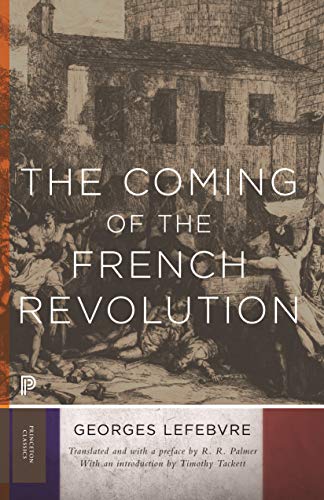
Ebook Info
- Published: 2019
- Number of pages: 261 pages
- Format: PDF
- File Size: 3.42 MB
- Authors: Georges Lefebvre
Description
The Coming of the French Revolution remains essential reading for anyone interested in the origins of this great turning point in the formation of the modern world. First published in 1939, on the eve of the Second World War, and suppressed by the Vichy government, this classic work explains what happened in France in 1789, the first year of the French Revolution. Georges Lefebvre wrote history “from below”—a Marxist approach. Here, he places the peasantry at the center of his analysis, emphasizing the class struggles in France and the significant role they played in the coming of the revolution.Eloquently translated by the historian R. R. Palmer and featuring an introduction by Timothy Tackett that provides a concise intellectual biography of Lefebvre and a critical appraisal of the book, this Princeton Classics edition continues to offer fresh insights into democracy, dictatorship, and insurrection.
User’s Reviews
Reviews from Amazon users which were colected at the time this book was published on the website:
⭐This book knocked me out. I am a history buff and really enjoy deep reads. This book really brought me to mentally experience that place and time. It clearly explained how the cards lined up for the eventual insanity of the terror.
⭐Extremely thorough and detailed. Lefebvre describes the wealth and structure of French society before the revolution and how the poverty endured by 98% of society almost inevitably led to the revolution. A little dry but heavy on facts and details. Sometimes mis-labeled as leftist or socialist because it describes the suffering of the poor and doesn’t ignore their contribution in order to describe the actions of the king and nobility and the nouveau riche.
⭐A Marxist take on the events leading up to The French Revolution. Judge it for yourself!
⭐French Revolution explained versus the English pro-monarchy historians that have never explained how the French nobility’s connivery defeated the Republic a couple of decades after 1789 & much less have these historians explained the Fronde revolt.Best Regards
⭐good for me
⭐Came in on time. Just as described
⭐This is a splendid introduction to the French Revolution in its early stages. It begins with the catastrophic state of the Old Regime and concludes with the Rights of Man and Citizen, i.e. before the murderous excesses and fanaticism that came later. If academic in tone, it is clearly written with incisive analyses and often takes the form of a narrative. I loved it and recommend it to any American who wants to understand how the French Revolution was more profoundly social and economic than our own.In 1787, France was in economic crisis. Not only did debt from Louis XVI’s support of the American Revolution threaten bankruptcy, but a series of bad harvests raised the spectre of famine. Unfortunately, in his sincere attempts to address this crisis, Louis XVI proved as thoroughly incompetent as his reputation. First, in order to raise funds, he made timid attempts to diminish aristocratic privileges, which were many, but without actively forging links to the rising bourgeoisie. Angered that they would have to give up their income as well as manorial and other privileges, the aristocrats rebelled, calling for an Estates General, the first in over 150 years. The King quickly acquiesced. This would bring the “rest of France” into a deliberative body with the aristocrats and clergy.Once the “Third Estate” was brought in, events immediately slipped from the King’s control. Most of this group consisted of the bourgeoisie, i.e. the entrepreneurs and others who worked for a living in the growing cities. They demanded greater representation and power, allying themselves with the King. This led to fundamental changes in parliamentary procedure, alienating most Aristocrats. As the situation deteriorated, Louis XVI began to resist them, leading to his virtual imprisonment and his withholding of “promulgation” of the new laws, including the Rights of Man and Citizen; the Rights subscribed to ideals similar to those of the American Revolution, but also abolished privilege and simplified the tax system enormously – instead of feudal rights that kings granted in a concatenation of obscure actions and grants, everyone became equal before the law.It was only when the King was threatened by citizen agitation that he capitulated and promulgated these documents. A number of violent actions followed, presaging the excesses that were soon to come. This brought the peasants in; they disagreed to a large extent with the bourgeois who were supposed to represent their interests. They wanted strict regulation of grain markets, guaranteed prices for bread, and similar conditions. Their anger towards the other classes was absolute and volatile, soon to be harnessed by demagogues such as Marat and later Robespierre.Here, in 1789, is where the author leaves the story, in which the Rights of Man and Citizen had effectively supplanted the feudal remnants in the Old Regime and reduced the role of the King to a near-ceremonial constitutional monarchy. Throughout, the King missed every opportunity to build bridges to other members of society and to shape his own role. He was astonishingly stupid and maladroit in any and all situations.To find out what happens next, the reader will have to look elsewhere. The great strength of the book is its delineation of the various forces in the society as they interacted and one thing led to another. Recommended with enthusiasm.
⭐In my study of revolutions I have always been interested in two basic questions- what were the ideas swirling around prior to the revolution that influenced people to see the need for revolution and the related question of how those ideas played out in the struggle for power. The study of the French Revolution most clearly presents those two phenomena in all their manifestations. Professor Lefebvre was a well-known and in his time a pre-eminent, if not the pre-eminent bourgeois historian of the French Revolution. I have reviewed his major general work on the French revolution elsewhere. Here, in this shorter work, he presents the events of 1789 as they unfolded and an analysis of what they meant in the period immediately before the revolution when all hell was breaking loose in French society.If one can talk legitimately about a sociology of revolutions then Professor LeFebvre has dramatically vindicated such sociology by presenting all of the factors that goes toward such a study in the early period of the French revolutionary experience. Clearly the Old Regime, represented in the person of King Louis XI, was no longer capable of ruling in the old way and the `people’ were no longer satisfied, for a myriad of reasons, with being governed under the premise of the divine right of kings. The struggle to turn from subjects of a monarch to citizens of a republic, a question of capital historic importance in human experience, finds its most dramatic expression in this revolution. Furthermore, vast segments of society from the liberal nobility and clergy to the nascent bourgeoisie to the working classes (the so-called sans culottes and other plebian urban elements) to the various layers of the peasantry each in their turn were willing to unite around that premise. As clearly, once each class (or part of a class) gained its ends it turned against further extension of the revolution and in the case of the nobility and clergy very shortly turned toward counterrevolution. Professor LeFebvre documents this trend very well, especially in the case of the peasantry which he had special knowledge of and charted throughout his academic career.This writer has set himself the task of trying to analyze and review each book of revolutionary experiences he considers on the basis of what lessons militant leftists can learn from the study of the old historical experiences. With that task in mind I was once again reminded by reading this book that the notion of the Popular Front as a political strategy has a lot longer history than in the France of the 1920’s and 1930’s when it was first formally introduced through by the French Socialist Party in an electoral alliance with the Left Radical bourgeois party.What do I mean by Popular Front? The theory of the popular front has been presented by forces such as the Socialist parties and later the Communist parties as a step in the direction of revolution. The premise of the popular front revolves around a belief that various classes, capitalist, urban and rural middle class and working class can come together around a minimum social program that will somehow make the plight of the oppressed classes involved less oppressive. Generally, in such political blocs the oppressed classes do the donkey work and the other classes reap whatever benefits accrue from the taking of power. This, moreover, is basically a concept of a parliamentary path to socialism.The long sordid history of this political device as an attempted sop by political leaderships to the working masses on one hand and a betrayal of their class interests on the other are still with us today. Even in the United States this strategy is used by what passes for the left, on its own hook mind you, when it blocs with the left-wing of the capitalist Democratic Party. Under the best of circumstances a popular front weakens and undermines the independence of the working classes. However, also remember that the Popular Front, as France and Spain in the 1930’s, Chile in the 1970’s and many other example show, can lead to bloody repression and destruction of the working masses for a long time. In modern times militant leftists say no to popular front ideology.Well, that said, what does all this have to do with the French Revolution. The French Revolution of 1789 represents in almost pure form the concept of the popular front. As mentioned above several different classes were ready to take down the absolute monarchy and furthermore were generally ready to subordinate, at least for a time, their own interests to do this. This begs the question of what the attitude of militants should be toward that phenomenon in 1789. Today we say no to the popular front concept but then we would have supported such a concept with both hands. Why? At that time the nature of French society, the tasks that needed to be accomplished around the creation of a nation-state and given the immaturity of the working classes both socially and politically a socialist solution to the problems of the day was precluded. While our sympathies historically go to the sans culottes who then and later were the vanguard that pushed the revolution to the left and we honor Robespierre and after him Babeuf and the Conspiracy of Equals in 1789 militants then could have politically supported the popular front against the absolute monarchy. Later, of course, as the revolution pushed leftward under Robespierre we would have united with him and the left elements of the bourgeoisie but we would nevertheless still have fought under the sign of the popular front then as well. Popular Front, 1789- Yes. Today- No. Read on.
Keywords
Free Download The Coming of the French Revolution (Princeton Classics Book 72) in PDF format
The Coming of the French Revolution (Princeton Classics Book 72) PDF Free Download
Download The Coming of the French Revolution (Princeton Classics Book 72) 2019 PDF Free
The Coming of the French Revolution (Princeton Classics Book 72) 2019 PDF Free Download
Download The Coming of the French Revolution (Princeton Classics Book 72) PDF
Free Download Ebook The Coming of the French Revolution (Princeton Classics Book 72)