Ebook Info
- Published: 2014
- Number of pages: 415 pages
- Format: PDF
- File Size: 21.65 MB
- Authors: Tony Hey
Description
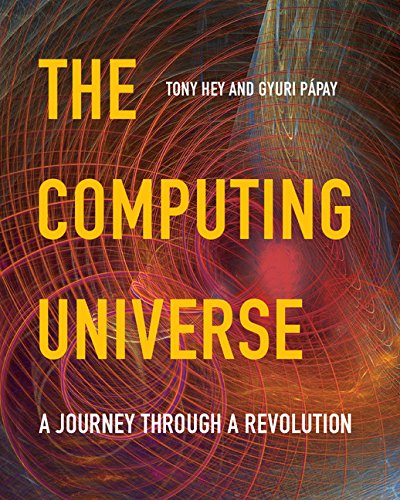
Computers now impact almost every aspect of our lives, from our social interactions to the safety and performance of our cars. How did this happen in such a short time? And this is just the beginning. In this book, Tony Hey and Gyuri Pápay lead us on a journey from the early days of computers in the 1930s to the cutting-edge research of the present day that will shape computing in the coming decades. Along the way, they explain the ideas behind hardware, software, algorithms, Moore’s Law, the birth of the personal computer, the Internet and the Web, the Turing Test, Jeopardy’s Watson, World of Warcraft, spyware, Google, Facebook and quantum computing. This book also introduces the fascinating cast of dreamers and inventors who brought these great technological developments into every corner of the modern world. This exciting and accessible introduction will open up the universe of computing to anyone who has ever wondered where his or her smartphone came from.
User’s Reviews
Reviews from Amazon users which were colected at the time this book was published on the website:
⭐Awesome book. I’m a computer programmer who went through many of these concepts in college, but never in a high-level, easy-to-understand manner like this. The math section that the author warns about has some complex theory, but not any complex algorithms or formulas. I would encourage everyone to give it a shot.
⭐“Finishing” something this comprehensive is truly impossible. It will take me a while to get through it, so I started at the end, as I’m working on a machine learning problem.
⭐Pretty good intro to the topic, a very wide range of coverage, clear and well written. Vastly superior to “Computing a concise history” by Ceruzzi, IMHO.
⭐wonderful book
⭐I found most of this book a thoroughly enjoyable read. The introduction provides a good overview of the book and states its intentions as well as its target audience. While the stated aim is a first year university student the chapter on binary and boolean logic for example takes a very basic approach and I found the majority of the book highly accessible. While not a computing academic I have been involved in various aspects of computing almost since the first PC so would consider myself an ‘informed reader’.Much of the book was fascinating and I learnt a lot about EDVAC and early computing machines for example. There were good illustrations and learning outcomes in each chapter and the time line and mini biographies gave very good overviews.The sheer scope of this book is remarkable and it is not a quick read. There is a chapter which the authors describe as much more mathematical than others and suggest non mathematicians may wish to skim and I confess I did. I did not skip any other chapters though. Some I found completely fascinating and found it hard to tear myself away. Obviously not all the chapters had that effect on me however the style of writing I found made reading very easy for the most part.I did find the chapter on hacking/worms/viruses much less convincing than many of the others. I realise that this book is intended as more of an overview however this chapter lacked the depth and authority of others. In general I felt it was weaker on more modern computing issues with Twitter and Facebook getting mentioned almost in passing for example. I liked the idea of a chapter on the “literature of computing” and the diverse threads discussed there were a useful contrast to the more technical aspects of computing. I was less convinced by ideas on the future of computing – changes can be so radical that I felt this might have the effect of making this very competent textbook outdated rather earlier than it should be. This should prove an interesting read for those concerned with the subject and a very effective foundation textbook.Disclosure – I received an advance copy of this book from the publisher.
⭐A rather selective history but with many good photos, an interesting though dissatisfying read. Regrettably the reader will not get to understand how computing evolved from ideas in the 19th century and earlier to the modern computer on their desk. There are many much better books available, some partial history’s and explanations but all more informative and engaging, such as James Gleick’s literary masterpiece “The Information”, Charles Petzold’s “Code” and Daniel Hillis’ “The Pattern on the Stone” which explain how the detailed internal logic works, Martin Campbell-Kelly and William Aspray’s “Computer. A History of the Information Machine”, and of course many others.
⭐Enjoyed reading it from A to Z. Its writing style is admirable and you get the impression that the authors enjoy explaining where terms we now take for granted originate from
⭐An excellent book
⭐Good, interesting
Keywords
Free Download The Computing Universe: A Journey through a Revolution 1st Edition in PDF format
The Computing Universe: A Journey through a Revolution 1st Edition PDF Free Download
Download The Computing Universe: A Journey through a Revolution 1st Edition 2014 PDF Free
The Computing Universe: A Journey through a Revolution 1st Edition 2014 PDF Free Download
Download The Computing Universe: A Journey through a Revolution 1st Edition PDF
Free Download Ebook The Computing Universe: A Journey through a Revolution 1st Edition