Ebook Info
- Published: 1961
- Number of pages: 154 pages
- Format: PDF
- File Size: 1.06 MB
- Authors: Charles T. Salkind
Description
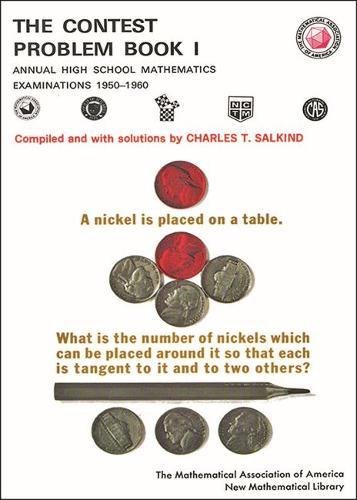
A great many students have participated annually in the Annual High School Mathematics Examination (AHSME) sponsored by the Mathematical Association of America (MAA) and four other national organizations in the mathematical sciences. In 1960, 150,000 students participated from about 5,200 high schools. In 1980, 416,000 students participated from over 6,800 high schools. Since 1950, when the first of these examinations was given, American high school students have tested their skills and ingenuity on such problem as: The rails on a railroad are 30 feet long. As the train passes over the point where the rails are joined, there is an audible click. The speed of the train in miles per hour is approximately the number of clicks heard in how many seconds? And many others, based on the high school curriculum in mathematics.
User’s Reviews
Editorial Reviews: About the Author Charles T. Salkind taught Mathematics at Brooklyn Polytechnic Institute and was one of the founders of the Annual High School Mathematics Examination which began in 1950.
Reviews from Amazon users which were colected at the time this book was published on the website:
⭐Great.
⭐This text compiles the first eleven (American) Annual High School Mathematics Examinations (AHSME). The AHSME, which began as a New York metropolitan area contest before becoming a national examination in 1957, is now called the American Mathematics Competition (AMC). The book contains the problems themselves, their answers, their solutions, and a list of problems classified by topic.The first ten examinations each consist of 50 problems. The 1960 examination has 40 problems. All problems are multiple choice. They are meant to be done without a calculator. Each examination consists of three parts. The first part, which the editors state is designed to test “fundamental skills based on conceptual understanding,” consists of problems that generally can be done quickly. According to the editors, the remaining parts are meant to “probe beyond mere reproduction of class-room work.” These problems are longer, particularly in the third part of each examination, and more difficult. The problems, which focus mostly on algebra and geometry, range in difficulty from routine problems to ones which require considerable ingenuity to solve. With a few exceptions, which Salkind notes in his solutions, the problems are based on the high school curriculum, which, at the time, did not include calculus.From 1950 to 1957, there were 15 problems in part 1, 20 problems in part 2, and 15 problems in part 3. In 1958, the format was changed so that there were 20 problems in part 1, 20 problems in part 2, and 10 problems in part 3. In 1960, the format was changed again so that there were 20 problems in part 1, 10 problems in part 2, and 10 problems in part 3. The effect of both format changes was to make the examination shorter.The format of the book allows you to solve the problems, check your answers, and then try to correct any mistakes you made before checking the solutions. Reading the solutions is instructive since Salkind usually provides elegant solutions to the problems. Sometimes he provides alternate solutions as well. However, there are some solutions that will seem cryptic if you are not already familiar with the results Salkind assumes.The index of problems by topic allows you to select problems in particular areas. However, I think that it would be better to choose a problem book which covers a particular topic for that purpose. For instance, if you want to focus on algebra and geometry problems, you could work through the two books Challenging Problems in Algebra and Challenging Problems in Geometry that Salkind co-authored with Alfred Posamentier.Working through these problems and reading Salkind’s solutions will enhance your problem-solving skills. They could also help you prepare for the American Mathematics Competition examinations. However, both the format of the examination and the high school curriculum have changed since these examinations were administered. For instance, non-decimal bases arise in these problems, but they are no longer part of the high school curriculum.Update (23 March 2009): To prepare for the current format of the AMC, you should work through
⭐in order to prepare for the AMC 10 or
⭐to prepare for the AMC 12. Top scorers on those examinations qualify for the American Invitational Mathematics Examination (AIME). Of the volumes in this series, only
⭐contains problems from the AIME.
Keywords
Free Download The Contest Problem Book No 1: Annual High School Mathematics Examinations 1950-1960 (New Mathematical Lib) (Bk. 1) (New Mathematical Library) 2nd Edition in PDF format
The Contest Problem Book No 1: Annual High School Mathematics Examinations 1950-1960 (New Mathematical Lib) (Bk. 1) (New Mathematical Library) 2nd Edition PDF Free Download
Download The Contest Problem Book No 1: Annual High School Mathematics Examinations 1950-1960 (New Mathematical Lib) (Bk. 1) (New Mathematical Library) 2nd Edition 1961 PDF Free
The Contest Problem Book No 1: Annual High School Mathematics Examinations 1950-1960 (New Mathematical Lib) (Bk. 1) (New Mathematical Library) 2nd Edition 1961 PDF Free Download
Download The Contest Problem Book No 1: Annual High School Mathematics Examinations 1950-1960 (New Mathematical Lib) (Bk. 1) (New Mathematical Library) 2nd Edition PDF
Free Download Ebook The Contest Problem Book No 1: Annual High School Mathematics Examinations 1950-1960 (New Mathematical Lib) (Bk. 1) (New Mathematical Library) 2nd Edition