

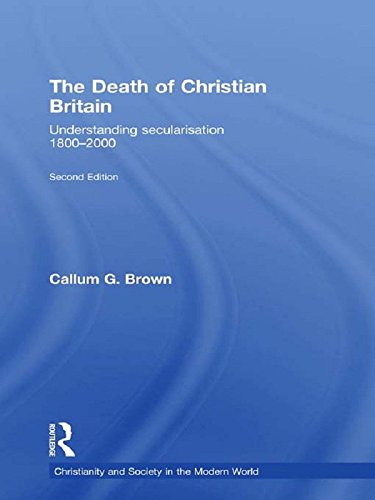
Ebook Info
- Published: 2009
- Number of pages: 322 pages
- Format: PDF
- File Size: 2.04 MB
- Authors: Callum G. Brown
Description
The Death of Christian Britain examines how the nation’s dominant religious culture has been destroyed. Callum Brown challenges the generally held view that secularization was a long and gradual process dating from the industrial revolution. Instead, he argues that it has been a catastrophic and abrupt cultural revolution starting in the 1960s. Using the latest techniques of gender analysis, and by listening to people’s voices rather than purely counting heads, the book offers new formulations of religion and secularization. In this expanded second edition, Brown responds to commentary on his ideas, reviews the latest research, and provides new evidence to back his claims.
User’s Reviews
Reviews from Amazon users which were colected at the time this book was published on the website:
⭐Brown is not unhappy about the death of Christian Britain. On the contrary, he argues that “relativism is a moral good of enormous proportions” (p 231).He marshals impressive studies showing the decline in religion in Britain was sudden and sharp, dating to the 1960s, as opposed to a gradual disappearance over many generations. “Between 1800 to 1963…Christianity informed the individual woman and the individual man about their own identities” (p 9).He points out that up until the mid twentieth centuries religion was the “primary and usually the only, focus of formal recreation” (p 131) especially for women, involving their best clothes and a chance to socialize. Women were regarded as the heart of their individual families and central to piety. Even for men, before that time, most ball games and other recreations were banned on Sundays.Middle class women attended church in great numbers, and their insistence on church likely influenced all their servants to attend as well. The surrounding culture, in the magazines and books and schools, suggested that those who attended church were virtuous and serious. That children were taught some form of Christianity was regarded as vital in order to create a new generation of moral adults.What “made Britain a Christian nation before 1950 was not the minority with a strong faith, but the majority with some faith” (p 142). Brown found that although London had slightly fewer churchgoers than rural areas, there was only a slight difference between rural areas and cities in some church participation. Surprisingly, even among the wealthy, female church attendance remained high between 1800 through around 1960. Only wealthy men showed declining participation in church.And then came the sixties.The elephant in the room that Brown has scrupulously not noticed is the effect the collapse of Christianity has had on marriage, illegitimacy, and, above all, children. Children raised in single parent families at a dramatically greater risk of drug and alcohol abuse, psychological problems, failing at school, dropping out of school, teen pregnancy, not to mention ending up in prison.. Child abuse numbers have increased by 149 percent between 1980 and 1993. Since 1950, the suicide rate has tripled among teens. Child sexual abuse has exploded, especially in families with a stepparent.
⭐It happened in 1963. That’s when Christianity in Britain died. Till I read this book I had wrongly thought in terms of a slow erosion of faith. In the late 19th C the unholy trinity of Darwin, Freud, and Marx had injected enough poison into European thought to kill the roots of traditional Christian faith even in Britain, the land of the Puritans and Wesley, and this was speeded up by liberal theology eager to bring religion in line with modern thinking. So by the outbreak of the First World War, the greenery was still visible, but the roots were weak. The first war, followed by the great crash, fascism, another war, and the holocaust then shouted from the rooftops, what the roots had long suggested: Christianity was dead. And so we move into the post Christian era. Brown shows this scheme of things to be wrong. Focusing on the period from 1800 to 1950 both the statistics and more importantly the print media – novels, magazines, tracts – he proves that Christianity was absolutely the dominating cultural force in Britain, and in contrast to the idea of an erosion of faith after the second war, church attendance actually rose in the 1950’s, what he calls between 1945 – 1958, a `return to piety’. So what happened in 1963? The Hull librarian poet Larkin has part of the answer:Sex was invented in 1963, between the Chatterley trial and the Beatles’ first LP.But it’s a little bit more complicated than more sex and people turning their backs on traditional Christian morality. That has been happening furtively since the beginning of time. What was different in 1963 was the reaction of women. Brown shows that in the Christian culture women had played a crucial role of being the ones who tamed men and brought them into the church. In novels and magazines the women were always the domestic saints, the men the potential prodigals. In the 1960’s women were no longer ready to be the guardians of the Christian home, and this rejection of `pious femininity destroyed the evangelical narrative’. Traditional magazines that used the old story of steadfast women taming men failed to sell, new ones like `Jackie’ giving women an independent agenda did. With this rejection came a massive exodus from the church…and so, along with the better known forces of secularisation at work, it was the daughters of Eve who ate the Apple label, and let Christianity die. It’s a stimulating thesis and well worth reading – but I don’t think the author gives enough credit to the impact that two world wars between two `Christian’ nations had on everyone’s psyche. It wasn’t just women swapping church for the Beatles. It was also a deep distress that somehow Christianity hadn’t worked which the children picked up from their parents. The tragic irony is of course that in fact Christianity, even the lukewarm Anglican fare of the 1930’s had worked. It had inspired a generation to combat Nazism. This makes the liberal fascist revolt of the 1960’s an even worse betrayal.
⭐A useful research book
⭐An interesting book but I found first several chapters rather boring and the whole analysis quite narrow in being concerned only with evangelical Christianity and therefore with the lack of generality of the analysis with the UK, not to mention other countries. It is possible that other explanations for the post 1960 decline could be advanced, and that might come better from people with the insights which accompany one actualy being a Christian
⭐I bought this book as its a requirement for my Open Uni course AA307 Religion and History (should be called History of Christianity in Europe).Im on the first 30-40 pages and it seems to be slightly dragging and boring at times although it is a well researched work. Worth a read for people interested in secularization theory and its application to Britian
Keywords
Free Download The Death of Christian Britain: Understanding Secularisation, 1800–2000 (Christianity and Society in the Modern World) 2nd Edition in PDF format
The Death of Christian Britain: Understanding Secularisation, 1800–2000 (Christianity and Society in the Modern World) 2nd Edition PDF Free Download
Download The Death of Christian Britain: Understanding Secularisation, 1800–2000 (Christianity and Society in the Modern World) 2nd Edition 2009 PDF Free
The Death of Christian Britain: Understanding Secularisation, 1800–2000 (Christianity and Society in the Modern World) 2nd Edition 2009 PDF Free Download
Download The Death of Christian Britain: Understanding Secularisation, 1800–2000 (Christianity and Society in the Modern World) 2nd Edition PDF
Free Download Ebook The Death of Christian Britain: Understanding Secularisation, 1800–2000 (Christianity and Society in the Modern World) 2nd Edition