

Ebook Info
- Published: 2010
- Number of pages: 320 pages
- Format: PDF
- File Size: 1.80 MB
- Authors: Robert Levy
Description
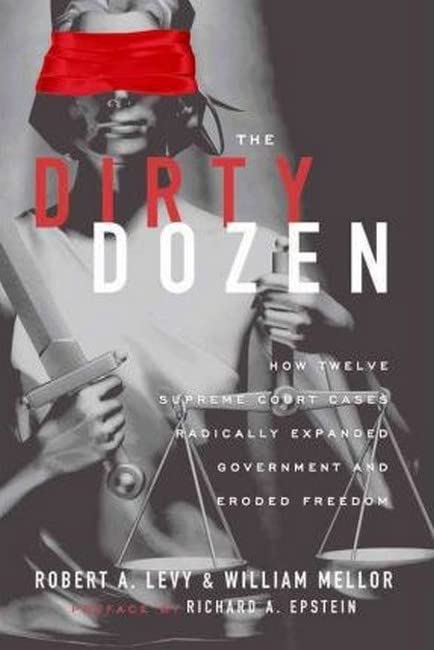
The Founding Fathers wanted the judicial branch to serve as a check on the power of the legislative and executive, and gave the Supreme Court the responsibility of interpreting the Constitution in a way that would safeguard individual freedoms. Sadly, the Supreme Court has handed down many destructive decisions on cases you probably never learned about in school. In The Dirty Dozen, two distinguished legal scholars shed light on the twelve worst cases, which allowed government to interfere in your private contractual agreements; curtail your rights to criticize or support political candidates; arrest and imprison you indefinitely, without filing charges; seize your private property, without compensation, when someone uses the property for criminal activity―even if you don’t know about it!
User’s Reviews
Editorial Reviews: Review Many of the most harmful decisions of the U.S. Supreme Court have been subject to sustained attack in separate places. But I am not aware of any volume whose major function is to critique the worst in one place. Into this void step two fearless writers,Bob Levy and Chip Mellor, who through their work have been deeply involved in shaping our legal and political culture. — From the Foreword by Richard A. Epstein, Professor of Law, University of ChicagoA passionate, thoughtful, provocative, and eminently readable book by two of America’s most influential libertarian lawyers and legal thinkers. — Eugene Volokh, Professor of Law, UCLA; Founder of the Volokh Conspiracy BlogAn easy read, and a very informative primer on some long-neglected cases. |fLyle Denniston, Scotus BlogLevy and Mellor offer fascinating insights on twelve of the most important and controversial cases of our time. Readers will gain new appreciation for the Supreme Court’s role in affecting their lives and liberties. With that appreciation will come heightened understanding of the stakes in future Supreme Court nominations. — Nadine Strossen, Former President, American Civil Liberties Union
Reviews from Amazon users which were colected at the time this book was published on the website:
⭐One of the most topical and insightful reads you can have. Right now. It is a book that is perfect for anyone who cares about their liberties and how they have been eroded over the past century.
⭐I plan on going to law school after I graduate college, so I’ve spent a lot of time reading books that pertain to law in some way, shape, or form (most recently I’ve read A Civil Action, which was spectacular). I’m moderately more liberal, so quite a few of the books I’ve been reading deal with topics that are typically deemed “liberal” concerns (such as the environmental and public health concerns of corporate activities, and how they detrimentally affect the economically disadvantaged in A Civil Action). But I do respect many more conservative viewpoints on certain matters, and I’m going to need to understand conservative positions on a multitude of topics, so I figured The Dirty Dozen would be a fine place to start.I was wrong.The Dirty Dozen is mainly hardline Libertarian fear mongering about the dangers of big government. It asserts itself as a study that reveals how select Supreme Court decisions after the 1930s have led to rapid expansion of federal power and trampled over individual rights, but it turns out that’s just a fancy way of disguising that this book is really about how government regulations protecting economically disadvantaged citizens from things such as predatory lenders, from insurance companies that try to screw over their policy holders through overly long legal contracts filled with legal jargon incomprehensible to the average citizen, public programs protecting impoverished working class people, etc, are all just there to trample over the rights of those poor, defenseless, corporate shareholding billionaires.Chapter 3, for example, uses hurricanes Andrew, Rita, and Katrina, as examples for how “government interference” led to the bankruptcy of a dozen different insurance companies because the government stepped in and retroactively altered insurance contracts and prevented them from backing out of covering the billions of dollars of damages the economically disadvantaged families living in the areas most affected by these disasters endured, with fairly heinous quotes such as “Corporate shareholders and employees are second -class citizens whose rights can be sacrificed to protect homeowners and farmers,” and describing these corporate billionaires as “parties whose rights have been extinguished.”…So you’re telling me, that the billionaires who entered into a contract with their policy holders, agreeing to cover the financial damages, should disaster strike the homeowners whom they insure, are essentially “second hand citizens” because they went bankrupt after the government stepped in, and forced them to cover the damages they agreed to cover? You’re kidding me, right? With the numerous occasions under which the courts have sided with corporate shareholders over the working class citizens whom they exploit (A Civil Action being just one example), you take it as a sign of a rampant, out of control government, on one of the few occasions when the courts sided with the working class, and a few billionaires went bankrupt as a result? You honestly believe that?But it really isn’t all bad, because this coauthor set of libertarian lawyers don’t just have corporate shareholder’s interest ms at heart, as chapter 4 expresses concern for the smaller businesses that went under trying to comply with regulations imposed by the EPA, which goes to demonstrate how obviously imperfect the system is, but their solution seems to lie within abolishing federal power and judicial power over fixing it. I get some smaller businesses have suffered when trying to comply with EPA regulations, and that needs to be addressed, but you can’t isolate these failings from the successes, like the recently successful project to reintroduce wolves to Yellowstone, and the massive beneficial impacts that’s had on the environment, the successful prosecution of corporations that have dumped toxic chemicals into water sources and poisoned families as a result, the decontamination of various water sources that had been poisoned with lead and mercury and arsenic, the exponentially improved air quality of major American cities such as LA from what it was in the 1970s, and literally thousands of other examples of success that have resulted in a better quality of life for millions of people, in order to justify repealing governmental regulation.(Part 3)The policies year writers are advocating for comes dangerously close to creating an oligarchical society, as much as they outwardly champion the idea of “individual freedom.” Even by omitting the successes of the system they’re writing against, they still fail to make a substantial case for how much of what they’re writing about adversely affects anybody outside of the billionaire class. Chapters 6, 7, 8, 9, 10 and 12 are the only topics discussed that actually affect common people.Chapter 6 deals with gun control, which presents a very solid case for deregulation of gun control, but it’s impossible to detangle what a tricky issue gun control is in a single chapter of a book, which results in an oversimplification of the issue through which they treat ending violent crime as a simple matter of deregulating guns. Even though I consider myself more liberal, I’m still pro-gun ownership, but I’m not going to fault the government for trying to grapple with the issue of keeping guns out of the hands of dangerous criminals, while allowing common citizens to remain armed. Violent crime and gun regulation is far more complicated than they make it seem.Chapter 7 deals with how rights to privacy get trampled on in favor of “national security,” chapter 8 deals with the most egregious flaw in our justice system (outside of police brutality), which is asset forfeiture without due process, and chapters 9 and 10 deal with eminent domain and how the government stiff arms people out of their property through regulation. All of these chapters are extremely solid and are definitely worth checking out.But chapter 12, on the other hand, deals with how programs such as affirmative action violates equal protection under the laws of the United States, which I find to be the most ridiculous argument this book tries to make. This review is long enough as it is, and I don’t want to end up writing an entire book out of how promoting diversity through programs such as affirmative action actually benefits our economy considerably, and helps to alleviate the systemic poverty that is still being inflicted on people of color to this very day, but even though o disagreed with the majority of this book’s thesis, none of the other chapters actually made me angry the way this final chapter did, and I’m not up to discussing in depth just how fundamentally broken many of these points are right now.Another thing I find bizarre in this book, is how the authors occasionally site The Federalist Papers when they’re making their case for smaller government, when in one of the very first papers, Alexander Hamilton literally says that many will argue for a weak federal government under the pretense of “individual liberties,” but that is a fallacious argument. I don’t know why Libertarians continue to keep using quotes from the Federalist Papers, Alexander Hamilton was the opposite of a Libertarian.I really do sound much more negative than I really am about The Dirty Dozen. While overall, I do disagree with a majority of the points presented in it, there are still lots of fairly compelling examples and arguments that are worth reading, even though I completely disagree with their solutions to the issues they present.
⭐I thought this would be an insightful exploration of where the judiciary, through flawed Supreme Court decisions, has eroded the integrity of Constitutional protections.. …. and in ways, it is —- But not always with an eye to the citizenry, or the rights of the individual.The thesis of the book is that Court decisions have altered the power toward the Federal government, and many of the authors’ conclusions are sound ones. I agree with a lot they say. But at times they leave me cold, their logic somehow removed from commonsense reality.Their arguments contradicting Court decisions are sometimes housed in that strangest of psychical phenomena: the ability to say that freedom exists in money and property——–the conflation of rights to the individual with the rights of power and influence, an artificial and unsustainable mixture.I want to look at one decision they examined to explain what I’m saying.In the case of McConnell v. Federal Election Commission (2003), a challenge to the Bipartisan Campaign Reform Act of 2002 (McCain-Feingold), the court held that limiting the quantity of money being fed to political candidates made sense in the greater interest of fairness in the electoral process.But NOT to the authors. . . .”Money preserves and protects the free discussion of political ideas.””Regulating the money that politicians raise and spend is a direct restriction on political speech, in the same way that regulating printng presses is a direct restriction on freedom of the press.” . . . who obviously are quite intellectually content to conflate money and freedom, money and free speech, without any acknowledgement that the conflation is not only illogical, but perversely so.To the authors, the Court’s differentiation in McConnell v.FEC of 1st Amendment-protected speech from the money used to pay for the speech is unsupportable: because to the authors, the money and the speech are one and same. To them, if you have the money, you have the speech, or at least the right to the speech; if you don’t have the money, you don’t have the speech, or, in realistic terms you don’t have the right to the speech. By conflating speech with money, and protecting both equally under the Constitution, the authors are affirming that speech can be purchased.Yet any thing that can be purchased is NOT free.So equating free speech with purchased speech the authors contend is valid argument.Consequently, Freedom = Wealth. And those who have the wealth have the right to speech. Those who do not have the wealth do not have the right to speech.Not only is their conflation wrong, but their affirmation of the Constitutionality of such conflation leads to even further obfuscation of what freedom represents: to the authors freedom involves having power, and wealth defines that power.This is NOT the ultimate freedom of a document which sought to mitigate the invested power of those who would gain power and use it constantly to their own ends…..or maintain that power over the struggles of those who would attempt to nationalize it to entrust it the the democratic citizenry.Their Constitution is one predicated on wealth, and property, and patriarchal rights, not on quaranteed freedoms regardless of wealth or gender.And while I found myself agreeing at times with some of their conclusions which ran counter to my established thoughts, I was still bothered by a certain lack of empathy in the authors with those who are disenfranchised from political equality from long-running social patterns. At times, social reparations mean softening the rules to allow a greater participation for minority members. The hard-and-fast Constitutional interpretation the authors at times espouse does not recognise this: rather it is whoever got there first deserves to have the upper hand.On the plus side, the authors are quite clearly on the side of the limitation of governmental intrusion into legitimate ownership, and particularly against expanding the governments’ ability to use police force against those who are not a threat or whose actions have not put others at risk. The right to seize property when there is evidence of wrongdoing constitutes excessive and unConstitutional punishment according to the authors, and I agree wholeheartedly with them.It is unfortunate that the current SC has completely sided with the authors in the case of Citizens United v Federal Election Commission and proclaimed that yes, indeed, money does equate to free speech while reaffirming that corporations are not only persons, but persons with greater freedom of speech, bigger persons than regular citizens who are only people persons.I can only imagine that Roberts & Company read this book, at least the part dealing with McConnell v. FEC.And we are poorer for it.
⭐The Supreme Court enforces the laws created by the legislative branch and executed by the executive branch under the guidance of the Constitution. Mellor and Levy point out the horrendous failures of 100 years of SCOTUS that have yielded a government that is no longer bound by enumerated powers and purposely rules in ways that reduce your freedoms.This eye opening book is a must read for all Constitutional enthusiasts who cherish their freedom and a smaller federal government.”That whenever any Form of Government becomes destructive of these ends, it is the Right of the People to alter or to abolish it, and to institute new Government, laying its foundation on such principles and organizing its powers in such form, as to them shall seem most likely to effect their Safety and Happiness.”
⭐Absolutely brilliant book – has been extremely valuable in educating me about the Constitution and its operation.
Keywords
Free Download The Dirty Dozen: How Twelve Supreme Court Cases Radically Expanded Government and Eroded Freedom, With a New Preface in PDF format
The Dirty Dozen: How Twelve Supreme Court Cases Radically Expanded Government and Eroded Freedom, With a New Preface PDF Free Download
Download The Dirty Dozen: How Twelve Supreme Court Cases Radically Expanded Government and Eroded Freedom, With a New Preface 2010 PDF Free
The Dirty Dozen: How Twelve Supreme Court Cases Radically Expanded Government and Eroded Freedom, With a New Preface 2010 PDF Free Download
Download The Dirty Dozen: How Twelve Supreme Court Cases Radically Expanded Government and Eroded Freedom, With a New Preface PDF
Free Download Ebook The Dirty Dozen: How Twelve Supreme Court Cases Radically Expanded Government and Eroded Freedom, With a New Preface