

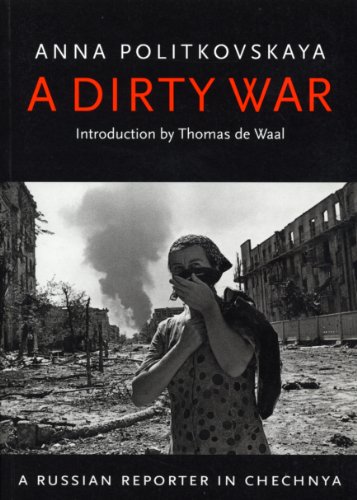
Ebook Info
- Published: 2001
- Number of pages: 368 pages
- Format: PDF
- File Size: 2.79 MB
- Authors: Anna Politkovskaya
Description
“My notes are written for the future. They are the testimon of the innocent victims of the new Chechen war, which is why I record all the detail I can” ANNA POLITKOVSKAYA The Chechen War was supposed to be over in i996 after the first Yeltsin campaign, but in the summer of iggg the new Putin government decided to “do the job properly”. Before all the bodies of those killed in the first campaign had been located or identified, thousands more would be slaughtered in another round of fighting. The first account to be written by a Russian woman, A Dirty War is an edgy and intense study of a conflict that shows no signs of being resolved. Exasperated by the Russian governments attempt to manipulate media coverage of the war, journalist Anna Politkovskaya undertook to go to Chechnya, to make regular reports and keep events in the public eye. In a series of despatches from July 1999 to January 2001 she vividly describes the atrocities and abuses of the war, whether it be the corruption endemic in post-Communist Russia, in particular the government and the military, or the spurious arguments and abominable behaviour of the Chechen authorities. In these courageous reports, Politkovskaya excoriates male stupidity and brutality on both sides of the conflict and interviews the civilians whose homes and communities have been laid waste, leaving them nowhere to live and nothing and no one to believe in.
User’s Reviews
Editorial Reviews: From Publishers Weekly A special correspondent for the Russian newspaper Novaya gazeta, Politkovskaya received the 2000 Golden Pen Award by the Russian Union of Journalists for her coverage of the Russian military campaign in Chechnya. She braved arrest and interrogation by the Russian military this past February, sparking international protests, and this October she was forced to flee Russia after receiving credible death threats from the Russian military; she remains in exile. All of which places importance and credibility on her savage indictment of the current situation in the Muslim province of the former U.S.S.R., Chechnya. The present book, clearly translated by John Crowfoot (who also did The KGB’s Literary Archives, among other titles), collects articles she wrote about the Second Chechen War (begun after the conflict had supposedly ended during the Yeltsin regime) from 2001 to 2001. Her on-sceners recount atrocities on both sides evenhandedly, and are passionately pro human rights, even when interviewing sordidly cynical Russian generals more preoccupied with the size of their apartments than the death and suffering brought upon the Chechen rebels. She reports that monumental corruption diverted humanitarian relief from the starving locals to greedy businessmen and the Russian military. Mothers of dead soldiers are reportedly bilked for cash by military representatives when seeking information on the locations of their sons’ bodies. The many black-and-white photos of dead Chechens will surely disturb readers. Meanwhile, the usual killing goes on, at an estimated 15 to 20 deaths a day, according to the Chechen side. (Nov. 12)Forecast: Russia has recently begun recasting the Chechen conflict as part of the “war on terrorism,” particularly given speculation of Chechen ties to al Qaeda and the bombings of a shopping mall and several apartment buildings in Russia. Politkovskaya’s indictments may take on a different cast in that light, but the book’s close reporting of the war’s effects on everyday people are directly analogous to Afghanistan. Readers looking for accounts of war’s impact on soldiers and civilians alike will find this book deeply disturbing; Politkovskaya will be able to further contextualize during a six-city tour this month.Copyright 2001 Cahners Business Information, Inc. From Library Journal Currently a journalist with the Russian newspaper Novaya gazeta in Moscow, Politkovskaya has spent the past 20 years covering social issues all around her country. This volume includes translations of articles she wrote during the Second Chechen War, from July 2001 through January 2001, based on several visits there at great risk to herself. She writes about profiteering by private businesspeople and government bureaucrats, humanitarian relief goods that never reach the intended recipients, the brutality of Russian military service for the enlisted troops, and the utter lawlessness that prevails in Chechnya. An old people’s home in Grozny, mentioned in several chapters, is her best metaphor for the plight of the most helpless among the civilian population. The residents receive aid only occasionally, are evacuated late, and then return to a seriously damaged building in a devastated city. The author’s opinions are very clear and forthright: she wants this war to end. Because this conflict receives only occasional coverage by the Western press, this collection is worthwhile, if uncomfortable, reading for an informed audience. Marcia L. Sprules, Council on Foreign Relations Lib., New York Copyright 2001 Reed Business Information, Inc. About the Author Anna Polikovskaya is a special correspondant for the biweekly Russian newspaper Novaya gazeta. In 2000, she was awarded the Golden Pen Award by the Russian Union of Journalists for her coverage of the new federal campaign in Chechnya. Read more
Reviews from Amazon users which were colected at the time this book was published on the website:
⭐Another book about the horrors and atrocities of the Chechen-Russian conflict. The book is similar to her A Small Corner in Hell as it revolves around families and the suffering of civilians in the war. I thought A Small Corner in Hell was a little more hard hitting and aimed at showing the horrific impacts of the war in comparison to this book.
⭐Excellent book at an excellent price. In my opinion, better than A Small Corner of Hell by the same author. Thanks Amazon!
⭐Anyone tempted to say that heroes no longer exist need look no further than opposition Russian journalists to be proven wrong. Although there are many heroes and martyrs amongst that group, the name Anna Politkovskaya is particularly sacred. A furious truth-teller, Politkovskay always had the courage of her convictions, descending into chaos, corruption, and the hell of the Second Chechen War in order to shine the light of her reporting on the deserving and undeserving alike. Her murder, about which doubts still linger, was a tragedy, but it is heartening to see that even in death she could not be silenced. “A Dirty War” is a collection of her articles on the Second Chechen War, here translated into English and provided with an introduction, maps, and notes to help orient the reader.”A Dirty War” is neither an exhaustive historical overview, nor the kind of “balanced” reporting American readers have come to expect from their own journalists. Politkovskaya was writing about contemporary issues for a Russian audience and expected them to be familiar with the cultural context of Russia in the late 1990s/early 2000s. The maps and notes will aid readers less familiar with the topic to keep track, but this is not a textbook survey of the situation and the players, so if you are looking for an introductory text on the Chechen wars, this is probably not the book for you. And American readers, used to the the fearful faux objectivity of much mainstream American news, may be taken aback by Politkovskaya’s overt presence within the text. She has no fear of taking a position and making it clear, even if it means contradicting herself: the first article, “Grave Robbers,” slams the agencies responsible for identifying the bodies of soldiers killed in action during the First Chechen War for incompetence and profiteering, while the second article, “Land of the Unknown Soldiers,” written after she had interviewed those in charge of the process, sympathetically lays out all the obstacles facing them. American readers may find the strident outrage that is so evident in Politkovskaya’s writing to be refreshing, or they may find it off-putting, but in either case they will find it striking.Although Politkovskaya has no problem in staking a position and defending it, she does not shy away from presenting the voices of all sides of the issue. “A Dirty War” includes interviews with refugees, ordinary citizens, Chechen leaders, Russian functionaries, Russian soldiers of all ranks, including a surprisingly sympathetic interview with General Shamanov, and Chechen separatist fighters. The overall picture is of people drowning in confusion and incompetence, both their own and others’. Refugees are trapped in camps without food, water, or heating for months, but attempts to restore Grozny to habitability are stymied by looters who strip the water and sewage stations of parts, rendering them inoperable. OMON [kind of like American SWAT teams] troops are forced to live off meager supplies of spoiled meat as they man checkpoints. Doctors and the families of the wounded have to go barter on the black market for anesthetic to perform operations. Even the higher-ups are not immune to the soul-sucking nature of the conflict: Shamanov, after issuing a number of platitudes about the need to do the dirty work that no one else will, is last shown sitting by himself at a function honoring paratroopers, so lonely and depressed that “It was painful to look at him.” No one reading this can be left with the impression that war, particularly this war, is a glorious business.Politkovskaya was in the business of revealing the ills of society, not necessarily curing them, and so there’s more here to infuriate the reader then to inspire them. Or rather, Politkovskaya wanted to inspire her readers by infuriating them into action. A number of the articles contain direct appeals to the readers to take specific actions to help Politkovskaya and her colleagues at Novaya Gazeta in their attempts to do at least a little good for the most wretched of the people she encounters. Although now, the better part of two decades after these events have taken place, and more than a decade after Politkovskaya’s murder, there is not much that we can do about anything depicted in the book, we can still bear witness. And while “A Dirty War” may have much in it that is indeed dirty, not to mention depressing, it is also a testament to unrelenting heroism, not just Politkovskaya’s, but that of the many doctors, teachers, volunteers, and others who stepped forward at great personal discomfort and risk in order to help out people whom their government and the world at large had abandoned. “A Dirty War” may leave you appalled at the depths to which humans can sink, but it will also leave you astounded at the heights of altruism and courage to which they can rise.
⭐This is a hard book to judge. In the first place, it’s a collection of articles for what the author refers to as a newspaper, though the “New Gazette” appears to publish biweekly. This leads to some jarring articles next to one another: the first article denounces officials involved in the identification of the corpses of Russian soldiers killed in the first Chechen War 1994-6, and the second article, immediately following, denounces the first one as biased and reverses all of its statements. It’s a bit strange.There’s also the issue of bias. Strangely, here in the States, most political conservatives disliked Putin’s war in Chechnya, and Yeltsin’s before him. In Russia, however, support for the war lies among Russia’s conservative political community, while liberals oppose it. The war itself is run as you would expect a Russian war to be run: the soldiers sell their weapons and ammunition to the rebels, who shoot it back at the same soldiers. The soldiers are rarely, if ever paid, and are regularly charged with everything from rape to murder to the relatively mild drug posession. Civilians trapped in the middle are starving, lacking clean water, medical supplies, housing, jobs, pretty much everything. The Russian government makes a lot of promises and then doesn’t fulfill any of them. The Chechens steal everything that isn’t nailed down (and what is, they pry up and *then* steal), hold old people hostage, set oil wells on fire if they can’t own them themselves, and set mines in their neighbors’ apartments in order to encourage them to leave. Everyone in this book is a vicious, nasty, mean person, except the innocent civilians the author interviews who are caught between the two forces.I mostly disagree with the accusations of bias on the part of the author. She clearly doesn’t like Putin or any of the Russian administration, but she also rips the Chechens regularly. One reason for her concentration on the negative aspects of the Russian army is that they’re not so violent that she can’t interview them, while the Chechen fighters, especially their leaders, are dangerous enough that she either didn’t try, or failed. Either way, there’s more material here on the Russians (most of it negative) than there is on the Chechens. She does show some sympathy for the soldiers at the front: she outlines everything from how underpaid they are to the lousy food (it comes to the front rotting in the cans it’s packaged in) to the indifferent officers and the horrible conditions at the front. The whole book, frankly, is full of negative, depressing things. This isn’t a book you read to cheer yourself up.I really thought this book informative, though given its anecdotal nature and content there’s very little material on the course of the war itself. I would recommend it to anyone interested in the subject.
⭐I first read this book as a college student in the spring of 2002. The US was still recovering from September 11th, but at that time, none of us in this course on international human rights realized how the collection of articles in “A Dirty War” would give insight to future acts of terror. Her point-blank assassination reinforces the truth and weight of her reporting. While neither I nor Politkovskaia would rationalize terror, her book gives insight into the environment in which terror festers and metastasizes. Regardless of the Chechen immigrant Patriots’ Day bombers’ motivations, Politkovskaia’s articles illuminate a small sampling of the every day occurrences in areas of violence and oppression that breed anger and hostility.
⭐Essential work. Politkoskaya was the only Russian female reporter to cover the second Chechnyan War early 2000. Her courage and her testimony are second to none. A timely eye opener and a must-read to shed a deeper light on the current war in Ukraine.
⭐This book shows the evils of Putin and if it was not for Anna and my friend John Crowfoot the translator, we would not be aware of these terrible atrocities.
⭐Brilliant translation and account of total devastation. Reading it with little knowledge on the Chechnya war, I left educated and impassioned and wanting to know a lot more.
⭐LOVED Anna’s Book…. Too bad she was murdered for speaking out against Putin’s new Russia. Anna really wrote fairly for Both sides.
Keywords
Free Download The Dirty War in PDF format
The Dirty War PDF Free Download
Download The Dirty War 2001 PDF Free
The Dirty War 2001 PDF Free Download
Download The Dirty War PDF
Free Download Ebook The Dirty War