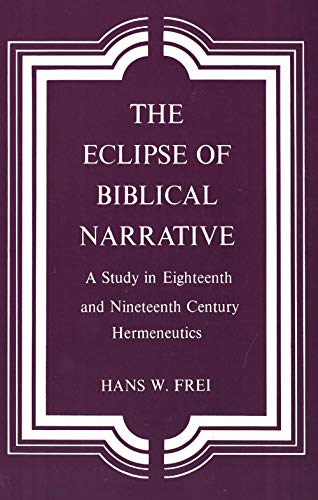
Ebook Info
- Published: 1980
- Number of pages: 368 pages
- Format: PDF
- File Size: 8.53 MB
- Authors: Hans W. Frei
Description
Laced with brilliant insights, broad in its view of the interaction of culture and theology, this book gives new resonance to old and important questions about the meaning of the Bible.
User’s Reviews
Reviews from Amazon users which were colected at the time this book was published on the website:
⭐”In a careful, detailed, tightly written essay”, Hans Frei traces the process by which, under the rise of rationalistic historical criticism, the Christian world suffered the eclipse of its confidence in the Bible as the inspired Word of God. For centuries the Bible had been read as “strongly realistic, at once literal and historical.and not only doctrinal or edifying. The words meant what they said and described real events and truths”. With modernity this outlook broke down with increasing rapidity. A subtle distinction developed between the factual truth of the biblical stories and the real historical world, as well as the meaning or religious significance of those stories. Frei was convinced that we could never go back to the traditional reading of the Bible. His book, he believes will provide “historical, philosophical and theological explanations” for the “puzzles” which stand in the way of a new approach to reading the Bible he calls “Realistic Narrative”.In a preface he calls attention to an outline of the substance of that proposal in a book published in 1974 by Fortress Press entitled “The Identity of Jesus”. Frei acknowledges a debt to Karl Barth for insights in the development of the thesis of the book.
⭐Frei investigates the breakdown between story and reality, realistic and figural interpretation. His Yale post-liberal presuppositions aid his analysing German liberalism. They do not help him construct a coherent alternative.A realistic interpretation is a strict correspondence between word and reality. There can only be one meaning: that of the author. This is problematic when one approaches biblical prophecy: were the prophets’ intended meanings the same as that of the New Testament readers? At this point the realistic paradigm breaks down.A figural reading is close to Reformed typology: the narrated sequence contains its own meaning (Frei 28). While Frei doesn’t draw the explicit conclusion, if typology is true, then one must have a narratival epistemology. One will note this is standard Protestant–especially Reformed covenantal–hermeneutics. So what happened in history, especially in Germany? The blossoming liberal schools quite correctly saw that if typology is true, then the bible has a coherent unity. If the bible has a coherent unity, then it forces a narratival epistemology. If that is true, then dualisms of a Platonic or Kantian sort are ruled out.“What if Plato were a German Liberal?”The development of hermeneutics didn’t take place in a vacuum. Scholars were interacting with contemporary philosophical shfits. The liberal schools would not accept a realistic hermeneutics because it was obvious (for them) that miracles and resurrection were not part of “reality.” They could not accept a typological reading because typology is at war with internalized, spiritual pious gush.Lessons to be learned: A Conclusion of sortsIt’s not clear if Frei himself avoids all of the criticisms of liberal theology. His distinction between factuality and factuality-like probably won’t hold up under scrutiny (which is why few liberals adopted it). His understanding of narrative theology is brilliant, but narrative theology only works if the narrative is…well..real. Did it actually happen?If we do not have eschatology as the corresponding pole to history, as none of the liberals did, then it is hard to avoid Strauss’s criticisms. If the goal of hermeneutics is eternal, timeless truths (ironically shared by both modern Evangelicals and Schleiermacher), then Lessing’s ditch is insurmountable. If truth is Platonic and necessary and eternal, necessary because it is eternal, then why bother with historical contingencies like narratives? If this is the case, Lessing is absolutely correct.
⭐Frei writes in a very obtuse manner. His sentences are nothing short of clunky. Still, if you read slow and carefully enough you can learn a great deal about the subject.
⭐Arrived on great condition and is really a good read if interested in the effects of religious hermeneutics of New England and Germany in the 18th century
⭐Hans Wilhelm Frei (1922-1988) was a biblical scholar and theologian played a major role in the development of Postliberal/Narrative Theology; he taught at Yale Divinity School. He also wrote
⭐,
⭐, and
⭐.He wrote in the Preface of this 1974 book, “This essay falls into the almost legendary category of analysis of analyses of the Bible in which not a single text is examined, not a single exegesis undertaken. Faced with certain puzzles that demanded historical, philosophical, and theological explanations, I tried to provide them as best I could; but there is no denying the odd result of a book about the Bible in which the Bible itself is never looked at. Nonetheless, I am confident that the essay may have significant implications for the study of the Bible. In making that claim I have to put myself in the awkward position of advertising my own wares…”He wrote in the Introduction, “Western Christian reading of the Bible in the days before the rise of historical criticism in the eighteenth century was usually strongly realistic, i.e. at once literal and historical, and not only doctrinal or edifying… The preeminence of a literal and historical reading of the most important biblical stories was never wholly lost in western Christendom… if it seemed clear that a biblical story was to be read literally, it followed automatically that it referred to and described actual historical occurrences… if the real historical world described by the several biblical stories is a single world of one temporal sequence, there must in principle be one cumulative story to depict it. Consequently, the several biblical stories narrating sequential segments in time must fit together into one narrative.” (Pg. 1-2)He continues, “The customary use of figuration was to show that Old Testament persons, events, and prophecies were fulfilled in the New Testament… Far from being in conflict with the literal sense of biblical stories, figuration or typology was a natural extension of literal interpretation… Figuration was at once a literary and historical procedure, an interpretation of stories and their meanings by weaving them together into a common narrative referring to a single history and its patterns of meaning.” (Pg. 2)He notes, “As the eighteenth century went on, this mode of interpretation and the outlook it represented broke down with increasing rapidity… the direction of interpretation now became the reverse of earlier days. Do the stories and whatever concepts may be drawn from them describe what we apprehend as the real world? Do they fit a more general framework of meaning than that of a general story?” (Pg. 4-5) He adds, “Figural reading, to the degree that it had been an extension of literal interpretation in the older kind of realistic, narrative reading, was now bound to look to historical-critical eyes like a rather preposterous historical argument, and it rapidly lost credibility.” (Pg. 7) And, “that [biblical] authority was bound to be gravely weakened if the Bible was neither reliable nor unitary.” (Pg. 8)He explains, “This book, then, is about one segment of the history of the theory of biblical interpretation rather than a history of biblical criticism… In particular, its topic is the eighteenth- and early nineteenth-century discussion about the proper rules and principles to guide interpretation of the history-like stories of the Old and New Testaments… To state the thesis: a realistic or history-like … element is a feature, as obvious as it is important, of many of the biblical narratives that went into the making of Christian belief. It is a feature that can be highlighted by the appropriate analytical procedure and by no other, even if it may be difficult to describe the procedure—in contrast to the element itself.” (Pg. 10)He states, “positivity is the affirmation of a direct or unmediated intervention of the Godhead in the finite realm… positivity did indeed involve the affirmation of the cruciality for human salvation of these historical events as actual transpirings… Thereafter one faced the theological issue of affirming or denying the centrality of positivity for the Christian religion. One chose whether Christianity was a rational-moral, experiential, or historical religion, or a combination of these three.” (Pg. 58-59)He goes on, “an argument over the meaning and interpretation of biblical narratives has turned into one over the reference of those narratives… A historical criterion has now come to adjudicate the meaning of the history-like narrative biblical texts. The new way of uniting explication with historical reference and analysis served… to make hermeneutics an auxiliary of a procedure which had all the structural ingredients needed to expand it into the historical-critical method… The argument over the fulfillment of prophecy … exhibited more clearly than anything else the drastic change in the reading of biblical narratives… and in the underlying new sensibility of a language-neutral external world which has taken the place of the narratively rendered temporal sequence satisfying the sensibility of an earlier day.” (Pg. 84-85)He says that theologians of the time “But almost no one… wanted to be in the position of affirming at the same time that Jesus as the unique, indispensable Savior is the explicative sense of the texts, AND that this affrirmation is irrelevant or of merely anachronistic interest… This position was universally rejected among theologians and non-theologians. One either claimed that the texts really do mean what they state… or else one said that this, taken literally, would be an insignificant statement and therefore cannot be what the text means… The question is: Why should the possibility be ruled out that this is indeed the meaning of the texts, and that it may well be religiously anachronistic or at least without direct religious consequence for anyone today?” (Pg. 131-132)He observes, “the new tradition of a LITERARY realism was never applied to the technical task of biblical interpretation… the debate over the factuality of the biblical reports was far too central and crucial… when prime interest is concentrated on the fact issue… the unmarked frontier is not longer merely real. Now it becomes impenetrable; one is either on one side of it or the other, and the decision between them is the crucial issue.” (Pg. 150)He adds, “Like history and the novel, much biblical narrative in explicative interpretation is not ‘system’ or pure factual description but the cumulative rendering of a temporal framework through realistic depiction and chronological continuity. But this made small impact on either pious use or technical scholarly analysis of the Bible… Such sense of a narrative framework as continued to exist among religious (and not merely scholarly) readers was now no longer chiefly that of providentially governed biblical history… All this had now changed. Such narrative sense as remained … found the connective narrative tissue which served simultaneously as its own effective thread to present experience in the history of the soul’s conversion and perfection.” (Pg. 152)He points out, “The fateful difference between these two [19th cent.] hermeneutical schools was not simply that the one wanted to confine hermeneutics to grammatical meaning while the other included historical interpretation. It was a broader disagreement…of the understanding of general hermeneutics as extending to the SUBJECT MATTER as distinct from the WORDS of a text… What we have here, then, is a fundamental disagreement over the scope of hermeneutics, i.e., the range of the applicability of general, theologically nonprivileged principles of interpretation.” (Pg. 248)He concludes, “There is no doubt that biblical hermeneutics underwent a radical transformation between late eighteenth-century subject-matter interpretation and early nineteenth-century hermeneutics of understanding… The earlier scholars had been confident that the text is directly accessible, and therefore a science of interpretation is no more than a codification of principles and rules of procedure. The later commentators stood in the shadow of Kant’s Copernican revolution in philosophy and of his successors… But there was increasing unease that this might not be the case and that there was a gap between the interpreting ‘subject’ and what can be known of the meaning of the text from the past. The endeavor to bridge that gap…became increasingly frequent, complex, and uneasy… The realistic narrative reading of biblical stories, the gospels in particular, went into eclipse throughout the period. Whether anything has changed in this respect since the days of Schleiermacher and Hegel is a question for another day.” (Pg. 323-324)This is an important work, that will be “must reading” for those studying Neoliberal Theology, the history of Biblical Criticism, or Contemporary Theology in general.
⭐wonderfully thoughtful
⭐Many today have trouble accepting the inspiration of the Bible but a good place to start is simply to empathetically treat the Bible as literature and as narrative. This should lead the sceptic to a greater appreciation of it’s worth.
Keywords
Free Download The Eclipse of Biblical Narrative: A Study in Eighteenth and Nineteenth Century Hermeneutics in PDF format
The Eclipse of Biblical Narrative: A Study in Eighteenth and Nineteenth Century Hermeneutics PDF Free Download
Download The Eclipse of Biblical Narrative: A Study in Eighteenth and Nineteenth Century Hermeneutics 1980 PDF Free
The Eclipse of Biblical Narrative: A Study in Eighteenth and Nineteenth Century Hermeneutics 1980 PDF Free Download
Download The Eclipse of Biblical Narrative: A Study in Eighteenth and Nineteenth Century Hermeneutics PDF
Free Download Ebook The Eclipse of Biblical Narrative: A Study in Eighteenth and Nineteenth Century Hermeneutics