

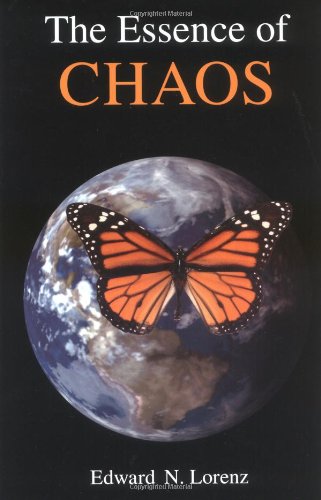
Ebook Info
- Published: 1995
- Number of pages: 240 pages
- Format: PDF
- File Size: 3.43 MB
- Authors: Edward Lorenz
Description
Chaos surrounds us. Seemingly random events ― the flapping of a flag, a storm-driven wave striking the shore, a pinball’s path ― often appear to have no order, no rational pattern. Explicating the theory of chaos and the consequences of its principal findings ― that actual, precise rules may govern such apparently random behavior ― has been a major part of the work of Edward N. Lorenz. In The Essence of Chaos, Lorenz presents to the general reader the features of this “new science,” with its far-reaching implications for much of modern life, from weather prediction to philosophy, and he describes its considerable impact on emerging scientific fields.Unlike the phenomena dealt with in relativity theory and quantum mechanics, systems that are now described as “chaotic” can be observed without telescopes or microscopes. They range from the simplest happenings, such as the falling of a leaf, to the most complex processes, like the fluctuations of climate. Each process that qualifies, however, has certain quantifiable characteristics: how it unfolds depends very sensitively upon its present state, so that, even though it is not random, it seems to be. Lorenz uses examples from everyday life, and simple calculations, to show how the essential nature of chaotic systems can be understood. In order to expedite this task, he has constructed a mathematical model of a board sliding down a ski slope as his primary illustrative example. With this model as his base, he explains various chaotic phenomena, including some associated concepts such as strange attractors and bifurcations.As a meteorologist, Lorenz initially became interested in the field of chaos because of its implications for weather forecasting. In a chapter ranging through the history of weather prediction and meteorology to a brief picture of our current understanding of climate, he introduces many of the researchers who conceived the experiments and theories, and he describes his own initial encounter with chaos.A further discussion invites readers to make their own chaos. Still others debate the nature of randomness and its relationship to chaotic systems, and describe three related fields of scientific thought: nonlinearity, complexity, and fractality. Appendixes present the first publication of Lorenz’s seminal paper “Does the Flap of a Butterfly’s Wing in Brazil Set Off a Tornado in Texas?”; the mathematical equations from which the copious illustrations were derived; and a glossary.
User’s Reviews
Editorial Reviews: Review “For the personal glimpses of chaos theory development alone, this book is worthwhile; for a clear, sharp development of the subject, the book is excellent; and for tying humanistic and scientific considerations together so well, there is a major debt owed to Lorenz.”―Geophysics”Lorenz has produced a wonderfully accessible book on the ideas and story of chaos. The book is superbly written providing delightful intellectual entertainment.”―Bulletin of the American Meteorological Society”In giving a nontechnical but careful account of the field of dynamical systems and ‘chaos,’ and setting it in a broader scientific context, Lorenz has .. communicate[d] the nature of the mathematical sciences and how mathematics contributes to society.”―SIAM Review”[A] unique chronicle of the insights of one of the founding fathers of this still burgeoning field.”―American Journal of Physics From the Back Cover ‘For the personal glimpses of chaos theory development alone, this book is worth-while; for a clear, sharp development of the subject, the book is excellent; and for tying humanistic and scientific considerations together so well, there is a major debt owed to Lorenz.’–Geophysics
Reviews from Amazon users which were colected at the time this book was published on the website:
⭐The recognition of chaos and its influence on us and the galaxy is amazing.
⭐Chaos is not randomness and randomness is not chaos. Ed Lorenz, one of the founding fathers of chaos theory, has produced a book aimed at explaining chaos theory to the public, starting and ending on the same point- common usage has incorrectly rendered “chaotic” and “random” to be synonyms. Randomness implies that there are no equations to govern the evolution of a system, while chaos implies that the system is incredibly sensitive to its initial conditions, but there are equations behind the curtain. A pinball machine, flipping coins, tossing dice, and the global weather are all examples of chaotic systems, despite what your math teachers might have told you. Along the way you get a small dose of the history of the field and the relevant higher-level mathematics.Lorenz does, I think, a pretty good job of explaining the subject. The more mathematically inclined reader will find all the details and differential equations in the appendix of the book, but for the most part you do not need to have that much of a mathematical background to understand the main points of the book. Sometimes the explanations do get a little hairy, and might require a second read. Lorenz makes analogies with simple systems and everyday occurrences (such as a pinball machine and skiing down moguls) in engaging language mostly free of jargon. I would recommend this book if you are interesting in learning about the basics of chaos theory. I haven’t yet read Gleick’s famous
⭐, but this seems like an excellent place to start.
⭐Like many others, I read James Gleick’s. book first. But this book is where the action is. It was so fascinating to read this first hand account. I thought that I had an outstanding education in mathematics after my mentor in electrical engineering graduate school, the famous mathematician Dr. Salomon Golomb insisted on filling my curriculum with higher mathematics in the 1960’s. Dr. Lorenz’s description of his first experience with computers, having to learn machine language programming, and worrying that the computer had a bad vacuum tube took me back to the IBM 1620 with the IBM cards and vacuum tubes that I used in undergraduate school. Then at JPL, we had a separate room with its own air conditioner to try to keep the computer from overheating in the 1970’s. My laptop has multiples of the power and storage of those computers that nevertheless were adequate to send men to the moon. Even my ihone has more computing power. To me, mathematics has always been about numbers, although trigonometry deals with shapes. The computer generated shapes in this book are fascinating. I will hve to read the book many more times.
⭐If your interest in Chaos was piqued by Gleick’s book on the subject, you may have found it unsatisfying. While it conveyed a enthusiasm for chaos, it only superficially answered questions about what characterizes a chaotic system. “The Essence of Chaos” is a much better book for gaining an understanding of chaos, mainly because it includes a discussion of the mathematics. Both authors strive to avoid mathematics as much as possible, but in the end, I believe Lorenz achieves a better balance. He only touches lightly on the math, but without that, it’s impossible to understand what makes a system chaotic. He doesn’t quite go so far as to show a practical application of chaos theory, but a clear and concise example of that probably doesn’t exist yet. But, he does achieve the goal of demonstrating and examining the fascinating characteristics of a chaotic system.
⭐Having read several books about Chaos Theory, and having been promised a user-friendly and yet academic book on the subject, this book fell a little short. Certainly academic, not so easy for someone who does not have a solid background in the sciences and mathematics fields. The various sections cover much of the recent research, and if you can get past the equations, you get a more complete sense of the progression in the subject.
⭐In my opinion this book is poorly written and long-winded. The author could have explained everything in a book half the size. His explanations are not entertaining either.The author is obviously well versed in chaos theory but lacks the ability to write a good book. For a good read on a similar topic that is much better written try The Black Swan by Taleb or The (MIS)Behavior of Markets by Mandelbrot.
⭐A good personal narrative from the grand old man of the Chaos field. Not an easy reading for laymen, some technical education (basic Calculus notions) is required for a full appreciation.
⭐Edward Lorenz is credited with “discovering” chaos theory based on his meteorological work. In The Essence of Chaos, Lorenz does a great job describing the historical background of chaos theory and its implications for the natural world. Well-written with some interesting graphics.
⭐A fantastic introduction to the fascinating phenomenon of chaos.
⭐The Essence of Chaos is Edward Lorenz’s primarily first-hand account of the development of the study of chaotic systems. As a meteorologist working with mathematical models of the atmosphere, Lorenz was one of the first to discover chaos when he noticed vastly different simulated weather patterns produced by two seemingly identical inputs. The discrepancy was eventually tracked down to tiny differences in the input parameters—in the second simulation, Lorenz manually keyed in the values as printed by the first simulation, which had truncated some of the least significant digits. These tiny differences, probably smaller than a tenth of a percent, led to quickly diverging behaviour between the two simulations, a sensitive dependence on initial conditions that has come to be known as chaos.Most of the book focuses on numerous examples of chaotic systems, without diving too deeply into the mathematics. We see several very “real-world” examples such as models of weather patterns and mogul ski slopes, along with some more artificially-constructed systems that have influenced the historical development of the field. A good portion of the book is also devoted to the history of chaos, which is much appreciated given the author’s eminence. For good measure, Lorenz throws in some early experimental tests of chaos theory—most notable are the so-called ‘dishpan’ experiments that suggest the chaos of the Earth’s weather might be a result of its 24-hour day, and that a significantly longer or shorter day might have caused small-scale weather patterns to disappear, leaving the long-term climate patterns to completely dominate.Overall, the book was enjoyable and very readable. I personally think it would have benefitted from integrating the mathematics into the main body text rather than setting it all aside in the appendices, but in most cases, the numerous figures compensate for the lack of equations. Four stars.
⭐il pregio, ma non a tutti può piacere, è dato anche dal fatto che Lorenz non è un matematico puro, ma un meteorologo con attitudine alla teoria … gli esperimenti concreti che descrive rendono più facile la comprensione dei corrispondenti strutture matematiche … alcuni concetti rimangono lievemente sfumati (ahimé non tutti sono “fluent” in inglese), la distinzione tra caos limitato e pieno non è così netta … molti concetti nuovi, un grande aiuto per chi si diletta in modo approfondito alla meccanica celeste …sono certo che dopo un tempo sufficiente, una seconda rilettura permetterà di dissipare le cose non perfettamente chiare … poteva bastare, forse, una tabella che correlasse caos limitato, caos pieno, presenza di attrattore … ecc.il racconto scorre bene …
⭐
⭐We often want to pierce the understanding of this life and how it relates to what happens afterward. What is God’s purpose? This book doesn’t answer those questions. It reveals how chaos actually has a pattern to it. And of course that leads to understanding other patterns in the world, and to the bigger picture.Cannot recommend it highly enough.
⭐The book is not as interesting as i expected. After a while, it ended up at the corner of my book shelf.
Keywords
Free Download The Essence of Chaos (Jessie and John Danz Lectures) 1st Edition in PDF format
The Essence of Chaos (Jessie and John Danz Lectures) 1st Edition PDF Free Download
Download The Essence of Chaos (Jessie and John Danz Lectures) 1st Edition 1995 PDF Free
The Essence of Chaos (Jessie and John Danz Lectures) 1st Edition 1995 PDF Free Download
Download The Essence of Chaos (Jessie and John Danz Lectures) 1st Edition PDF
Free Download Ebook The Essence of Chaos (Jessie and John Danz Lectures) 1st Edition