

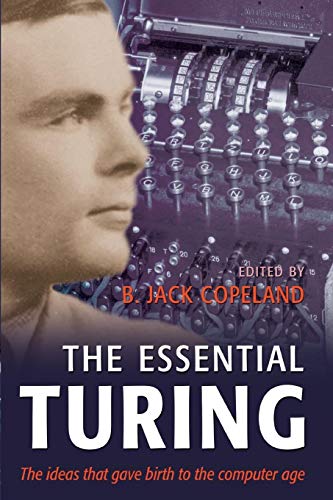
Ebook Info
- Published: 2004
- Number of pages: 622 pages
- Format: PDF
- File Size: 3.33 MB
- Authors: Alan M. Turing
Description
Alan Turing was one of the most influential thinkers of the 20th century. In 1935, aged 22, he developed the mathematical theory upon which all subsequent stored-program digital computers are modeled.At the outbreak of hostilities with Germany in September 1939, he joined the Government Codebreaking team at Bletchley Park, Buckinghamshire and played a crucial role in deciphering Engima, the code used by the German armed forces to protect their radio communications. Turing’s work on the versionof Enigma used by the German navy was vital to the battle for supremacy in the North Atlantic. He also contributed to the attack on the cyphers known as “Fish,” which were used by the German High Command for the encryption of signals during the latter part of the war. His contribution helped toshorten the war in Europe by an estimated two years.After the war, his theoretical work led to the development of Britain’s first computers at the National Physical Laboratory and the Royal Society Computing Machine Laboratory at Manchester University.Turing was also a founding father of modern cognitive science, theorizing that the cortex at birth is an “unorganized machine” which through “training” becomes organized “into a universal machine or something like it.” He went on to develop the use of computers to model biological growth, launchingthe discipline now referred to as Artificial Life.The papers in this book are the key works for understanding Turing’s phenomenal contribution across all these fields. The collection includes Turing’s declassified wartime “Treatise on the Enigma”; letters from Turing to Churchill and to codebreakers; lectures, papers, and broadcasts which opened upthe concept of AI and its implications; and the paper which formed the genesis of the investigation of Artifical Life.
User’s Reviews
Editorial Reviews: Review “A sophisticated, compelling, and philosophically competent account of the role that Turing has played in the information revolution. No bibliography on the foundations of computing is complete without The Essential Turing. This attractive package offers an essential text for any scholar of thehistory, philosophy, or future of computing, and an excellent textbook for every academic program concerned with philosophy of mind, artificial intelligence, or artificial life. Copeland’s commentary and effortless writing turn reading the works of the father of the digital age into a pleasure,making The Essential Turing an accessible bestseller in popular science.”–Ammon H. Eden, Minds & Machines”Alan Turing, pioneer of computing and World War II code breaker, was one of the most important and influential thinkers of the twentieth century. In this book, Turing’s work… is made easily accessible for the first time…This volume contains the work of a genius who, in his all too short life,made significant contributions in important areas benefiting us today. — Cryptologia Reviews”In this book, Turing’s key writings…are made easily accessible for the first time. Lectures, scientific papers, top secret wartime material, correspondence, and broadcasts are introduced and set in context by Jack Copeland, Director of the Turing Archive for the History of Computing.” –TheAmerican Cryptogram Association”It is a book that belongs in your personal library to read at your leisure. It would be a welcome gift.”–Cryptologia”A sophisticated, compelling, and philosophically competent account of the role that Turing has played in the information revolution. No bibliography on the foundations of computing is complete without The Essential Turing. This attractive package offers an essential text for any scholar of thehistory, philosophy, or future of computing, and an excellent textbook for every academic program concerned with philosophy of mind, artificial intelligence, or artificial life. Copeland’s commentary and effortless writing turn reading the works of the father of the digital age into a pleasure,making The Essential Turing an accessible bestseller in popular science.”–Ammon H. Eden, Minds & Machines”Both the editorial commentaries and Turing’s own writings are engrossing reading.”–The Review of Modern Logic About the Author B. J. Copeland is Reader in Philosophy at the University of Canterbury, New Zealand.
Reviews from Amazon users which were colected at the time this book was published on the website:
⭐Editor Jack Copeland wrote in the Preface to 2004 book, “Turing founded the field now called ‘Artificial Intelligence’ (AI) and was a leading early exponent of the theory that the human brain is in effect a digital computer… [This book] collects together for the first time the series of five papers that Turing devoted exclusively to Artificial Intelligence… Also included is s discussion of AI by Turing, Newman, and others… Turing was a far-sighted genius and much of the material in this book is of even greater relevance today than in his lifetime. His research had remarkable breadth and the chapters range over a diverse collection of topics—mathematical logic and the foundations of mathematics, computer design, mechanical methods in mathematics, cryptanalysis and chess, the nature of intelligence and mind, and the mechanisms of biological growth. The chapters are united by the overarching theme of Turing’s work, his enquiry into (as Newman put it) ‘the extent and the limitations of mechanistic explanations.’” (Pg. 2-3)Each of Turing’s papers is preceded by a very thorough and helpful introduction, by Copeland and others. For example, Copeland explains, “On 20 February 1947 Turing lecture on the ACE [Automatic Computing Engine] to the London Mathematical Society. So far as is known, this was the earliest public lecture to mention computer intelligence, providing a breathtaking glimpse of a new field. Turing discussed the prospect of machines acting intelligently, learning, and beating human opponents at chess, remarking that ‘[w]hat we want is a machine that can learn from experience’ and that ‘[t]he possibility of letting the machine alter its own instructions provides the mechanism for this.” (Pg. 375)In this paper, Turing observes, “I have spent a considerable time in this lecture on this question of memory, because I believe that the provision of proper storage is the key to the problem of the digital computer, and certainly if they are to be persuaded to show any sort of general intelligence much larger capacities than are yet available at reasonably short notice is much more important than that of doing operations such as multiplication at high speed. Speed is necessary if the machine is to work fast enough for the machine to be commercially valuable, but a large storage capacity is necessary if it is to be capable of anything more than rather trivial operations. The storage capacity is therefore the more fundamental requirement.” (Pg. 383)He predicts, “I expect that digital computing machines will eventually stimulate a considerable interest in symbolic logic and mathematical philosophy. The language in which one communicates with these machines, i.e. the language of instruction tables, forms a sort of symbolic logic… Actually one could communicate with these machines in any language provided it was an exact language… provided that the machine were given instruction tables which would enable it to interpret that logical system… since the machines will be doing more and more mathematics themselves, the centre of gravity of the human interest will be driven further and further into philosophical questions of what can in principle be done etc.” (Pg. 392)He suggests, “The memory capacity of the human brain is probably on the order of ten thousand million binary digits. But most of this is probably used in remembering visual impressions, and other comparatively wasteful ways. One might reasonably hope to be able to make some real progress with a few million digits, especially if one confined one’s investigations to some rather limited field such as the game of chess. It would probably be quite easy to find instruction tables which would enable the ACE to win against an average player… But I would not consider such a victory very significant. What we want is a machine that can learn from experience. The possibility of letting the machine alter its own instructions provides the mechanism for this…” (Pg. 393)In another paper, he outlines, “I propose to investigate the question as to whether it is possible for machinery to show intelligent behavior. It is usually assumed without argument that it is not possible. Common catch phrases such as ‘acting like a machine,’ ‘purely mechanical behavior’ reveal this common attitude. It is no difficult to see why such an attitude should have arisen. Some of the reasons are: (a) An unwillingness to admit the possibility that mankind can have any rivals in intellectual power… (b) A religious belief that any attempt to construct such machines is a sort of Promethean irreverence. (c) The very limited character of the machinery which has been used until recent times (e.g. up to 1940). This encouraged the belief that machinery was necessarily limited to extremely straightforward, possibly even to repetitive, jobs… (d)… the theorem of Gödel and related results… have shown that if one tries to use machines for such purposes as determining the truth or falsity of mathematical theorems and one is not willing to tolerate an occasional wrong result, then any given machine will in some cases be unable to give an answer at all… (e) In so far as a machine can show intelligence this is to be regarded as nothing but a reflection of the intelligence of its creator.” (Pg. 410-411)He continues, “A great positive reason for believing in the possibility of making thinking machinery is the fact that it is possible to make machinery to imitate any small part of a man. That the microphone does this for the ear, and the television camera for the eye, are commonplaces. One can also produce remote controlled Robots whose limbs balance the body with the aid of servo-mechanisms… One way of setting about our task of building a ‘thinking machine’ would be to take a man as a whole and to try to replace all the parts of him by machinery. He would include television cameras, microphones, loudspeakers, wheels and ‘handling servo-mechanisms’ as well as some sort of electronic ‘brain.’ This would of course be a tremendous undertaking… Thus although this method is probably the ‘sure’ way of producing a thinking machine it seems to be altogether too slow and impracticable. Instead we propose to try and see what can be done with a ‘brain’ which is more or less without a body… We are then faced with the problem finding suitable branches of thought for the machine to exercise its power in.” (Pg. 420)And in his famous paper on ‘Computing Machinery and Intelligence,’ he outlines what has come to be known as the ‘Turing Test’ for computer intelligence: “I propose to consider the question, ‘Can machines think?’ … the problem can be described in terms of a game which we call the ‘imitation game.’ It is played with three people, a man (A), a woman (B), and an interrogator (C) who may be of either sex. The interrogator stays in a room apart from the other two. The object of the game for the interrogator is to determine which of the other two is the man and which is the woman… In order that tones of voice may not help the interrogator the answers should be written, or better still, typewritten. The ideal arrangement is to have a teleprinter communicating between the two rooms… We now ask the question, ‘What will happen when a machine takes the part of A in this game?’… These questions replace our original, ‘Can machines think?’ … The question and answer method seems to be suitable for introducing almost any one of the fields of human endeavor that we wish to include. We do not wish to penalize the machine for its inability to shine in beauty competitions, not to penalize the man for losing in a race against an aeroplane… May not machines carry out something which ought to be described as thinking but which is very different from what a man does? This objection is a very strong one, but … if, nevertheless, a machine can be constructed to play the imitation game satisfactorily, we need not be troubled by this objection… it will be assumed that the best strategy is to try to provide answers that would naturally be given by a man.” (Pg. 441-443) Later, he adds, “I believe that in about fifty years’ time it will be possible to program computers … to make them play the imitation game so well that an average interrogator will not have more than 70 percent chance of making the right identification after five minutes of questioning.” (Pg. 449)He acknowledges, “I do not wish to give the impression that I think there is no mystery about consciousness. There is, for instance, something of a paradox connected with any attempt to localize it. But I do not think these mysteries necessarily need to be soled before we can answer the question with which we are concerned in this paper.” (Pg. 452-453)In another paper, he states, “My contention is that machines can be constructed which will simulate the behavior of the human mind very closely. They will make mistakes at times, and at time they may make new and very interesting statements, and on the whole the output of them will be worth attention to the same sort of extent as the output of the human mind.” (Pg. 472)In the three-way dialogue, he states, “Well, that’s my test. Of course I am not saying at present either that machines really could pass the test, or that they couldn’t. My suggest is just that this is the question we should discuss. It’s not the same as ‘Do machines think,’ but it seems near enough for our present purpose, and raises much the same difficulties.” (Pg. 495)For me, Turing’s papers on AI alone are well worth the price of the book; the excellent introductions by Copeland and others are also not to be missed. This book will be “must reading” for anyone seriously studying Turing, and the development of Artificial Intelligence.
⭐I had hoped more into the insights of Turing. This is a great hisitorical document about the development and logic of Turing’s approaches to the issues of encryption, but it is not an easy read. This will have value to technology/history buffs who are very technically inclined, but it is not an easy read. This is a great collection of documents for a limited number of people.
⭐to much math i wanted more history
⭐A long overdue book. Copeland collects together Turing’s greatest papers. As in where Turing tackled the fundamentals of what is now called a Turing machine – ie. a universal computer. Plus other papers where Turing ruminated on artificial intelligence, and founded that field. Plus coming up with the Turing Test for AI.Turing’s papers are interleaved with chapters by Copeland that give extra context to the times in which Turing lived. Notably on Turing’s crucial contribution to the Enigma project at Bletchley Park during World War 2. It is no exaggeration to say that his insight into decoding the German encryptions saved the lives of thousands of Allied soldiers.Valuable also is a reprinting of Turing’s “Treatise on the Enigma”, which was only declassified in 1996. Though by then, its essence had been known for decades. Finally, the book lets you read Turing’s words on Enigma.
⭐Copeland’s “Essential Turing” reviews Turning’s major writings and is a valuable source of knowledge for computer scientists and avid CS/Mathematics readers alike. Turing was a brilliant British mathematician, logician, and cryptographer and is widely considered to be the father of computer science. This book doesn’t portray him merely as a code breaker but also provides commentary on his brilliant foundation work as on Artificial intelligence. Discussion on the ultimate Turing test (proposal for a test of a machine’s capability to perform human-like conversation) and Entscheidungs Problem is worth reading.I shelve this book next to Knuth’s “The Art of Computer Programming” which may state what it’s worth.
⭐Enjoy this profound book by the father of the Digital Age. The Essential Turing is an excellent edition and long overdue. Turing’s essential works are finally available in a single volume. Turing is one of the most important thinkers of the 20th century–he was rated up there with Einstein in Time magazine’s ‘The Century’s Greatest Minds’. Copeland’s lucid commentaries on Turing’s work are fascinating and helpful. OUP is to be congratulated on putting Turing into the hands of the popular science book-buyer at long last.
⭐This is a terrific book. Turing is one of the most important figures of our time. Copeland’s lucid and helpful introductions to Turing’s key works make fascinating reading. (The hundreds of footnotes are testimony to the depth of scholarship that underlies Copeland’s smooth prose.) Copeland makes Turing, and so the origins of the digital age, accessible to all.
⭐Copeland’s book is basically a collection of some of Turing’s original papers, completed with a short introduction for each part of the book. I was disappointed by this book as (1) one can easily find copies of Turing’s work on the web, (2) there is very little additional value in Copeland’s comments, and (3) the papers are not reproduced in their original typeset and layout. Elsevier’s “Collected Works of A. M. Turing” (4 volumes) does a much better job and offers Turing’s complete work.
⭐The major problem with the Kindle edition of this book is that it cannot be read on either Kindle for Windows 8 nor on Kindle for an Android phone. I suggest that Amazon indicate this on the information page. As for the book itself, Copeland is at his usual best introducing complex ideas in a clear manner.
⭐De lo mejor que he leído en el tema Turing. Desarrolla el conocimiento de su investigación asociando partes biográficas; una presentación que ofrece una agradable y relevante lectura.
⭐
⭐和書ではなかなかアラン・チューリングのバランスの取れた資料が無いのですが素晴らしいバランスの取れた内容に仕上がっています。主題は戦前のチューリングマシンに戦後の人工知能なのですが、この本の凄い所は戦時中のチューリングのブレッチェリーパークでの活動がエニグマ暗号機の解読と共に非常に詳細に述べられている所です!サブタイトルにもある様にエニグマ暗号機の記事は本来はオマケ扱いですが、何しろ洋書ですらも資料が不足しているので、エニグマ暗号機の研究者には必須の本だと思います。オマケという割にはかなり具体的で、サイモン・シン「暗号解読」では触れられなかった、ポーランドの初期解読方法の苦悩にBombaやチューリングのSpiderという技術についても説明記事が有ります。勿論、チューリングマシンやAIにも興味がある方にも良い資料だと思いますが、こちらは他の和書でも最近は資料が充実しだしていますからね…全体を通して、伝記ではなく技術書という出来に仕上がっていますので軽く読みたいという方には少々荷が重いかもしれません。※この本、読み込んでいるとエニグマ暗号機解読の章は途轍もないディープな内容です。 レイェフスキが作ったBombaの事まで載ってます。もはや、ここまで来ると直接は チューリングには関係ないのですが、助かります!!!!
⭐
Keywords
Free Download The Essential Turing: Seminal Writings in Computing, Logic, Philosophy, Artificial Intelligence, and Artificial Life plus The Secrets of Enigma 1st Edition in PDF format
The Essential Turing: Seminal Writings in Computing, Logic, Philosophy, Artificial Intelligence, and Artificial Life plus The Secrets of Enigma 1st Edition PDF Free Download
Download The Essential Turing: Seminal Writings in Computing, Logic, Philosophy, Artificial Intelligence, and Artificial Life plus The Secrets of Enigma 1st Edition 2004 PDF Free
The Essential Turing: Seminal Writings in Computing, Logic, Philosophy, Artificial Intelligence, and Artificial Life plus The Secrets of Enigma 1st Edition 2004 PDF Free Download
Download The Essential Turing: Seminal Writings in Computing, Logic, Philosophy, Artificial Intelligence, and Artificial Life plus The Secrets of Enigma 1st Edition PDF
Free Download Ebook The Essential Turing: Seminal Writings in Computing, Logic, Philosophy, Artificial Intelligence, and Artificial Life plus The Secrets of Enigma 1st Edition