Ebook Info
- Published: 2002
- Number of pages: 192 pages
- Format: PDF
- File Size: 1.84 MB
- Authors: Ralph Morrison
Description
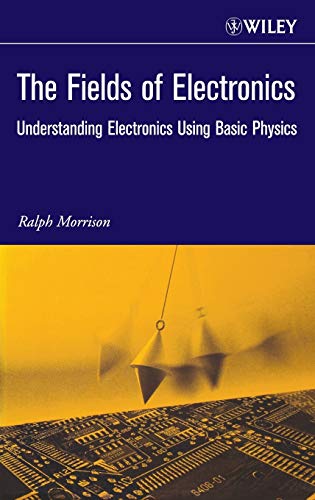
A practical new approach that brings together circuit theory and field theory for the practicing engineer To put it frankly, the traditional education of most engineers and scientists leaves them often unprepared to handle many of the practical problems they encounter. The Fields of Electronics: Understanding Electronics Using Basic Physics offers a highly original correction to this state of affairs. Most engineers learn circuit theory and field theory separately. Electromagnetic field theory is an important part of basic physics, but because it is a very mathematical subject, the connection to everyday problems is not emphasized. Circuit theory, on the other hand, is by its nature very practical. However, circuit theory cannot describe the nature of a facility, the interconnection of many pieces of hardware, or the power grid that interfaces each piece of hardware. The Fields of Electronics offers a unique approach that brings the physics and the circuit theory together into a seamless whole for today’s practicing engineers. With a clear focus on the real-world problems confronting the practitioner in the field, the book thoroughly details the principles that apply to: * Capacitors, inductors, resistors, and transformers * Utility power and circuit concepts * Grounding and shielding * Radiation * Analog and digital signals * Facilities and sites Written with very little mathematics, and requiring only some background in electronics, this book provides an eminently useful new way to understand the subject of electronics that will simplify the work of every novice, experienced engineer, and scientist.
User’s Reviews
Editorial Reviews: Review “…you needn’t be an engineer to learn a great deal from this refreshingly different approach to basic electrotechnology.” (Electrical Apparatus, June 2002) “…loaded with practical information?any electrical engineer…will find this book an invaluable reference…circuit theory teachers could also find this excellent…” (IEEE Electrical Insulation Magazine, Vol. 18, No. 5, September/October 2002)”Recommended for libraries…upper-division undergraduates; professionals” (Choice, Vol. 40, No. 3, November 2002)”…it could very usefully find a place on the shelves of an electronics laboratory…” (Contemporary Physics, Vol.44, No.1, 2003) From the Inside Flap A practical new approach that brings together circuit theory and field theory for the practicing engineer To put it frankly, the traditional education of most engineers and scientists leaves them often unprepared to handle many of the practical problems they encounter. The Fields of Electronics: Understanding Electronics Using Basic Physics offers a highly original correction to this state of affairs. Most engineers learn circuit theory and field theory separately. Electromagnetic field theory is an important part of basic physics, but because it is a very mathematical subject, the connection to everyday problems is not emphasized. Circuit theory, on the other hand, is by its nature very practical. However, circuit theory cannot describe the nature of a facility, the interconnection of many pieces of hardware, or the power grid that interfaces each piece of hardware. The Fields of Electronics offers a unique approach that brings the physics and the circuit theory together into a seamless whole for today’s practicing engineers. With a clear focus on the real-world problems confronting the practitioner in the field, the book thoroughly details the principles that apply to: * Capacitors, inductors, resistors, and transformers * Utility power and circuit concepts * Grounding and shielding * Radiation * Analog and digital signals * Facilities and sites Written with very little mathematics, and requiring only some background in electronics, this book provides an eminently useful new way to understand the subject of electronics that will simplify the work of every novice, experienced engineer, and scientist. From the Back Cover A practical new approach that brings together circuit theory and field theory for the practicing engineer To put it frankly, the traditional education of most engineers and scientists leaves them often unprepared to handle many of the practical problems they encounter. The Fields of Electronics: Understanding Electronics Using Basic Physics offers a highly original correction to this state of affairs. Most engineers learn circuit theory and field theory separately. Electromagnetic field theory is an important part of basic physics, but because it is a very mathematical subject, the connection to everyday problems is not emphasized. Circuit theory, on the other hand, is by its nature very practical. However, circuit theory cannot describe the nature of a facility, the interconnection of many pieces of hardware, or the power grid that interfaces each piece of hardware. The Fields of Electronics offers a unique approach that brings the physics and the circuit theory together into a seamless whole for today’s practicing engineers. With a clear focus on the real-world problems confronting the practitioner in the field, the book thoroughly details the principles that apply to: * Capacitors, inductors, resistors, and transformers * Utility power and circuit concepts * Grounding and shielding * Radiation * Analog and digital signals * Facilities and sites Written with very little mathematics, and requiring only some background in electronics, this book provides an eminently useful new way to understand the subject of electronics that will simplify the work of every novice, experienced engineer, and scientist. About the Author RALPH MORRISON is a consultant and lecturer in the area of interference control and electronics. He has over thirty years of design and consulting experience, was president of Instrum Inc. for more than a decade, and has authored Grounding and Shielding Techniques, 4th Edition; Noise and Other Interfering Signals; Grounding and Shielding in Facilities; and Solving Interference Problems in Electronics, all published by Wiley. Read more
Reviews from Amazon users which were colected at the time this book was published on the website:
⭐Great book concept, but needs tighter editing. The author is expert at the topic matter, and has personal drive to educate EEs to think about field physics not just the customary lumped element circuit theory, to understand what they’re doing rather than blindly follow rules of thumb or handed-down oral tradition of their industry. Better understanding of electrical systems as physical electromagnetic systems will be ever more important in the 21st Century with spacecraft, high energy particle accelerators, medical equipment, digital devices running at mumble-mumble zillion hoogaHertz frequencies, and in specialties critical to pushing the limits of performance such as signal integrity engineering.The earlier chapters will be easy review for advanced students and practicing engineers – Ohm’s law, power and such. Later chapters gave me insights to how electric and magnetic fields, charges and current interplay in real life electronics. The math is fairly easy going – i didn’t see any calculus or vector math. Even the chapter on Poynting’s vector has no vector math. All directional concepts are given with arrows in illustrations. Some familiarity with phasors may be useful, but only the concept; there are no complex number equations here either. The fancier math is great for ideal textbook problems of perfect cylinders, but hard to apply to real life equipment. The book’s emphasis is on magnitudes and intuitive concepts.The book is imperfect, unfortunately. There are problems given for practice with answers in back of the book (and not just for the odd-numbered) but some of these are marred by typos or unclear explanations in the answers. The text in general could use polishing. Some paragraphs seemed redundant or could be reworded. Some illustrations didn’t make their point clearly.However, given the expertise and street-smarts of the author, a smart engineer should be able to figure their way around these flaws and pick up fresh insights. Parts of the book seemed somewhat more like a brain dump than a well-crafted story. The best thing about this book is that it fills the gap between most electronics books that may describe field only in specialized situations (IC design, microwave shielding, etc.) and physics books that are almost always far to theoretical and mathematically sophisticated for the practical-minded engineer. Morrison has be praised for his expertise covering the range of 60Hz power up to GHz. Of course, what good are the laws of physics if they don’t apply everywhere? The physics ideas are simple, taken one at a time; it’s the application to practical problems such as shielding where this book helps.The book came out in 2002. My hope is the author gets enough feedback and demand to put out a 2nd edition, with much tighter technical editing and fresh illustrations.I’m reviewing a university library copy with a drab black cover, so i don’t get to enjoy the colorful blue and orange cover as shown above.
⭐I really wanted to like this book. Truly. But it fails. Miserably. It does not represent a comprehensive approach to circuit and field theory. What I mean by this is that there is absolutely no method or application of field theory that provides insight into the quantitative design requirements of electronics to be found here. There is some solid construction advice concerning shielding and grounding, but this is probably better covered in the author’s previous works. The numerous mistakes, not just typos, should have been caught in editing. The “fields” of schematic circuits… I wish they were laughable.The graphics are not even good enough to make this pass as a good con job.
⭐
Keywords
Free Download The Fields of Electronics: Understanding Electronics Using Basic Physics 1st Edition in PDF format
The Fields of Electronics: Understanding Electronics Using Basic Physics 1st Edition PDF Free Download
Download The Fields of Electronics: Understanding Electronics Using Basic Physics 1st Edition 2002 PDF Free
The Fields of Electronics: Understanding Electronics Using Basic Physics 1st Edition 2002 PDF Free Download
Download The Fields of Electronics: Understanding Electronics Using Basic Physics 1st Edition PDF
Free Download Ebook The Fields of Electronics: Understanding Electronics Using Basic Physics 1st Edition