Ebook Info
- Published: 1998
- Number of pages: 312 pages
- Format: PDF
- File Size: 7.42 MB
- Authors: James Pustejovsky
Description
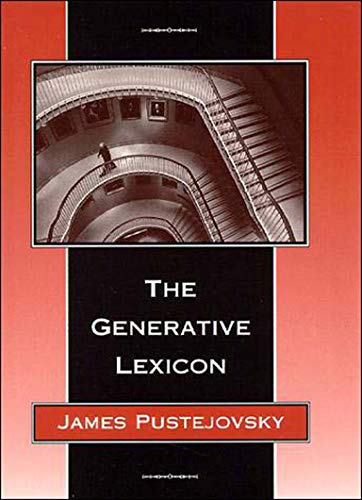
The first formally elaborated theory of a generative approach to word meaning, The Generative Lexicon lays the foundation for an implemented computational treatment of word meaning that connects explicitly to a compositional semantics.The Generative Lexicon presents a novel and exciting theory of lexical semantics that addresses the problem of the “multiplicity of word meaning”; that is, how we are able to give an infinite number of senses to words with finite means. The first formally elaborated theory of a generative approach to word meaning, it lays the foundation for an implemented computational treatment of word meaning that connects explicitly to a compositional semantics.In contrast to the static view of word meaning (where each word is characterized by a predetermined number of word senses) that imposes a tremendous bottleneck on the performance capability of any natural language processing system, Pustejovsky proposes that the lexicon becomes an active—and central—component in the linguistic description. The essence of his theory is that the lexicon functions generatively, first by providing a rich and expressive vocabulary for characterizing lexical information; then, by developing a framework for manipulating fine-grained distinctions in word descriptions; and finally, by formalizing a set of mechanisms for specialized composition of aspects of such descriptions of words, as they occur in context, extended and novel senses are generated.The subjects covered include semantics of nominals (figure/ground nominals, relational nominals, and other event nominals); the semantics of causation (in particular, how causation is lexicalized in language, including causative/unaccusatives, aspectual predicates, experiencer predicates, and modal causatives); how semantic types constrain syntactic expression (such as the behavior of type shifting and type coercion operations); a formal treatment of event semantics with subevents); and a general treatment of the problem of polysemy.Language, Speech, and Communication series
User’s Reviews
Editorial Reviews: Review “ÝW¨ell worth reading. . . . For those who are unfamiliar with the emerging field of lexical semantics. . . it will present an interesting entry point. For those who work in the field, it covers a wide range of interesting and serious problems, in ways that suggest fruitful interaction with a variety of other views and approaches.”– J. Terry Nutter, “Computational Linguistics”– J. Terry Nutter, “Computational Linguistics”” [W]ell worth reading. . . . For those who are unfamiliar with the emerging field of lexical semantics. . . it will present an interesting entry point. For those who work in the field, it covers a wide range of interesting and serious problems, in ways that suggest fruitful interaction with a variety of other views and approaches.” — J. Terry Nutter, “Computational Linguistics”” No one has more clearly challenged the assumptions of traditional lexicography.” — George Miller, Princeton University& quot; [W]ell worth reading. . . . For those who are unfamiliar with the emerging field of lexical semantics. . . it will present an interesting entry point. For those who work in the field, it covers a wide range of interesting and serious problems, in ways that suggest fruitful interaction with a variety of other views and approaches.& quot; — J. Terry Nutter, Computational Linguistics& quot; No one has more clearly challenged the assumptions of traditional lexicography.& quot; — George Miller, Princeton University”No one has more clearly challenged the assumptions of traditional lexicography.”–George Miller, Princeton University”[W]ell worth reading. . . . For those who are unfamiliar with the emerging field of lexical semantics. . . it will present an interesting entry point. For those who work in the field, it covers a wide range of interesting and serious problems, in ways that suggest fruitful interaction with a variety of other views and approaches.”–J. Terry Nutter, “Computational Linguistics” Review [W]ell worth reading…. For those who are unfamiliar with the emerging field of lexical semantics… it will present an interesting entry point. For those who work in the field, it covers a wide range of interesting and serious problems, in ways that suggest fruitful interaction with a variety of other views and approaches.―J. Terry Nutter, Computational Linguistics From the Back Cover The Generative Lexicon presents a novel and exciting theory of lexical semantics that addresses the problem of the “multiplicity of word meaning” – that is, how we are able to give an infinite number of senses to words with finite means. The first formally elaborated theory of a generative approach to word meaning, it lays the foundation for an implemented computational treatment of word meaning that connects explicitly to a compositional semantics. In contrast to the static view of word meaning (where each word is characterized by a predetermined number of word senses) that imposes a tremendous bottleneck on the performance capability of any natural language processing system, Pustejovsky proposes that the lexicon becomes an active – and centralcomponent in the linguistic description. The essence of his theory is that the lexicon functions generatively, first by providing a rich and expressive vocabulary for characterizing lexical information; then, by developing a framework for manipulating fine-grained distinctions in word descriptions; and finally, by formalizing a set of mechanisms for specialized composition of aspects of such descriptions of words, as they occur in context, extended and novel senses are generated. The subjects covered include semantics of nominals (figure/ground nominals, relational nominals, and other event nominals); the semantics of causation (in particular, how causation is lexicalized in language, including causative/unaccusatives, aspectual predicates, experiencer predicates, and modal causatives); how semantic types constrain syntactic expression (such as the behavior of type shifting and type coercion operations); a formal treatment of event semanticswith subevents); and a general treatment of the problem of polysemy. About the Author James Pustejovsky is Associate Professor, Michtom School of Computer Science at Brandeis University. Read more
Reviews from Amazon users which were colected at the time this book was published on the website:
⭐学生時代に言語学を勉強したことのある、素人愛好家(i.e., 非大学教員、非研究者等)としての感想です。 はじめに個人的なことでかなり恐縮ですが、この本は私が学生時代まともに読んだ数少ない研究書の1冊で、内容的にも現在に至るまで大いに共鳴している、思い入れのあるものです。発行年が1995年と、本レビュー時の2020年において人によっては「内容的にもう古い」とか「なぜ今更レビュー?」などと揶揄一蹴されそうです。 しかしながら2019年の秋、著者のJames Pustejovsky氏のウェブサイトで“An Introduction to Generative Lexicon Theory”という本がOUPより2019年にforthcomingとなっているのを知りました。学生時代は95年の “The Generative Lexicon”(GL)と並行して、Pustejovsky氏によるGL関連の他文献もいくつか読んできましたが、あるときを境に、GL関連の作品が見られなくなってしまいました。(しかし2015年に共編著で“Advances in Generative Lexicon Theory”という論文集が出ており、20近い論考の中にはPustejovsky氏とNicholas Asher氏の、それぞれタイトルだけでも個人的には大変興味が引かれる論文が含まれています。余計なことですが、学生ではなくなっている現在では、購入以外のアクセスが容易ではありません。買うのに躊躇してしまう値段です) 「Pustejovsky氏はGLのことはどうでもよくなってしまったのか」と思っていましたが、上述のforthcomingを見て、「まだGLに取り組んでいたんだ!」と嬉しく感じ、思い入れの深い95年の本書をもう一度読んでみようと思いました(3回目になります)。(しかしながら、この“An Intro to GL”は、本レビュー投稿時において、AmazonやOxford U. Pr.においてもヒットしません。果たして本当に出版されるのでしょうか)「内容的にもう古い」とか「なぜ今更レビュー?」などと言われそうだ、と先ほど書きましたが、forthcomingの“An Intro to GL”をAmazonで調べたところ、“The Lexicon”というPustejovsky氏ともうお一方による、CUPの教科書シリーズの本を偶然見つけました。この本はGLもっぱらではありませんが、GL理論を含む代表的な言語理論におけるlexiconの役割を紹介しつつ、lexicon一般についての解説を提供している良書です。それでもGLは95年よりもelaboratedされた内容で大きく取り上げられています(特にinheritance structureで示されるオントロジー面で)。“The Lexicon”を読んでみて、「GLは見捨てられていなかった!」と再度確認しました。ゆえに、「内容的にもう古い」とか「なぜ今更レビュー?」とは言われずに済みそうです。 さて本書の内容ですが、特に語彙意味論のプロの方ならばご承知のことであると思われます。私なりに、まず至極大雑把に言えば「多義性(polysemy)」の効率的な説明を主軸に、95年当時まで主流であった、「意味の列挙のlexiconアプローチ(sense enumerative lexicon)」を大幅に乗り越える、レキシコン理論の展開です。純なlexiconの面での特徴、つまり語彙項目としては、語のもつ表示レベルの豊富さが本理論の売りです。GL登場以前の従来のargument structureに加え、event structureとqualia structureが加わっていることが要になっています。Qualia structureをコアにargumentとeventが絡み合って、意味現象が説明されます。Qualia structureには4つの表示があり、中でも語がdenoteする事物や事柄の、起源・発生を表すAGENTIVE roleと、目的・機能を表すTELIC roleがとりわけ特徴的に思われます。 意味現象の説明のために、type coercion, selective binding, co-compositionという3つのsemantic operationが考案されています。 Type coercionというのは、形式意味論で重要な役割をしているtype shiftingの一種です。特に、目的語の動詞の要求するタイプへの変化(強制;coercion)が典型例です。たとえば“John enjoyed the book”というのは字義通りでは「ジョンはその本を楽しんだ」ですが、実際の優勢的な解釈は「ジョンはその本を読むことを楽しんだ」です。すると、“enjoy”のタイプは通常ならば
⭐
⭐
Keywords
Free Download The Generative Lexicon (Language, Speech, and Communication) in PDF format
The Generative Lexicon (Language, Speech, and Communication) PDF Free Download
Download The Generative Lexicon (Language, Speech, and Communication) 1998 PDF Free
The Generative Lexicon (Language, Speech, and Communication) 1998 PDF Free Download
Download The Generative Lexicon (Language, Speech, and Communication) PDF
Free Download Ebook The Generative Lexicon (Language, Speech, and Communication)