

Ebook Info
- Published: 2018
- Number of pages: 216 pages
- Format: PDF
- File Size: 1.75 MB
- Authors: Alan I. Abramowitz
Description
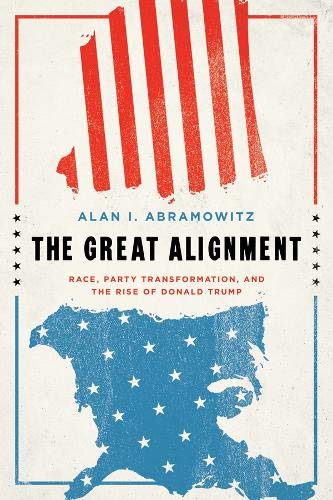
Alan I. Abramowitz has emerged as a leading spokesman for the view that our current political divide is not confined to a small group of elites and activists but a key feature of the American social and cultural landscape. The polarization of the political and media elites, he argues, arose and persists because it accurately reflects the state of American society. Here, he goes further: the polarization is unique in modern U.S. history. Today’s party divide reflects an unprecedented alignment of many different divides: racial and ethnic, religious, ideological, and geographic. Abramowitz shows how the partisan alignment arose out of the breakup of the old New Deal coalition; introduces the most important difference between our current era and past eras, the rise of “negative partisanship”; explains how this phenomenon paved the way for the Trump presidency; and examines why our polarization could even grow deeper. This statistically based analysis shows that racial anxiety is by far a better predictor of support for Donald Trump than any other factor, including economic discontent.
User’s Reviews
Editorial Reviews: Review “Abramowitz doesn’t polemicize; he simply lays out the facts. But the story he tells suggests that the essential first step to getting past extremism and polarization is the defeat of today’s intemperate brand of Republicanism, embodied by the most intemperate president in our history.”—E.J. Dionne, The Washington Post“Clear and comprehensive. . . . Abramowitz’s detailed yet concise analysis is accessible even for novices, and it offers a critical lesson on the American electorate and politics in a polarized nation.”—Publishers Weekly“Copious survey research and statistical analysis about why the divide between Republican and Democratic voters is more contentious than ever and how that affects not only the presidency and Congress, but also state and local elections . . . A solid academic study offering scant hope for the future.”—Kirkus Reviews“The book delivers a feast of important findings for students of US politics.”—Choice”Alan Abramowitz is dead-on in his analysis of the deep polarization that characterizes American society. A majority of voters are dug in, with their party choice reinforced by race, gender, age, social issues, ideology, religion, even their location in the U.S. Some analysts suggest well-meaning but superficial solutions, but Abramowitz is rightly skeptical. Like it or not, polarization is probably going to define our politics for many years to come.”—Larry J. Sabato, Director, UVA Center for Politics “Nobody is better at analyzing and documenting American public opinion than Alan Abramowitz. In this invaluable book, he shows with precision, power and clarity what has happened to transform American politics over the past decades. The consequences are real, dramatic—and terrifying.”—Norman Ornstein, coauthor of One Nation After Trump: A Guide for the Perplexed, the Disillusioned, the Desperate and the Not-Yet-Deported “Abramowitz’s lucid analysis makes a major contribution to our understanding of the most salient and, to many, troubling phenomenon in current American politics.”—Gary Jacobson, Distinguished Professor Emeritus, University of California, San Diego About the Author Alan I. Abramowitz is Alben W. Barkley Professor of Political Science at Emory University.
Reviews from Amazon users which were colected at the time this book was published on the website:
⭐There are many great arguments posed in this book and backed up by reference to studies and data analysis.He addresses some popular countervailing views (most notably by Morris P. Fiorina) that the citizenry is not polarized, just the “political class.” But, Abramowitz shows that “sorting” is indistinguishable from ideological preference. The reasons the two major parties seem so polarized is because they have become better at signaling to voters certain ideological differences. Voters then respond.The most significant question for a general understanding of this ideological and partisan breakdown is: Do you believe that the social and cultural changes that have happened in America since the Civil Rights Movement in the 1960s have made America better or worse than before?That movement began an era of increasing racial and ethnic diversity, secularism, and sexual liberation in society. Whether one views those transformations as good or bad determines much of the political polarization and resulting negative partisanship we observe.
⭐This is a scarily prescient book. Years ago I studied Kevin Phillips’s book, the Emerging Republican Majority in a graduate seminar at Hopkins. Phillips came to the class because Milton Cummings was a student of voting behavior in a famous book with V.O. Key. I suppressed the thesis of Phillip’s book throughout all those years thinking that somehow we weren’t that tilted toward racialist politics. I was wrong. Abramowitz shows us why.Trump’s victory was not a fluke; Trump fulfilled The Great Alignment. You won’t understand what’s going on at the border and separating children from parents until you read Abramowitz.
⭐If you are interested in what’s behind the polarization of the US then this book is a must read. It will definitely open your eyes. The biggest takeaway for me is that what we have is not from an abrupt shift in the electorate; it is a result of a number of decades of increasing polarization. Another big takeaway: there are very few undecideds in this country; and those who are don’t care and probably won’t vote.Read this book.
⭐Alan provides a statistical view on the transition and restructuring of the 2 political parties and provides valuable if unsettling insights into why our country is so divided. Lots of data. Has confirmed a couple of hypothesis that I have been considering over the last 24 – 36 months.
⭐I’m a little biased because I have the author as a professor, but this is one of my favorite books that I have ever had to read for school. It’s current, it’s concise, and it is fairly easy to read even if you are not an academic.
⭐Impressive analysis on the division in the electorate. Work is diminished as author allows his own political views to creep into the work. Citing left leaning news outlets as authority for points, or no authority lessens his analysis on the implications of his work.
⭐Far more statistical than I expected. I took it on vacation – big mistake!
⭐‘The Great Alignment’ is a tour de force piece of political science; an intensely scientific study of our American partisan politics. Prof. Abramowitz doesn’t shy from data-heavy statistical arguments, approaches this life scientist greatly appreciates. Having said that, this approach is likely to turn off some readers. However, if readers can set aside such aversions their reward is great indeed. The extensive data and Abramowitz’s analyses provide clear assessments of our current polarized electorate and how we got here in the past 50-60 years. Some of the most salient points are: 1) that much of our polarization grew out of strengthening ideological linkage to partisanship; 2) the days of moderates are gone, we are now sorted by ideology/partisanship in ways that social and economic positions align with each other along party lines; 3) that the Democratic and Republican parties and ideologies have largely sorted along both cultural, geographical and racial lines, with Republicans being dominated by conservative whites and the Democrats being represented as the primarily non-white oriented party; 4) within the racial sorting Abramowitz found that whites in the Republican ranks are becoming more conservative and trending toward less educated (eg, lacking a college education), while whites in the Democratic ranks are trending more liberal and more educated. Two of the findings Abramowitz explores late in the book relate directly to the rise of Donald Trump as a viable, and ultimately successful, Presidential candidate. The oft asked questions that Abramowitz’s analyses provide clear answers to is: why did Trump appeal and why were voters swayed to give him victory? Abramowitz addresses these questions not with biased judgement but through voter data. In brief, two popular explanations have emerged in the three years since the 2016 election: one rather innocuous, that Trump’s appeal was economic (people felt left out and behind economically), and the other more nefarious, that Trump’s support was ‘deplorable’ – pure racism. Abramowitz’s data analyses show that economic anxiety indeed played a role but that race was the key factor driving people to Trump. However, the data, as Abramowitz point out, do not support racism as the dominant or even major motivator. Instead his analysis point to ‘racial resentment’ as the driver. As the author explains, ‘racial resentment’ need not, and most often in Trump supporters, is not based on racism (a feeling of racial superiority). Rather white conservative voters who have lined up with Trump embraced his rhetoric of white victimhood (even as much of his rhetoric is racist) as an explanation for what they feel is a society and government paying scant attention to their feelings and needs, while courting the advances of non-white groups. This ‘racial resentment’ of perceived (it matters not if it is real for the perception) societal position based on race was, and is, the strongest motivator of Trump support. As Abramowitz also points out the data also indicate that economic anxiety and racial resentment can not be easily separated, not can we infer from the data which drives the other, but that racial resentment is much more present and persistent a motivator than economic anxiety. This is a fascinating and enlightening book. 4 of 5 stars (this reviewer is only deducting 1 star on expectation that the data-rich and statistic nature of the study will deter some readers – but I loved the book).
Keywords
Free Download The Great Alignment: Race, Party Transformation, and the Rise of Donald Trump in PDF format
The Great Alignment: Race, Party Transformation, and the Rise of Donald Trump PDF Free Download
Download The Great Alignment: Race, Party Transformation, and the Rise of Donald Trump 2018 PDF Free
The Great Alignment: Race, Party Transformation, and the Rise of Donald Trump 2018 PDF Free Download
Download The Great Alignment: Race, Party Transformation, and the Rise of Donald Trump PDF
Free Download Ebook The Great Alignment: Race, Party Transformation, and the Rise of Donald Trump