

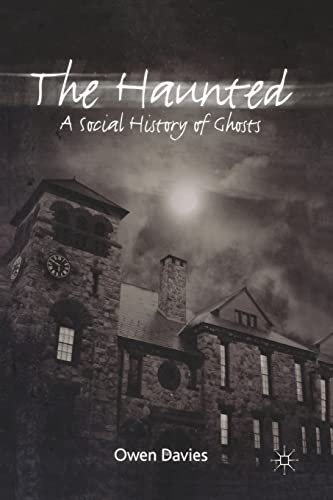
Ebook Info
- Published: 2007
- Number of pages: 299 pages
- Format: PDF
- File Size: 2.00 MB
- Authors: O. Davies
Description
The Haunted’ is the first truly comprehensive social history of ghosts. Using fascinating and entertaining examples, Davies places the history of ghosts within their wider social and cultural context, and examines why a belief in ghosts continues to be vibrant, socially relevant and historically illuminating.
User’s Reviews
Editorial Reviews: Review ‘A general, accessible history of ghosts and ghosts beliefs is much-needed, particularly one like this which manages to be empathetic to the beliefs involved while rescuing the topic from the enthusiasts of the ‘ghost-hunting’ fraternity. The quality of the writing is a major bonus: Davies wears his erudition lightly, and weaves it into accessible and often witty prose. This book manages the difficult feat of representing a real advance in scholarship, while appealing to a wider general readership. It’s an admirable achievement.’ – Peter Marshall, University of Warwick, UK’A fascinating and authoritative cultural history, packed with illuminating stories. From medieval revenants and headless horsemen to the sensational hauntings at Cock Lane and Borley Rectory, all England’s ghosts are here. With great skill and sensitivity, Owen Davies takes these strange tales at face value in order to peer into the obscure mental world of our ancestors. It is a fine achievement.’ – Malcolm Gaskill, University of East Anglia, UK’Owen Davies has produced the most comprehensive, lively and perceptive cultural history of English ghosts ever written. It is an amazingly broad survey, which covers every angle that I might have expected, and plenty that I did not: painstakingly researched, imaginative, and generous to all involved in his case-studies.’ – Ronald Hutton, University of Bristol, UK’I enjoyed Owen Davies’ book enormously. He has written a remarkably detailed account of largely English ghosts and ghostly phenomena in an intelligent, fascinating, and very readable narrative which answers most of the questions one is likely to ask about them. I commend it as one of the best books I have read on the subject’ – Peter Maxwell-Stuart, University of St Andrews’A provocative and splendidly, comprehensively researched new book.’ – Laurie Taylor, Thinking Allowed, BBC Radio 4’What is a ghost? Owen Davies suggests that no single definition can cover revenants, angels, devils, fairies, will-o’-the-wisps, or demonic cadavers. The context in which ghosts appear is influenced by contemporary philosophy, religion and science. So, the Reformation in England eradicated the worship of saints and reduced the relevance of angels, leaving ghosts ‘the sole manifest representatives of the afterlife for most Anglicans’. Davies is no debunker: with the best rational will in this world (and in the next) he considers the phenomena from the Dark Ages to our own New Age.’ – Iain Finlayson, The Times’Rather than simply focusing on reported manifestations of ghosts through the ages, Owen Davies’s meticulously researched work puts the events in context, investigating not only the origin of such reports, but also how they’re spun or rationalised, based often upon the social climate of the time…Hardcore followers…will find this a treasure trove of information and insight.’ – Beyond Magazine’…this is exactly what the world needs: a fresh, original and thorough analysis of the torrent of ghost stories that have been with us since probably the beginnings of language…As the book is both informative and enlightening, I’ve no hesitation in recommending it.’ – Bob Rickard, Fortean Times’This is a well-written and researched book that gives an interesting overview of the common beliefs about ghosts from the Middle Ages to the 18th century…Recommended.’ – The Cauldron’In his exhaustive, intelligent and impeccably researched new book, The Haunted:A Social History of Ghosts, Owen Davies entertainingly delineates the sheer scope of the phenomenon – from medieval superstition to nineteenth-century spiritualism to the present-day abundance of psychics who haunt the murkier channels of digital television.’ – Jon Barnes, Times Literary Supplement’Davies packs his book with a wealth of detail and constantly referes to contemporary documents, but the wider scope makes for a more interesting read, with the reader able to follow various strands down through the years.’ – Peter Tennant, Black Static No. 4’Over the last few years scholars in the humanities have begun to take historical narratives featuring ghosts seriously and Davies makes a significant contribution to the emerging debates on the subject. In summing up the book I cannot better the view of P.G. Maxwell-Stuart given on the back of the dust jacket, “intelligent, fascinating and very readable.’ – John Newton, Journal of the Society for Psychical Research’Davies’ book is an impressive achievement, particularly in its handling of the intellectual and cultural dimensions of ghost-beliefs.’ – Thomas Kselman, Journal of Contemporary History About the Author OWEN DAVIES is Reader in Social History at the University of Hertfordshire, UK. He has appeared as an authority on witchcraft and magic in a number of television programmes including People Detectives (BBC2, April 2001) and The Real Harry Potter (Channel 4, November 2001). He is the author of numerous articles on witchcraft and magic in various periodicals and of the following books: Witchcraft, Magic and Culture 1736-1951, A People Bewitched: Witchcraft and Magic in Nineteenth-Century Somerset and Cunning-Folk: Popular Magic in English History.
Reviews from Amazon users which were colected at the time this book was published on the website:
⭐The Haunted: A Social History of Ghosts by Owen Davies was first published in England in 2007. A paperback was released in the United States in 2009. The Haunted is not a traditional or linear history. Davies looks at trends spanning several centuries, from the Reformation to the present day. By exploring these trends, he hopes to explain how and why England has become so “haunted.”Debates over ghost belief reveal much about England’s social and intellectual history. Davies makes a compelling argument that being haunted by the dead is part of the human condition, at least for a significant portion of the population, as all attempts to eradicate ghost belief over the past 500 years have failed.Davies divides his book into three parts: Experience (what did ghosts look like, where were they found, and how have people tried to find them?), Explanation (how have people made sense of ghost sightings?), and Representation (how have people sought to replicate or reproduce ghosts and ghostly phenomenon?). The Haunted runs the gamut of English (and some Continental) cultural and intellectual experience, but its organization opens these topics to the reader in an easy to digest format. Every chapter explains the key players, arguments, and trends, while offering plenty of primary examples.Most studies of ghosts from 1700 on primarily rely on four authors who collected hundreds of accounts, but these accounts were collected from the middle and upper classes. They say little about the beliefs of rural and urban working classes, who made up the majority of the population. Davies scours a grab bag of sources to add these voices to the discussion, while never losing sight of the dominant intellectual trends.Davies goes beyond a simple recounting of Spiritualism, the Society for Psychical Research, and other well-worn topics. He demonstrates how familiar arguments for and against the existence of ghosts were continually repurposed as ammunition in the intellectual and spiritual battles of the day. Meanwhile, ghosts continued to be a source of popular entertainment. Hoaxers overturned assumptions about who were society’s fearful, as servant girls turned the tables on their masters. On stage and in early film, slapstick comedy taught people to laugh at their fears and robbed the white sheet of its power to scare.The cultural aspects of ghost belief are interesting enough, but where the author truly shines is in his discussion of technological trends. The few attempts I’ve read to explore technology and the paranormal have floundered. Davies finally gets it right. Chapter 7: Projecting Ghosts in particular describes how technology has evolved to allow us to more closely replicate ghosts, from “camera obscura,” mirrors, and smoke in the sixteenth century to cinematic portrayals in the twentieth. He mercifully avoids the current “gadget” fetish among self-described paranormal investigators.During the late Medieval period, the Catholic Church taught that ghosts were the souls of the dead in Purgatory, a halfway point between earth and Heaven. Protestant theology officially rejected the idea of ghosts as a Catholic holdover and ignorant superstition. As a Protestant country, England should have rejected ghosts centuries ago. Instead, people feel more free to express their belief in ghosts than ever before. So continued ghost belief tells more about English tradition, culture, and psychology than religious persuasion.
⭐If you are looking to read a ghost story, this is not the book to reach for. Owen Davies writes about the social history of ghosts, as the book’s subtitle clearly states. What is not be clear from the book’s title is that the focus is on the history of ghosts in Great Britain. I was aware of that when I bought it, so I am not disappointed that there is no discussion of American spirits or those found on the Continent or elsewhere in the world. Still, as Owen writes in the first sentence of his Introduction, “England has long had a reputation for being haunted.” My English mother had a few ghost stories to tell me, and I grew up reading about ghosts and the various pixies and elves and other folk that inhabited fen and forest.There are eight chapters broken into three sections: Experience, Explanation, and Representation. Davies writes with a sureness that seems to indicate a long time spent researching the topic, and I have no reason to doubt his comfort level with the material. As this is the first social history that I’ve read about hauntings or the history of psychic phenomena, I don’t feel qualified to submit Davies’s material to deep scrutiny, but the book is well cited and there are ample notes for anyone who wants to read more deeply in the subject.Despite being an academic volume, there are places where Davies indulges in a bit of tongue-in-cheek humor, but he stops short of mocking his subjects. Clearly, for many people ghosts and spirits and demons were real, not just figments of the imagination. But for others, ghosts provided an avenue for earning a bit of extra cash by duping the gullible. What did surprise me was how popular the ghost chases were in Victorian times: I had thought that all of the ghost hunting was of a more recent vintage (as in, the TV generation). In some instances, crowds filled the streets, vying for a chance to spot a ghost, and made nuisances of themselves to local residents.The book also includes some history of the role of ghosts in theater and literature, especially the gothic novel. In one story Davies relates, a rather portly actor who was portraying a ghost got stuck in the stage trapdoor when he was trying to “disappear.” The actor, to the audience’s delight, made light of the incident and turned the accident into a humorous event. Gems like this dot the book and will probably left me wanting more — definitely a good thing.The pace was even and Davies writes clearly. In just 250 pages of text, there is an incredible amount of information in here about the history of English ghosts’ interaction with the living. Most of the information ranges from the 18th century to present day, but there are a few bits about earlier ghost stories and sightings. A good read and an excellent reference, The Haunted will be a keeper in my library.
⭐The author offers a comprehensive look at how and when and why ghosts are experienced, primarily in Great Britain. Ghostly phenomenon are taken seriously without venturing a position about whether these are verifiable or real. For a scholar, Davies writes very well, making this an entertaining, informative read.
⭐OK
⭐This is a serious academic account of ghost-lore in England, but Davies is also alive to the entertainment potential of the history of popular beliefs.He knows his way around the existing sources, which allows him both to present the titillating and terrifying stories that haunted our forebears, but also to give the reader some idea of why records survive of particular hauntings, and what problems face the historian of popular culture when dealing with phenomena that were actively disapproved by religious and secular authorities.This is both a highly informative survey (with a gentle argument about the continuing relevance of spirits in “modern” cultures) and a good read. There are some particularly engrossing tales of pranksters and bystanders mistaken for ghosts and killed… Chilling stuff.
Keywords
Free Download The Haunted: A Social History of Ghosts in PDF format
The Haunted: A Social History of Ghosts PDF Free Download
Download The Haunted: A Social History of Ghosts 2007 PDF Free
The Haunted: A Social History of Ghosts 2007 PDF Free Download
Download The Haunted: A Social History of Ghosts PDF
Free Download Ebook The Haunted: A Social History of Ghosts