Ebook Info
- Published: 2013
- Number of pages: 176 pages
- Format: PDF
- File Size: 16.39 MB
- Authors: Steven G. Krantz
Description
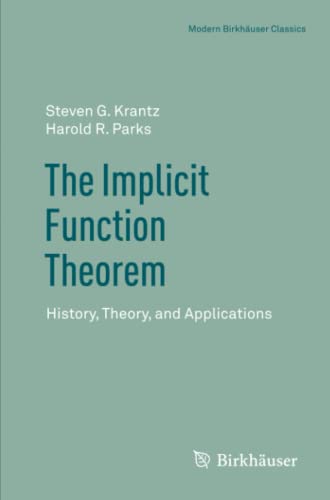
The implicit function theorem is part of the bedrock of mathematical analysis and geometry. Finding its genesis in eighteenth century studies of real analytic functions and mechanics, the implicit and inverse function theorems have now blossomed into powerful tools in the theories of partial differential equations, differential geometry, and geometric analysis.There are many different forms of the implicit function theorem, including (i) the classical formulation for Ck functions, (ii) formulations in other function spaces, (iii) formulations for non-smooth function, and (iv) formulations for functions with degenerate Jacobian. Particularly powerful implicit function theorems, such as the Nash–Moser theorem, have been developed for specific applications (e.g., the imbedding of Riemannian manifolds). All of these topics, and many more, are treated in the present uncorrected reprint of this classic monograph. Originally published in 2002, The Implicit Function Theorem is an accessible and thorough treatment of implicit and inverse function theorems and their applications. It will be of interest to mathematicians, graduate/advanced undergraduate students, and to those who apply mathematics. The book unifies disparate ideas that have played an important role in modern mathematics. It serves to document and place in context a substantial body of mathematical ideas.
User’s Reviews
Editorial Reviews: Review From the reviews:“The book under review balances the historical analyses with presentations and discussions of the proofs of some formulations of the implicit function theorem. … The authors have taken some care to make the book self-contained, and as such a well-motivated undergraduate student can profitably read many parts of it, and the whole book is within the reach of a first-year graduate student.” (Felipe Zaldivar, MAA Reviews, March, 2013) From the Back Cover The implicit function theorem is part of the bedrock of mathematical analysis and geometry. Finding its genesis in eighteenth century studies of real analytic functions and mechanics, the implicit and inverse function theorems have now blossomed into powerful tools in the theories of partial differential equations, differential geometry, and geometric analysis. There are many different forms of the implicit function theorem, including (i) the classical formulation for Ck functions, (ii) formulations in other function spaces, (iii) formulations for non-smooth functions, and (iv) formulations for functions with degenerate Jacobian. Particularly powerful implicit function theorems, such as the Nash–Moser theorem, have been developed for specific applications (e.g., the imbedding of Riemannian manifolds). All of these topics, and many more, are treated in the present uncorrected reprint of this classic monograph.Originally published in 2002, The Implicit Function Theorem is an accessible and thorough treatment of implicit and inverse function theorems and their applications. It will be of interest to mathematicians, graduate/advanced undergraduate students, and to those who apply mathematics. The book unifies disparate ideas that have played an important role in modern mathematics. It serves to document and place in context a substantial body of mathematical ideas.
Reviews from Amazon users which were colected at the time this book was published on the website:
⭐The topic of this book is extremely important, e.g. in the study of manifolds, yet is consistently poorly explained in books on real analysis (*cough* Rudin *cough*), and brushed aside as a prerequisite which the student should already know and understand well in books on differential geometry. This book fills an important intermediate position. In particular, this book explains in many places the underlying ideas well. At the points where textbooks don’t explain the underlying ideas well at all, this book fills in the gaps. It would be nice if the book went above and beyond this and explained the ideas well at all other places, even those which are not even mentioned in books on real analysis. However, some sections (e.g. the one on the Newton polygon and numerical homotopy) don’t achieve this lofty goal — however that defect isn’t important, since those are not important applications/connections of the implicit function theorem. Still, it would have been nice if the deep connection with Newton’s method was explained better, the relationship between Newton’s method, Banach fixed point theorem, Picard’s theorem for ODE’s, and this theorem, all came out more strongly from this book — the connection can be seen obliquely, but this is still an area of some confusion for me even after reading this book. Also, this differences/distinctions between all of the alternate forms could be explained better (constant rank theorem, local submersion theorem, local immersion theorem, domain straightening theorem, range straightening theorem), but the distinction between the inverse and implicit function theorems at least is clear and the proof of the constant rank theorem is clean, even albeit if I still struggle to compare and contrast the constant rank theorem with the implicit function theorem after reading this book. Also, it would have been nice if a proof using the Banach fixed point theorem was first given for finite-dimensional spaces before using it to prove the theorem for Banach spaces — at least for stupid people like me, it all felt like too many steps being taken at once. However, this book has probably the best treatment of equivalent characterizations of embedded submanifolds which I have ever seen — every textbook on differential geometry and topology mentions similar things, but none explains them well or organizes them well — this book however does do that. Thus, since this book accomplished what was its most important goal for me personally (filling in the gap between real analysis and differential geometry textbooks) I give it five stars, although I hope that the authors continue working on this book in the future to make every section a conceptual tour de force.
⭐I first came across the Implicit Function Theorem in The Absolute Differential Calculus: Calculus of Tensors (Dover Books on Mathematics) by Tullio Levi-Civita (Sep 14, 2005). To get further than page 9, it’s essential to spend a few weeks getting to grips with what it is, and the proofs given there are vague and complicated.So I was delighted to come across the book being reviewed here: The Implicit Function Theorem: History, Theory, and Applications. It’s a further delight to see the authors have managed to get to the heart of the theorem within the first few pages, while managing to keep the presentation rigorous, yet elementary. Thus it’s possible for the student to have a go at initially trying to prove the theorem by themselves and seeing how it can be improved. I don’t think it’s fair the other reviewer giving the book a 1 star for the typos, since the real value in the book is the way it provides the backbone for further study. Hence, I’ve given it 5 stars.
⭐The book is full of typos and mistakes which make every proof a headache to read and understand. This is my third book by the same publisher and they are all of similar quality, full of typos and logical mistakes. Both are deadly sins but they are even deadlier in math books so just stay away from Birkhäuser books when it comes to math.
⭐very concise, precise and useful.
⭐陰関数定理についてじっくり学べ、かつその応用例も豊富であるので、解析学を専攻にする学部生に良いと思われる。ただ、私が思うに証明の行間を埋めるのが難儀であった。
⭐
Keywords
Free Download The Implicit Function Theorem: History, Theory, and Applications (Modern Birkhäuser Classics) 2013th Edition in PDF format
The Implicit Function Theorem: History, Theory, and Applications (Modern Birkhäuser Classics) 2013th Edition PDF Free Download
Download The Implicit Function Theorem: History, Theory, and Applications (Modern Birkhäuser Classics) 2013th Edition 2013 PDF Free
The Implicit Function Theorem: History, Theory, and Applications (Modern Birkhäuser Classics) 2013th Edition 2013 PDF Free Download
Download The Implicit Function Theorem: History, Theory, and Applications (Modern Birkhäuser Classics) 2013th Edition PDF
Free Download Ebook The Implicit Function Theorem: History, Theory, and Applications (Modern Birkhäuser Classics) 2013th Edition